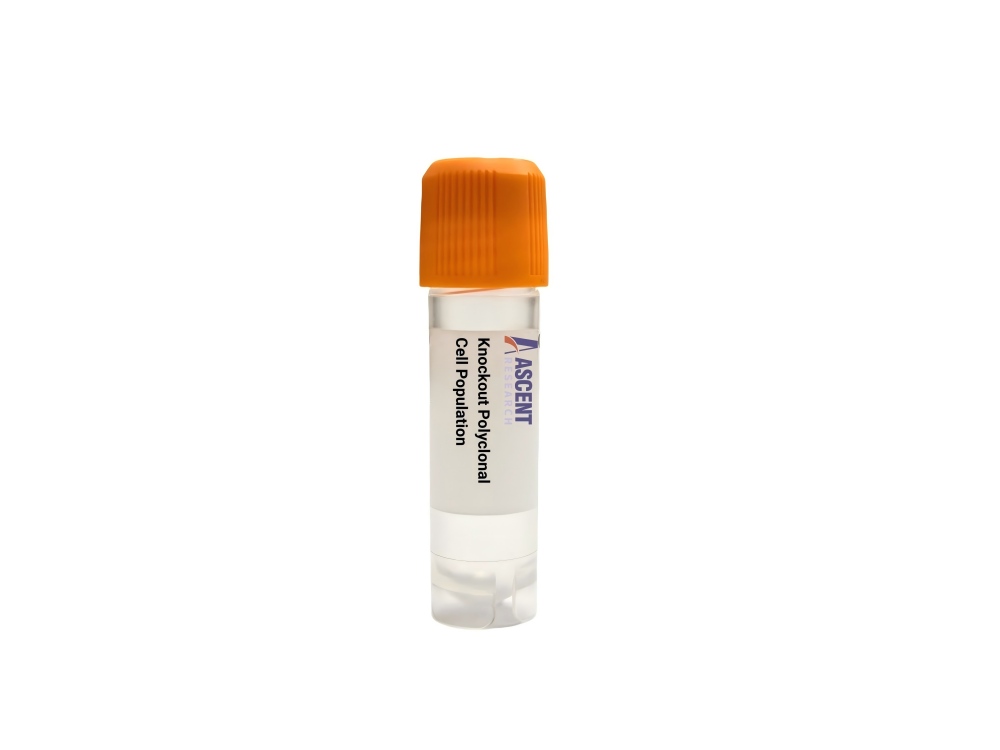
Polyclonal Cell Population
Homo sapiens (Human)
Bone
Suspension
The MRM1 Knockout Raji Polyclonal Cells are a CRISPR/Cas9-edited polyclonal knockout population of the Raji B lymphocyte cell line (Burkitt's lymphoma), designed for studying mitochondrial rRNA methyltransferase 1 (MRM1) function. MRM1 catalyzes 2'-O-methylation of mitochondrial 16S rRNA, essential for mitochondrial ribosome assembly and translation of OXPHOS subunits such as MT-ND1 and MT-CO1. By disrupting MRM1, this model impairs mitochondrial translation, linking mitochondrial gene expression to lymphoma cell metabolism and apoptosis. It is suitable for cancer metabolism research, mitochondrial dysfunction studies, and screening of mitochondrial translation inhibitors using techniques like metabolic flux analysis, ribosome profiling, and immunoblotting.
 C6orf120 Knockout Hela Polyclonal Cells
Cat. No. ARG23791
JMJD4 Knockout K562 Polyclonal Cells
Cat. No. ARG20731
BCOR Knockout A2780 Polyclonal Cells
Cat. No. ARG28888
HADHA Knockout NCI-H1299 Polyclonal Cells
Cat. No. ARG30696
GDF2 Knockout CAL27 Polyclonal Cells
Cat. No. ARG11477
CSK Knockout MES-OV Polyclonal Cells
Cat. No. ARG6657
C6orf120 Knockout Hela Polyclonal Cells
Cat. No. ARG23791
JMJD4 Knockout K562 Polyclonal Cells
Cat. No. ARG20731
BCOR Knockout A2780 Polyclonal Cells
Cat. No. ARG28888
HADHA Knockout NCI-H1299 Polyclonal Cells
Cat. No. ARG30696
GDF2 Knockout CAL27 Polyclonal Cells
Cat. No. ARG11477
CSK Knockout MES-OV Polyclonal Cells
Cat. No. ARG6657
The MRM1 Knockout Raji Polyclonal Cells consist of a CRISPR/Cas9-edited polyclonal knockout population derived from the Raji human Burkitt’s lymphoma B lymphocyte line. This heterogeneous pool carries targeted MRM1 gene disruptions, creating a loss-of-function model to study mitochondrial rRNA methylation and its impact on mitochondrial translation. The polyclonal format maintains biological variability and is suitable for bulk functional assays and comparative analyses with wild-type controls.
The parental Raji cell line is an EBV-positive B lymphocyte line from an 11-year-old male Burkitt’s lymphoma patient. It retains features of humoral immunity, including antigen presentation and immunoglobulin expression, alongside deregulated proliferation and metabolic reprogramming typical of aggressive lymphomas, offering a clinically relevant backdrop for mitochondrial gene expression studies in B-cell malignancies.
MRM1 encodes a mitochondrial rRNA methyltransferase that catalyzes 2′-O-methylation of mitochondrial 16S rRNA at U1369, crucial for large mitochondrial ribosomal subunit assembly. Its expression is regulated by NRF1, TFAM, PGC-1??, and mTOR signaling in response to cellular energy state. In mitochondria, MRM1 cooperates with MRM2, MTERF4, NSUN4, and GTPBP5 to site-specifically modify the rRNA. This modification is required for efficient translation of OXPHOS subunits such as MT-ND1, MT-CO1, and MT-CYB. Loss of MRM1 thus disrupts mitochondrial ribosome biogenesis, dampens mitochondrial protein synthesis, and impairs OXPHOS complexes I and IV.
In Raji lymphoma cells, MRM1 disruption likely perturbs mitochondrial function relevant to cancer biology. Lymphoma cells often depend on mitochondrial metabolism for proliferation; MRM1 knockout can reveal how mitochondrial translation sustains energy production and redox balance. Resulting OXPHOS deficiency may elevate reactive oxygen species and sensitize cells to apoptosis, making this model valuable for testing mitochondrial ribosomes as therapeutic targets in B-cell malignancies.
Applications include studying mitochondrial translation in lymphoma, screening MRM1 inhibitors, and examining mitochondrial dysfunction in cancer. Representative assays: Western blot for OXPHOS subunits, RT-qPCR for mitochondrial transcripts, Seahorse metabolic flux, mitochondrial translation pulse-chase, co-immunoprecipitation of MRM1 complexes, ribosome profiling, and flow cytometry for mitochondrial parameters and apoptosis. Researchers can also use it to validate MRM1 as a biomarker. Contact Ascent Research for further details.