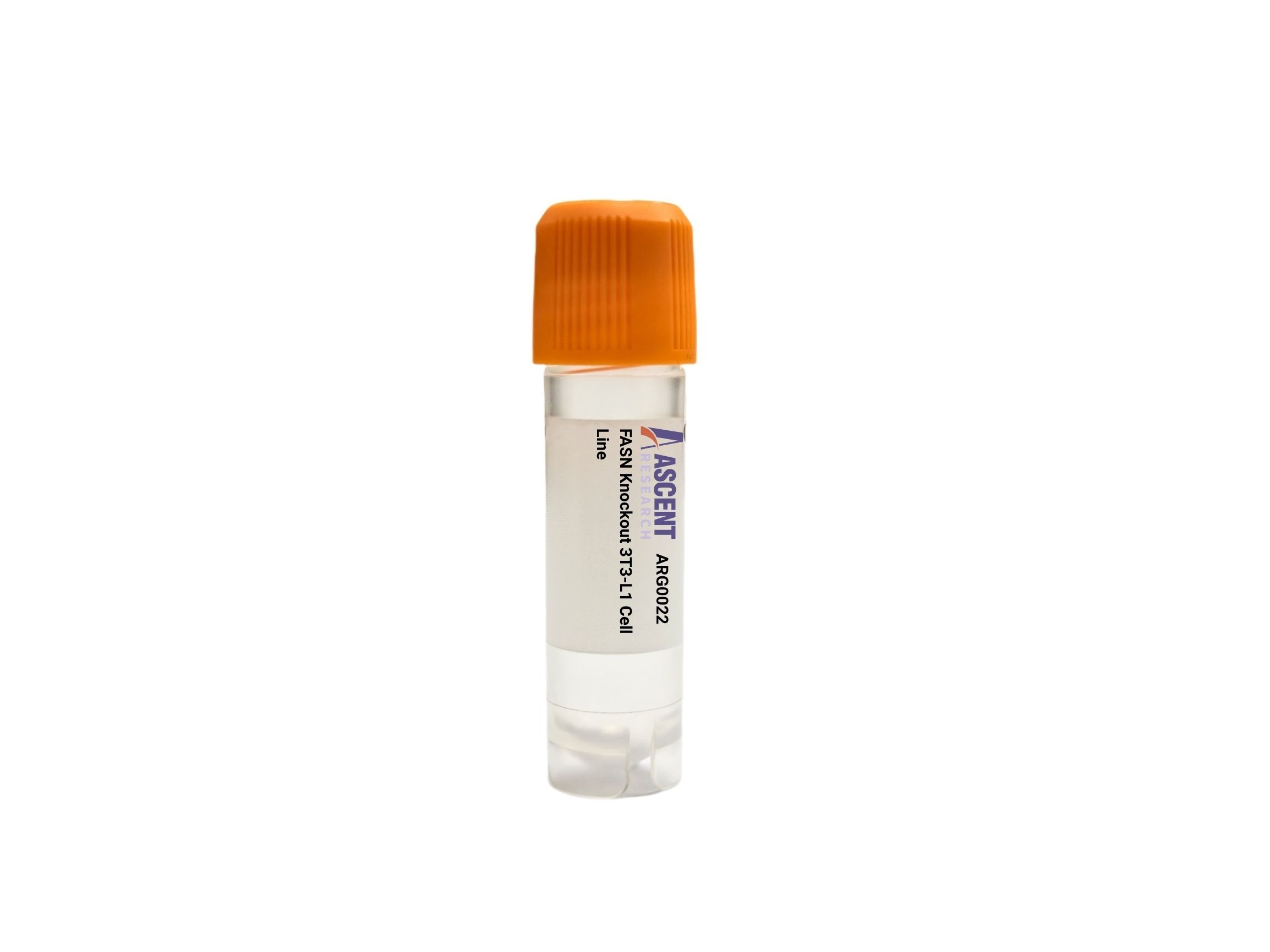
Genome-edited Cells
Embryo
The FASN Knockout 3T3-L1 Cell Line is a CRISPR/Cas9-edited mouse preadipocyte model for studying de novo lipogenesis in a well-established adipogenesis system. FASN functions downstream of insulin, AKT1, and SREBF1/MLXIPL-driven lipogenic programs to generate palmitate for triglyceride and phospholipid synthesis, lipid droplet formation, and adipogenic lipid storage. In 3T3-L1 cells, FASN loss provides a relevant platform to investigate adipocyte differentiation, insulin-responsive metabolism, lipid droplet biology, and metabolic disease mechanisms using assays such as Oil Red O staining, triglyceride quantification, RT-qPCR, western blotting, and stable isotope metabolic flux analysis.
 CALD1 Knockout HGC-27 Polyclonal Cells
Cat. No. ARG29798
CCNL2 Knockout HEK293T Polyclonal Cells
Cat. No. ARG43253
DNAJB14 Knockout K562 Polyclonal Cells
Cat. No. ARG39104
FAM204A Knockout HEK293T Polyclonal Cells
Cat. No. ARG3714
CHSY1 Knockout AGS Polyclonal Cells
Cat. No. ARG2724
CALD1 Knockout HGC-27 Polyclonal Cells
Cat. No. ARG29798
CCNL2 Knockout HEK293T Polyclonal Cells
Cat. No. ARG43253
DNAJB14 Knockout K562 Polyclonal Cells
Cat. No. ARG39104
FAM204A Knockout HEK293T Polyclonal Cells
Cat. No. ARG3714
CHSY1 Knockout AGS Polyclonal Cells
Cat. No. ARG2724
 Rat Bronchial Epithelial Cell Medium
Cat. No. ARM0182
Rat Bronchial Epithelial Cell Medium
Cat. No. ARM0182
The FASN Knockout 3T3-L1 Cell Line is a CRISPR/Cas9-engineered mouse cell model in which the FASN gene has been disrupted to eliminate functional fatty acid synthase expression. This stable in vitro knockout system is generated in 3T3-L1 cells, a fibroblast-like preadipocyte line that provides a tractable background for studying lipid metabolism, adipocyte differentiation, and nutrient-responsive signaling. The model is designed for researchers investigating how loss of de novo fatty acid synthesis influences adipogenic programs and metabolic phenotypes in a well-established murine preadipocyte context.
3T3-L1 cells are derived from mouse embryo fibroblast-like precursors and are widely used because they undergo robust differentiation into adipocyte-like cells with characteristic lipid droplet accumulation, insulin responsiveness, and lipogenic gene induction. As a result, this host line is broadly applied to studies of adipogenesis, triglyceride storage, insulin action, and lipid droplet biology. Its experimental utility also extends to disease-relevant investigations in obesity, insulin resistance, type 2 diabetes, dyslipidemia, and other metabolic disorders in which adipocyte lipid handling and nutrient sensing are disrupted.
FASN encodes the multifunctional enzyme complex that catalyzes de novo synthesis of palmitate from acetyl-CoA and malonyl-CoA using NADPH, thereby supplying a central substrate pool for triglyceride synthesis, phospholipid synthesis, membrane lipid remodeling, and complex lipid production. In lipogenic cells, FASN functions downstream of insulin-activated INSR, IRS1, PI3K, and AKT1 signaling and is transcriptionally regulated by SREBF1/SREBP1c, MLXIPL/ChREBP, PPARG, and CEBPA. Its activity is integrated with ACLY and ACACA/ACC1 to generate lipogenic precursors and with SCD1, ELOVL6, DGAT1, and DGAT2 to support fatty acid modification and neutral lipid storage. FASN-dependent palmitate production also influences PLIN1-associated lipid droplet accumulation, membrane lipid composition, and protein palmitoylation capacity. These processes are further modulated by mTORC1 components MTOR and RPTOR, while AMPK signaling through PRKAA1/PRKAA2 acts as a counter-regulatory metabolic brake.
Within the 3T3-L1 background, FASN knockout provides a mechanistically relevant platform for examining how impaired lipogenesis alters adipocyte maturation and downstream metabolic outputs. Because this host system couples differentiation-dependent transcriptional programs with strong insulin-sensitive lipid synthesis, disruption of FASN can be used to interrogate dependence on endogenous fatty acid production during adipogenesis, lipid droplet biogenesis, and insulin-responsive anabolic signaling. The model is also useful for studying compensatory changes in lipogenic networks involving ACACA, SCD1, MLXIPL, and PPARG.
This cell line is suitable for western blotting, RT-qPCR, and RNA-seq analysis of lipogenic and adipogenic gene networks; Oil Red O and BODIPY staining to quantify lipid droplet formation; triglyceride assays and GC-MS or LC-MS fatty acid profiling to assess lipid output; stable isotope tracing for metabolic flux analysis; and glucose uptake or insulin-stimulated phospho-AKT assays to examine nutrient response. It can also support immunofluorescence, proliferation studies, and rescue experiments using exogenous fatty acids to distinguish direct consequences of FASN loss from secondary effects on differentiation or cellular lipid availability. Researchers may contact Ascent Research for additional technical information, product details, or related gene-edited cell models.