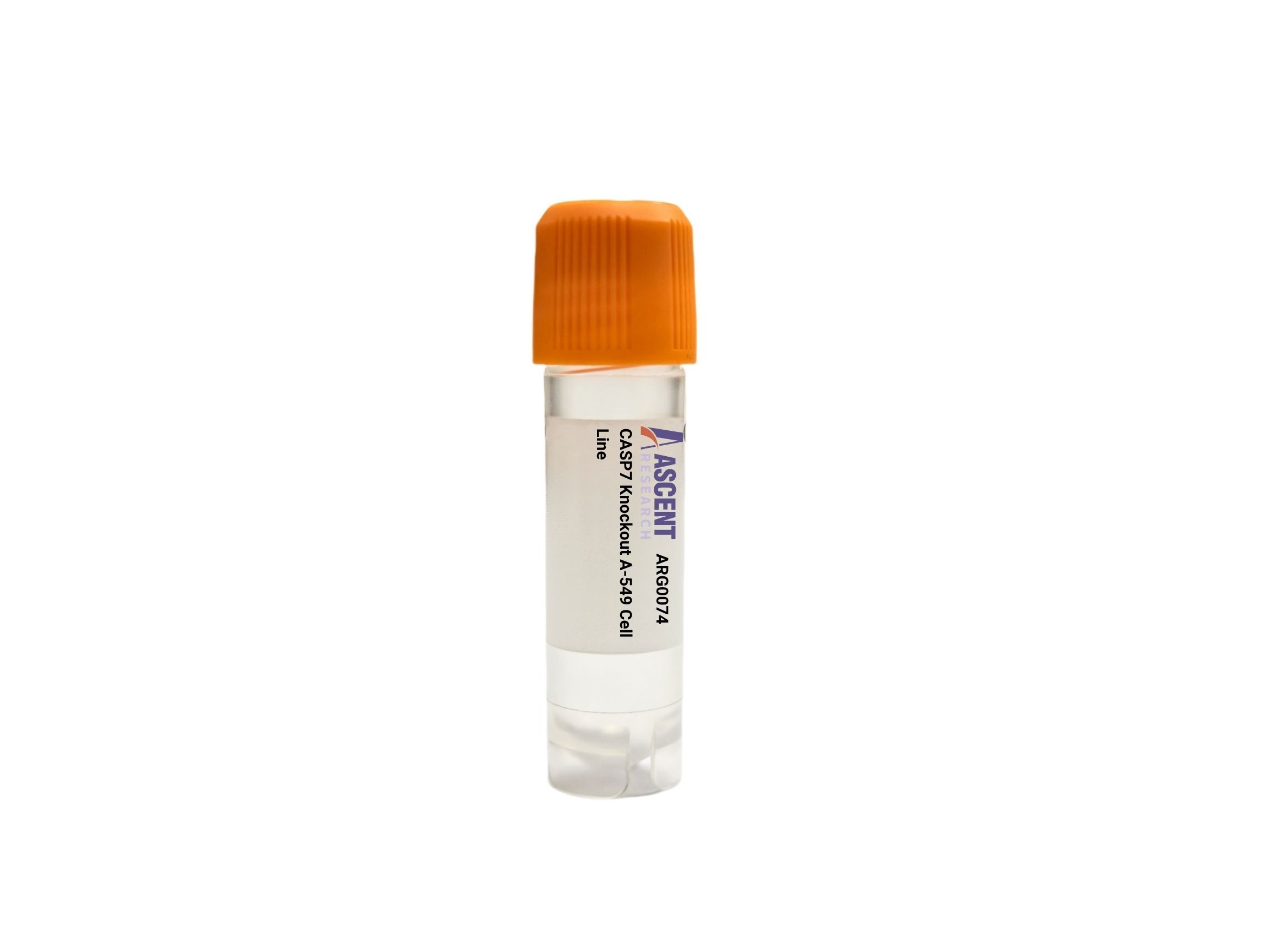
Genome-edited Cells
Lung
CASP7 Knockout A-549 is a human CRISPR/Cas9-edited alveolar epithelial lung adenocarcinoma cell line lacking functional CASP7 expression. In this A-549 background, the model supports analysis of execution-phase apoptosis, stress-associated cell death, and therapeutic response in pulmonary cancer cells. CASP7 normally functions downstream of CASP8, CASP9, and the APAF1 apoptosome and contributes to cleavage of substrates such as PARP1 during intrinsic and extrinsic apoptosis. This knockout line is useful for apoptosis mechanism studies, death receptor and ER stress signaling, chemotherapy response profiling, and comparative analysis of CASP7 versus CASP3 dependence using western blotting, flow cytometry, and drug sensitivity assays.
 ARL6IP4 Knockout HAP1 Polyclonal Cells
Cat. No. ARG21901
CIRBP Knockout jurkat Polyclonal Cells
Cat. No. ARG13648
ATG2B Knockout HGC-27 Polyclonal Cells
Cat. No. ARG29649
ANKRD26 Knockout HT29 Polyclonal Cells
Cat. No. ARG32947
C17orf80 Knockout HT29 Polyclonal Cells
Cat. No. ARG33187
EFNA5 Knockout AGS Polyclonal Cells
Cat. No. ARG40674
ARL6IP4 Knockout HAP1 Polyclonal Cells
Cat. No. ARG21901
CIRBP Knockout jurkat Polyclonal Cells
Cat. No. ARG13648
ATG2B Knockout HGC-27 Polyclonal Cells
Cat. No. ARG29649
ANKRD26 Knockout HT29 Polyclonal Cells
Cat. No. ARG32947
C17orf80 Knockout HT29 Polyclonal Cells
Cat. No. ARG33187
EFNA5 Knockout AGS Polyclonal Cells
Cat. No. ARG40674
The CASP7 Knockout A-549 Cell Line is a human CRISPR/Cas9-engineered cell model in which the CASP7 gene has been disrupted to eliminate functional caspase-7 expression. This stable knockout line is generated in A-549 cells, a human alveolar basal epithelial adenocarcinoma cell line, and provides an in vitro system for examining execution-phase cell death mechanisms in a lung epithelial cancer background. As CASP7 encodes an executioner caspase involved in proteolytic substrate cleavage during apoptosis and related stress-associated death programs, this model is suited for studies requiring direct assessment of CASP7-dependent signaling outputs.
A-549 cells are derived from alveolar type II-like lung adenocarcinoma epithelium and are widely used to study pulmonary epithelial biology, epithelial stress responses, oncogenic signaling, and therapeutic sensitivity. Their relevance as an epithelial barrier-derived lung cancer model makes them useful for investigating how malignant lung cells respond to cytotoxic injury, inflammatory stimuli, and targeted perturbation of programmed cell death pathways. In this context, A-549 cells support mechanistic studies of apoptosis regulation, drug response, and transcriptional or proteomic remodeling associated with epithelial tumor cell survival.
CASP7 functions downstream of initiator caspases in both intrinsic and extrinsic apoptosis. It is activated by signaling mediated through FASLG-FAS, TRADD, FADD, and CASP8 in death receptor pathways, and through BAX- and BAK1-dependent mitochondrial outer membrane permeabilization, cytochrome c release, APAF1 apoptosome formation, and CASP9 activation in intrinsic apoptosis. Activated caspase-7 cleaves substrates including PARP1 and components of the DFFB/ICAD axis, while also contributing to processing of structural proteins such as gelsolin, lamin A/C, and cytokeratins, thereby promoting membrane blebbing, DNA fragmentation, and apoptotic cell disassembly. CASP7 activity is modulated by inhibitor of apoptosis proteins including XIAP, BIRC2/cIAP1, BIRC3/cIAP2, and survivin/BIRC5, whereas DIABLO/SMAC can relieve IAP-mediated suppression. Its functional relationship with CASP3 is particularly relevant in defining executioner caspase redundancy and pathway compensation.
In the A-549 background, CASP7 loss provides a useful system for resolving how executioner caspase usage influences lung cancer cell death phenotypes downstream of TP53 activation, ER stress, death receptor stimulation, or chemotherapy exposure. This model can help distinguish CASP7-specific contributions from CASP3-dependent apoptosis and clarify how epithelial tumor cells couple upstream signals from CASP8, CASP9, FAS, DR4, or DR5 to terminal substrate cleavage and cellular disassembly.
This knockout cell line can be applied in western blot analysis of PARP1 processing and caspase pathway components, annexin V/propidium iodide flow cytometry to quantify apoptotic progression, and caspase-3/7 activity assays interpreted with isoform awareness to separate composite readouts. It is also suitable for mitochondrial membrane potential assays during intrinsic apoptosis, immunofluorescence-based analysis of cytoskeletal or nuclear disassembly, RT-qPCR and RNA-seq studies of stress-response gene expression, co-immunoprecipitation of apoptosis-regulatory complexes, and drug sensitivity experiments evaluating cytotoxic agents, ER stress inducers, or death receptor agonists in lung cancer cells. Researchers may contact Ascent Research for additional technical information, product details, or related gene-edited cell models.