Genome-edited Cells
Lung
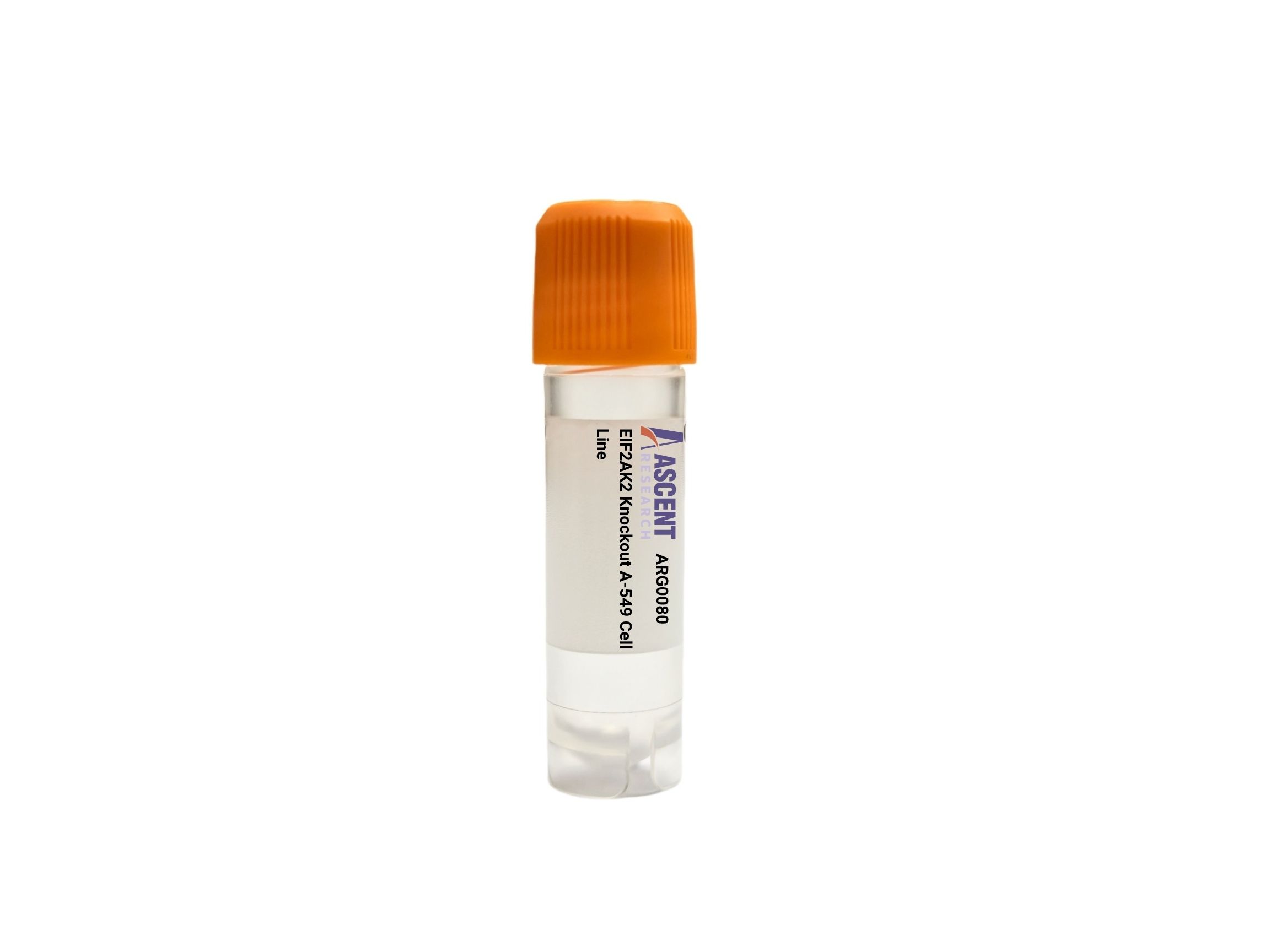
EIF2AK2 Knockout A-549 is a human CRISPR/Cas9-edited alveolar epithelial adenocarcinoma cell line with disruption of EIF2AK2, which encodes the dsRNA-activated kinase PKR. In A-549 cells, PKR functions downstream of interferon and dsRNA sensing to phosphorylate EIF2S1/eIF2alpha, suppress translation, and influence ATF4, DDIT3/CHOP, NF-kB, and apoptotic signaling. This model is useful for studying antiviral innate immunity, integrated stress response mechanisms, interferon signaling, lung cancer biology, and host-pathogen interactions using assays such as phospho-eIF2alpha western blotting, RT-qPCR, RNA-seq, viral infection studies, cytokine profiling, and drug sensitivity testing.
 MKRN3 Knockout A2780 Polyclonal Cells
Cat. No. ARG18272
MSI2 Knockout Hela Polyclonal Cells
Cat. No. ARG8239
APOC2 Knockout Hela Polyclonal Cells
Cat. No. ARG20866
NBR1 Knockout A549 Polyclonal Cells
Cat. No. ARG10034
ERGIC3 Knockout 786-O Polyclonal Cells
Cat. No. ARG5318
MGST1 Knockout Raji Polyclonal Cells
Cat. No. ARG2042
MKRN3 Knockout A2780 Polyclonal Cells
Cat. No. ARG18272
MSI2 Knockout Hela Polyclonal Cells
Cat. No. ARG8239
APOC2 Knockout Hela Polyclonal Cells
Cat. No. ARG20866
NBR1 Knockout A549 Polyclonal Cells
Cat. No. ARG10034
ERGIC3 Knockout 786-O Polyclonal Cells
Cat. No. ARG5318
MGST1 Knockout Raji Polyclonal Cells
Cat. No. ARG2042
The EIF2AK2 Knockout A-549 Cell Line is a human CRISPR/Cas9-engineered cell model in which the EIF2AK2 gene has been disrupted to eliminate functional PKR expression. This stable knockout line is generated in A-549 cells, a human alveolar basal epithelial adenocarcinoma background, and provides a defined in vitro system for examining EIF2AK2-dependent signaling in pulmonary epithelial biology. By removing a central double-stranded RNA-responsive kinase from a widely used airway-associated cancer cell model, this product supports mechanistic studies of stress signaling, innate immune regulation, and translational control.
A-549 cells are broadly used as an in vitro model of alveolar type II-like lung epithelium and are well established in studies of respiratory infection, epithelial barrier-associated responses, interferon biology, and lung cancer signaling. Their epithelial origin and pulmonary relevance make them particularly useful for investigating host-pathogen interactions, inflammatory signaling, and stress-adaptive responses in the respiratory tract. In addition, A-549 cells are frequently used to model tumor cell-intrinsic signaling networks that integrate cytokine exposure, viral challenge, and survival or apoptotic programs.
EIF2AK2 encodes PKR, an interferon-inducible serine/threonine kinase activated by double-stranded RNA and regulated upstream by interferon-alpha, interferon-beta, interferon-gamma, IFNAR1/IFNAR2 signaling, and the JAK1-TYK2-STAT1 axis. PKR is also modulated by PRKRA/PACT, TARBP2/TRBP, heparin, and broader cellular stress inputs. Once activated, PKR phosphorylates EIF2S1/eIF2alpha, driving global translation attenuation and promoting integrated stress response outputs including ATF4 and DDIT3/CHOP induction. EIF2AK2 additionally interfaces with NF-kB signaling components, IRF1-associated inflammatory programs, MAPK8/JNK stress signaling, apoptosis, and stress granule formation. Its activity is further shaped by interactions with PPP1R15A/GADD34 and the PP1 catalytic subunit, which contribute to eIF2alpha dephosphorylation dynamics.
In the A-549 context, EIF2AK2 loss is valuable for defining how pulmonary epithelial tumor cells couple dsRNA sensing and interferon exposure to translational repression, inflammatory cytokine expression, and cell fate decisions. This model can help distinguish PKR-dependent from PKR-independent responses downstream of type I interferon signaling, clarify pathway crosstalk between eIF2alpha phosphorylation and NF-kB or JNK activation, and support studies of viral susceptibility, immune evasion, and stress response dysregulation relevant to lung cancer and inflammatory lung disease.
This knockout cell line is suitable for western blot analysis of PKR pathway components and phospho-EIF2S1/eIF2alpha, RT-qPCR or RNA-seq profiling of ATF4-, DDIT3-, IRF1-, or cytokine-associated transcriptional programs, and reporter assays for NF-kB-responsive signaling. It can also be applied in viral infection assays, apoptosis measurements, immunofluorescence-based stress granule studies, flow cytometric phenotyping, co-immunoprecipitation of PKR-associated regulatory factors such as PRKRA or TARBP2 pathway components, cytokine profiling, and drug sensitivity experiments evaluating interferon response or stress pathway dependencies. Researchers may contact Ascent Research for additional technical information, product details, or related gene-edited cell models.