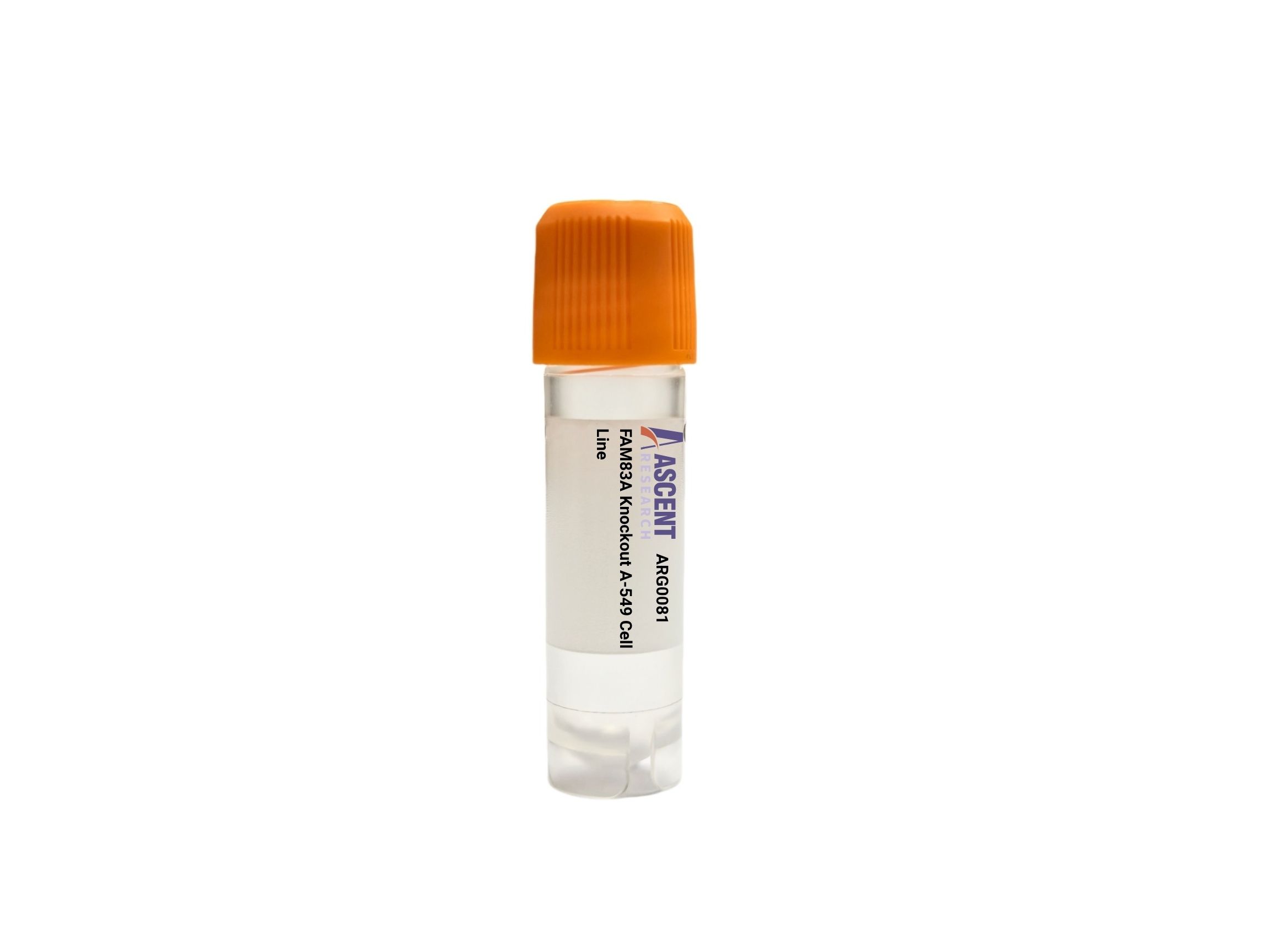
Genome-edited Cells
Lung
The FAM83A Knockout A-549 Cell Line is a human CRISPR/Cas9-edited lung adenocarcinoma epithelial model with disruption of the proto-oncogenic scaffold FAM83A. In A-549 cells, this knockout supports analysis of EGFR/ERBB-driven signaling and its coupling to RAF-MEK-ERK and PI3K-AKT-mTOR pathways, including effects on ERK1/2 and AKT phosphorylation, MYC-associated programs, and cyclin D1-linked proliferation. This model is useful for lung cancer functional genomics, growth factor response studies, EGFR inhibitor resistance research, and assays such as western blotting, RNA-seq, proliferation, apoptosis, migration/invasion, colony formation, and drug sensitivity testing.
 C2CD5 Knockout A2780 Polyclonal Cells
Cat. No. ARG28957
CNTLN Knockout SK-HEP-1 Polyclonal Cells
Cat. No. ARG16269
LYRM1 Knockout HT29 Polyclonal Cells
Cat. No. ARG14832
INIP Knockout Hela Polyclonal Cells
Cat. No. ARG26271
HDDC2 Knockout NCI-H1975 Polyclonal Cells
Cat. No. ARG31605
ADARB1 Knockout HT29 Polyclonal Cells
Cat. No. ARG32857
C2CD5 Knockout A2780 Polyclonal Cells
Cat. No. ARG28957
CNTLN Knockout SK-HEP-1 Polyclonal Cells
Cat. No. ARG16269
LYRM1 Knockout HT29 Polyclonal Cells
Cat. No. ARG14832
INIP Knockout Hela Polyclonal Cells
Cat. No. ARG26271
HDDC2 Knockout NCI-H1975 Polyclonal Cells
Cat. No. ARG31605
ADARB1 Knockout HT29 Polyclonal Cells
Cat. No. ARG32857
The FAM83A Knockout A-549 Cell Line is a human CRISPR/Cas9-engineered knockout model in which the FAM83A gene has been disrupted to eliminate functional gene expression. This stable edited cell line is generated in the A-549 background, a lung adenocarcinoma epithelial cell line, and provides an in vitro system for investigating the contribution of FAM83A to tumor-associated signaling, proliferation, survival, and therapeutic response in a pulmonary epithelial-like cancer context.
A-549 is a widely used human non-small cell lung carcinoma model with epithelial morphology and alveolar epithelial-like features. It is extensively applied in studies of lung adenocarcinoma biology, oncogenic signal transduction, and preclinical therapeutic testing. Because A-549 cells are responsive to growth factor and receptor tyrosine kinase signaling inputs and support robust molecular and phenotypic assays, they are well suited for dissecting mechanisms that control proliferation, survival, epithelial transformation, and drug sensitivity in lung cancer research.
FAM83A is a proto-oncogenic signaling scaffold that enhances output from EGFR and related ERBB family pathways. It functions downstream of receptor tyrosine kinase activation and oncogenic RAS pathway activity, and has been implicated in reinforcing signaling through the RAS-RAF-MEK-ERK and PI3K-AKT-mTOR cascades. Mechanistically, FAM83A interacts with components of the EGFR signaling network, including CK1 isoforms, CRAF/RAF1, and PI3K pathway-associated factors, thereby supporting signal propagation from EGFR, ERBB2, KRAS, BRAF, and RAF1 to MEK1/2, ERK1/2, AKT, and mTOR. In this context, FAM83A is linked to regulation of ERK1/2 phosphorylation, AKT phosphorylation, MYC-associated proliferative programs, cyclin D1 expression, cell-cycle progression, and survival signaling. These pathway connections make FAM83A relevant to non-small cell lung cancer, lung adenocarcinoma, and studies of EGFR inhibitor resistance and broader oncogenic signaling dependencies.
In the A-549 background, loss of FAM83A provides a useful system for examining how a signaling adaptor influences growth factor-driven phenotypes in lung adenocarcinoma cells. Comparing the knockout line with the parental host can help resolve the extent to which FAM83A mediates receptor tyrosine kinase-dependent MAPK and PI3K-AKT pathway activation, contributes to survival under mitogenic or therapeutic stress, and supports transformation-associated phenotypes in epithelial tumor cells.
This model is suitable for western blot analysis of phospho-ERK and phospho-AKT, RT-qPCR or RNA-seq profiling of MYC- and CCND1-linked transcriptional responses, co-immunoprecipitation studies of FAM83A-associated signaling complexes, and immunofluorescence-based analysis of pathway-responsive cellular states. It is also applicable to cell proliferation, colony formation, apoptosis, migration, and invasion assays, as well as drug sensitivity studies designed to evaluate EGFR pathway dependency, resistance-associated signaling, and combinatorial targeting of MAPK or PI3K-AKT-mTOR nodes. Researchers may contact Ascent Research for additional technical information, product details, or related gene-edited cell models.