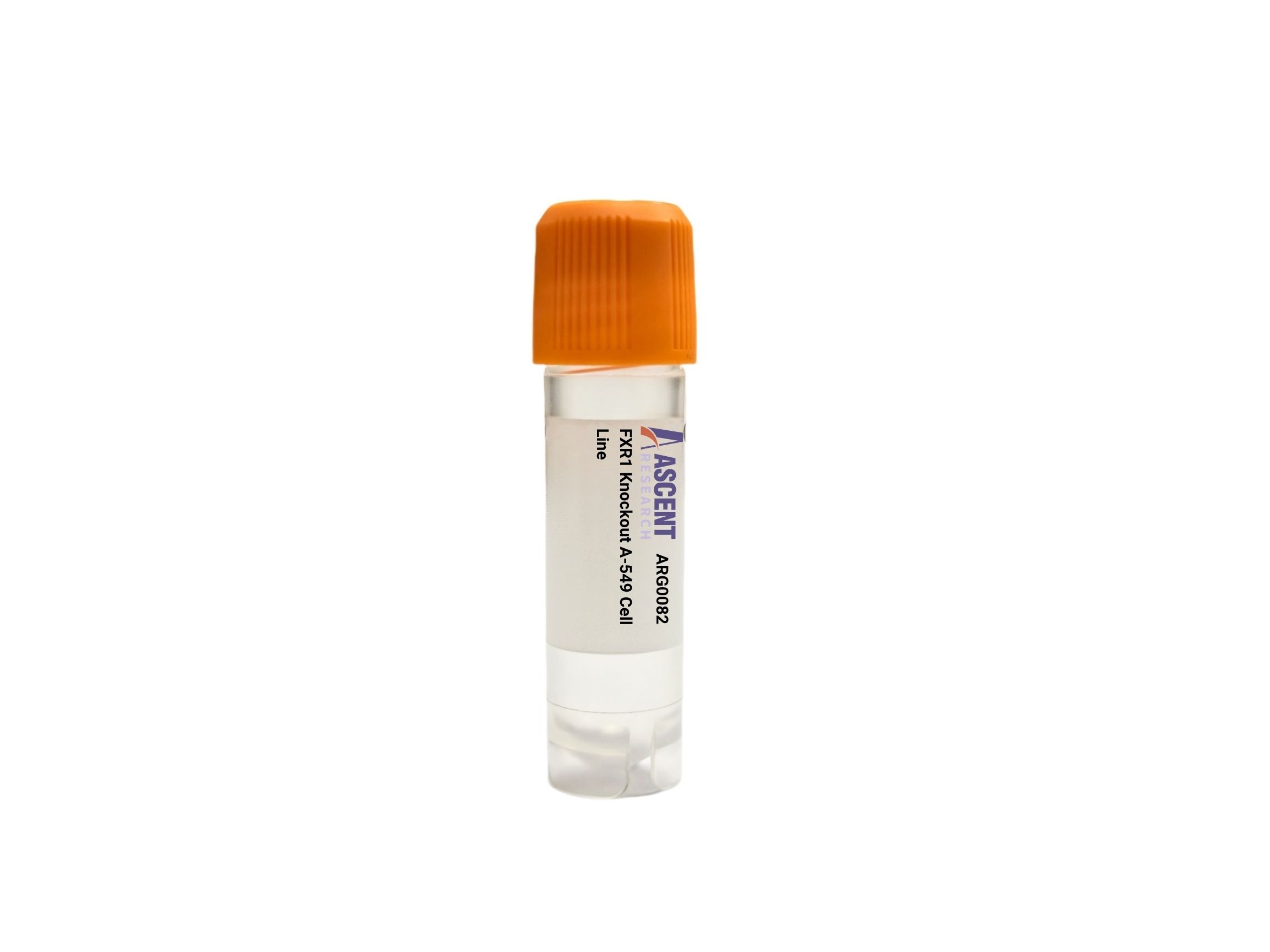
Genome-edited Cells
Lung
FXR1 Knockout A-549 is a human CRISPR/Cas9-edited lung adenocarcinoma epithelial cell line with disruption of the RNA-binding protein FXR1 in an alveolar epithelial-like NSCLC background. FXR1 normally regulates mRNA stability, translation, and stress granule biology through interactions with factors including FMR1, FXR2, AGO2, G3BP1, and PABPC1, and influences targets such as p21/CDKN1A and AU-rich element-containing mRNAs. This model is useful for studying post-transcriptional regulation, RNP granule dynamics, lung cancer proliferation and motility, apoptosis, and chemotherapeutic response using RNA-seq, polysome profiling, immunofluorescence, migration assays, and drug sensitivity assays.
 NQO1 Knockout HEK293 Polyclonal Cells
Cat. No. ARG12661
JADE1 Knockout NCI-H1975 Polyclonal Cells
Cat. No. ARG31792
KCTD12 Knockout A549 Polyclonal Cells
Cat. No. ARG34455
DOCK7 Knockout HT29 Polyclonal Cells
Cat. No. ARG39612
CDYL Knockout HEK293T Polyclonal Cells
Cat. No. ARG3893
NQO1 Knockout HEK293 Polyclonal Cells
Cat. No. ARG12661
JADE1 Knockout NCI-H1975 Polyclonal Cells
Cat. No. ARG31792
KCTD12 Knockout A549 Polyclonal Cells
Cat. No. ARG34455
DOCK7 Knockout HT29 Polyclonal Cells
Cat. No. ARG39612
CDYL Knockout HEK293T Polyclonal Cells
Cat. No. ARG3893
 Sheep Pulmonary Microvascular Endothelial Cells
Cat. No. ARP0942
Sheep Pulmonary Microvascular Endothelial Cells
Cat. No. ARP0942
The FXR1 Knockout A-549 Cell Line is a human CRISPR/Cas9-engineered cell model in which the FXR1 gene has been disrupted to eliminate functional FXR1 expression. This stable knockout line is generated in A-549 cells, a lung adenocarcinoma epithelial background, and provides an in vitro system for analyzing the consequences of FXR1 loss in a pulmonary tumor context. As an RNA-binding protein of the fragile X family, FXR1 is implicated in post-transcriptional control, making this model relevant for studies of mRNA fate, translational regulation, and ribonucleoprotein complex biology in cancer cells.
A-549 is a well-established human non-small cell lung cancer cell line derived from alveolar type II-like epithelial cells. The line is widely used in pulmonary biology, cancer signaling, and pharmacology because it models key features of alveolar epithelial-like tumor cells, including proliferative behavior, stress adaptation, and response to therapeutic agents. In biomedical research, A-549 cells are commonly applied to investigate mechanisms of lung tumor growth, epithelial plasticity, cytotoxic stress, and drug sensitivity, providing a practical host background for interrogating gene function in non-small cell lung cancer-relevant pathways.
FXR1 functions within ribonucleoprotein assemblies to regulate mRNA stability, translation, and granule dynamics. It is regulated by TP53, cellular stress, serum and growth factor signaling, microRNAs targeting FXR1 transcripts, and proliferation-associated transcriptional programs. At the molecular level, FXR1 interacts with FXR2 and FMR1 and forms functional relationships with AGO2, DICER1, PABPC1, eIF4E, eIF4G, G3BP1, CAPRIN1, and YBX1, linking it to translational initiation, RNA silencing machinery, and stress granule organization. Representative downstream outputs include regulation of AU-rich element-containing mRNAs such as TNF mRNA, control of p21/CDKN1A expression, MYC-associated translational outputs, and modulation of cytoskeleton- and motility-related transcripts. These activities place FXR1 at the intersection of mRNA decay, translational control, epithelial-mesenchymal transition-associated gene regulation, and cytoskeletal remodeling relevant to cancer progression and chemoresistance.
In the A-549 background, FXR1 loss provides a biologically meaningful system for examining how disruption of post-transcriptional gene regulation alters lung cancer cell phenotypes. Because A-549 cells are frequently used to study proliferation, survival signaling, motility, and drug response, FXR1 knockout can support mechanistic analysis of pathway dependencies that connect RNA regulation to tumor cell growth, stress tolerance, and invasive behavior. This model is also suitable for investigating how ribonucleoprotein granule dynamics and selective mRNA translation contribute to non-small cell lung cancer-associated phenotypes.
This cell line is applicable to western blotting and RT-qPCR analysis of FXR1-dependent targets, RNA-seq for transcriptome-level consequences of gene loss, and polysome or ribosome profiling to define translational changes downstream of FXR1 disruption. It can also be used in immunofluorescence-based stress granule quantification involving G3BP1- or TIA1-associated structures, co-immunoprecipitation or RNA immunoprecipitation studies of altered RNP composition, and functional assays including apoptosis measurements, colony formation, migration and invasion assays, metabolic assays, and chemotherapeutic drug sensitivity testing. Researchers may contact Ascent Research for additional technical information, product details, or related gene-edited cell models.