Genome-edited Cells
Lung
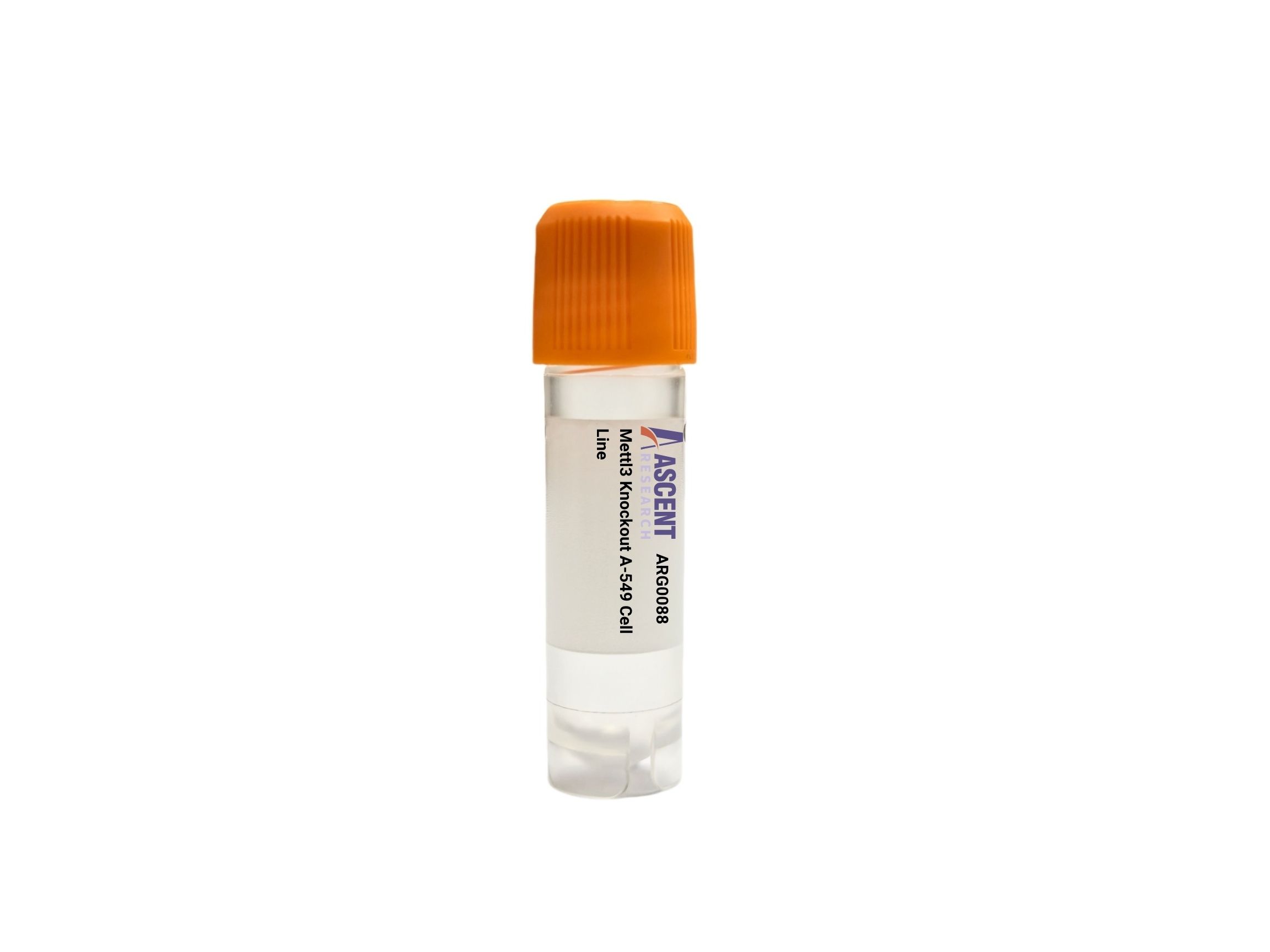
The Mettl3 Knockout A-549 Cell Line is a human CRISPR/Cas9-edited alveolar epithelial carcinoma model with disrupted Mettl3 expression in the widely used A-549 lung adenocarcinoma background. METTL3 is the catalytic core of the m6A writer complex, functioning with METTL14 and WTAP to regulate RNA splicing, stability, and translation through m6A-modified transcripts and reader proteins such as YTHDF1/YTHDF2. In A-549 cells, this knockout supports studies of RNA epitranscriptomics, EMT, hypoxia response, PI3K-AKT and MYC-associated programs, therapy resistance, and lung cancer drug sensitivity using RNA-seq, MeRIP-seq, LC-MS/MS, proliferation, apoptosis, and migration assays.
 C2CD5 Knockout MES-OV Polyclonal Cells
Cat. No. ARG24393
CDKN2A Knockout NCI-H1975 Polyclonal Cells
Cat. No. ARG16735
KLHDC7B Knockout HAP1 Polyclonal Cells
Cat. No. ARG23031
AP3D1 Knockout NCI-H1299 Polyclonal Cells
Cat. No. ARG30359
HAVCR1 Knockout HT29 Polyclonal Cells
Cat. No. ARG36169
C2CD5 Knockout MES-OV Polyclonal Cells
Cat. No. ARG24393
CDKN2A Knockout NCI-H1975 Polyclonal Cells
Cat. No. ARG16735
KLHDC7B Knockout HAP1 Polyclonal Cells
Cat. No. ARG23031
AP3D1 Knockout NCI-H1299 Polyclonal Cells
Cat. No. ARG30359
HAVCR1 Knockout HT29 Polyclonal Cells
Cat. No. ARG36169
 MDR1 Overexpression MDCK Stable Cell Line
Cat. No. ARG0569
MDR1 Overexpression MDCK Stable Cell Line
Cat. No. ARG0569
The Mettl3 Knockout A-549 Cell Line is a human CRISPR/Cas9-engineered knockout model in which the Mettl3 gene has been disrupted to abolish functional METTL3 expression. This stable gene-edited cell line is generated in A-549 cells, a human alveolar epithelial carcinoma line, and provides an in vitro system for studying consequences of impaired m6A RNA methyltransferase activity in a lung cancer-relevant epithelial background. The model is suited for mechanistic investigation of epitranscriptomic regulation, post-transcriptional gene control, and phenotype-associated signaling programs downstream of METTL3 loss.
A-549 is a widely used human lung adenocarcinoma epithelial cell line that exhibits alveolar type II-like features and serves as a standard model of non-small cell lung cancer biology. It is frequently applied to studies of pulmonary epithelial signaling, tumor cell proliferation and survival, epithelial-mesenchymal transition, and drug response. Because this host line integrates oncogenic growth control, stress adaptation, and epithelial lineage characteristics within a tractable culture system, it is a useful platform for examining how RNA regulatory mechanisms shape lung cancer-associated phenotypes.
METTL3 is the catalytic core of the m6A writer complex and forms functional complexes with METTL14, WTAP, VIRMA/KIAA1429, RBM15, RBM15B, ZC3H13, and HAKAI/CBLL1 to deposit N6-methyladenosine on mRNA and other RNAs. This modification regulates RNA fate through reader proteins including YTHDF1, YTHDF2, and YTHDC1, while the demethylases FTO and ALKBH5 counterbalance methylation status. METTL3-dependent m6A deposition can influence mRNA splicing, decay, and translational efficiency, including effects on transcripts linked to BCL2, MYC, SOCS2, EGFR pathway signaling, and EMT-associated programs. METTL3 is regulated by S-adenosylmethionine availability and is functionally connected to hypoxia/HIF1A-associated signaling, MYC-driven transcriptional programs, TGF-beta signaling, and cellular stress responses, placing it at a central node in RNA metabolism and adaptive tumor-cell state control.
In the A-549 context, loss of METTL3 provides a relevant system for interrogating how disruption of m6A-mediated RNA regulation alters lung adenocarcinoma cell behavior. This model can support analysis of gene-expression rewiring associated with proliferation, apoptosis, survival signaling, EMT, hypoxia adaptation, and therapy resistance. It is particularly useful for distinguishing direct epitranscriptomic effects from secondary signaling changes in a pulmonary carcinoma background where PI3K-AKT and MYC-associated pathways are commonly studied.
Researchers can apply this knockout line in western blotting and RT-qPCR workflows to confirm pathway perturbation, in RNA-seq and MeRIP-seq/m6A-seq experiments to define transcriptome-wide methylation-dependent regulatory changes, and in LC-MS/MS nucleoside analysis or m6A quantification assays to assess global methylation loss. The model is also suitable for polysome profiling and RNA stability assays to dissect translational and decay phenotypes, as well as co-immunoprecipitation and immunofluorescence studies examining writer-complex and reader-associated mechanisms. In functional cancer biology, the line can be used in proliferation, apoptosis, migration, invasion, and drug sensitivity assays to evaluate how Mettl3 disruption modifies tumor progression-related traits, therapeutic response, and synthetic lethal dependencies in non-small cell lung cancer. Researchers may contact Ascent Research for additional technical information, product details, or related gene-edited cell models.