Genome-edited Cells
Lung
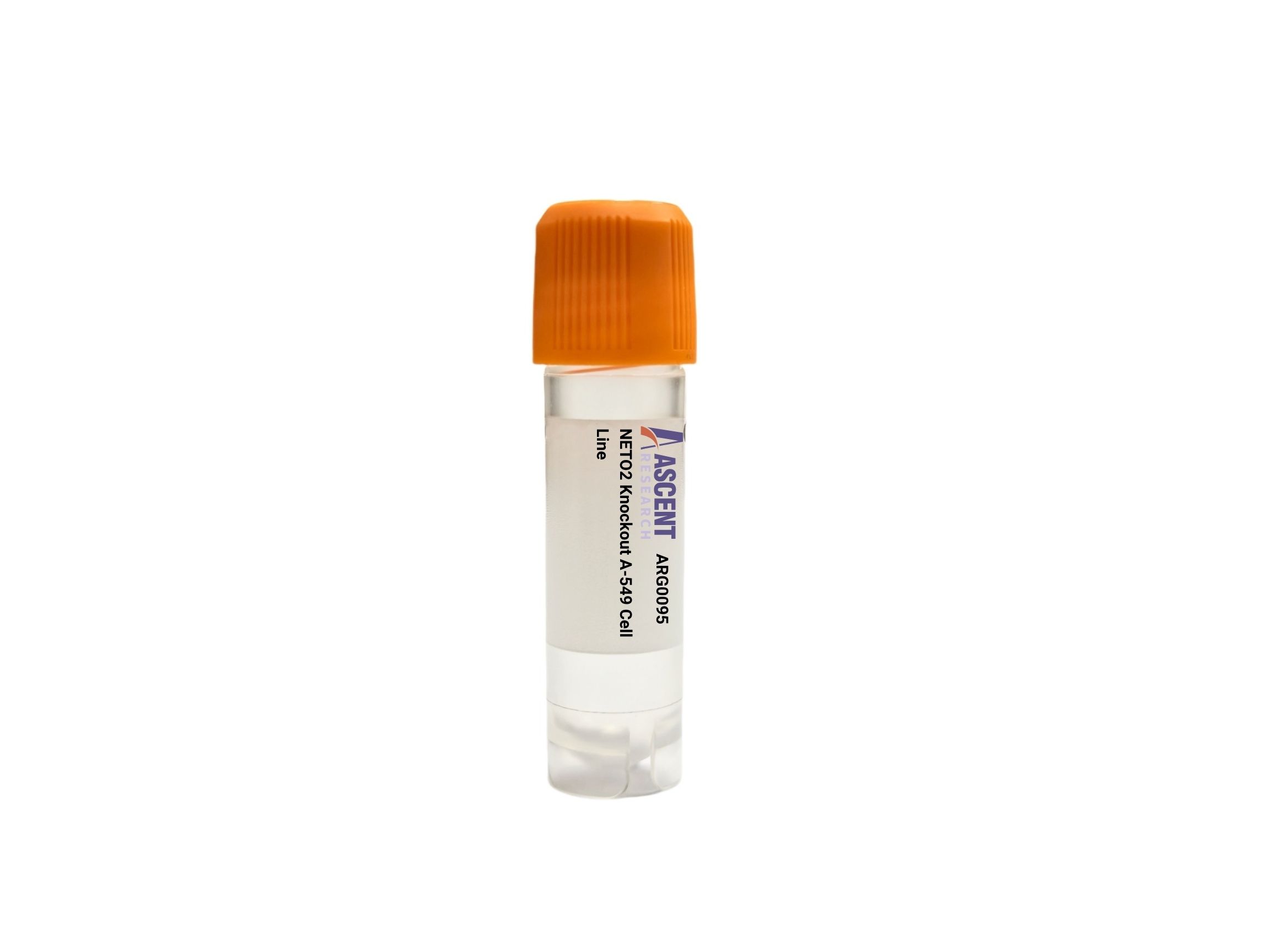
NETO2 Knockout A-549 is a human CRISPR/Cas9-edited lung adenocarcinoma epithelial cell line with disrupted NETO2 expression. In the A-549 non-small cell lung cancer background, this model supports investigation of NETO2 function in cell adhesion, migration, EMT-like regulation, and metastasis-associated signaling. NETO2 is linked to TGF-beta, EGFR-MAPK/ERK, and PI3K-AKT pathway activity, with downstream relevance to CDH1, CDH2, VIM, MMP2, and MMP9 as well as ERK and AKT phosphorylation states. Suitable applications include western blotting, RT-qPCR, RNA-seq, migration and invasion assays, wound-healing studies, phospho-signaling analysis, and drug response profiling.
 CHST12 Knockout NCI-H1975 Polyclonal Cells
Cat. No. ARG16858
CRK Knockout jurkat Polyclonal Cells
Cat. No. ARG13028
MALSU1 Knockout A549 Polyclonal Cells
Cat. No. ARG10350
KIAA0319L Knockout HEK293T Polyclonal Cells
Cat. No. ARG37748
DNAJA2 Knockout K562 Polyclonal Cells
Cat. No. ARG39071
MED16 Knockout Hela Polyclonal Cells
Cat. No. ARG7808
CHST12 Knockout NCI-H1975 Polyclonal Cells
Cat. No. ARG16858
CRK Knockout jurkat Polyclonal Cells
Cat. No. ARG13028
MALSU1 Knockout A549 Polyclonal Cells
Cat. No. ARG10350
KIAA0319L Knockout HEK293T Polyclonal Cells
Cat. No. ARG37748
DNAJA2 Knockout K562 Polyclonal Cells
Cat. No. ARG39071
MED16 Knockout Hela Polyclonal Cells
Cat. No. ARG7808
The NETO2 Knockout A-549 Cell Line is a human CRISPR/Cas9-engineered cell model in which the NETO2 gene has been disrupted to abolish functional gene expression. This stable knockout line is generated in A-549 cells, a human lung adenocarcinoma epithelial cell line, and provides an in vitro system for investigating NETO2-dependent mechanisms in tumor-associated signaling, cell-state regulation, and motility-related phenotypes. The model is suited for experiments requiring a defined genetic loss-of-function background in a widely used non-small cell lung cancer context.
A-549 cells are derived from human lung adenocarcinoma and display epithelial morphology with alveolar epithelial-like characteristics. As a broadly used non-small cell lung cancer model, A-549 has substantial utility in studies of cancer cell proliferation, migration, signaling plasticity, toxicology, and respiratory biology. The line is particularly valuable for examining pathways relevant to epithelial tumor progression, including growth factor responsiveness, cytoskeletal remodeling, focal adhesion signaling, and therapeutic sensitivity. Its established use in lung cancer research makes it a practical host background for testing how specific gene disruption alters malignant cell behavior.
NETO2 encodes a single-pass transmembrane protein belonging to the neuropilin and tolloid-like family and has been implicated in regulation of adhesion, migration, and invasive signaling programs in cancer cells. In epithelial tumor systems, NETO2 has been associated with epithelial-mesenchymal transition-like marker changes involving CDH1, CDH2, and VIM, and with migration-associated effectors including MMP2 and MMP9. Its expression and function are linked to upstream TGF-beta signaling, growth factor receptor activity, oncogenic MAPK signaling, PI3K-AKT pathway activity, and EMT-associated transcription factors such as SNAI1, TWIST1, and ZEB1. In this network context, NETO2 is relevant to signaling downstream of components including EGFR, KRAS, RAF, MEK1/2, ERK1/2, PI3K, AKT, FAK/PTK2, and SRC. Reported interacting factors include GRIK family kainate receptor subunits, membrane-associated scaffolding proteins, and cytoskeletal regulatory complexes.
Loss of NETO2 in A-549 cells provides a relevant system for defining how this transmembrane regulator contributes to lung adenocarcinoma cell motility, invasion, and pathway output. Because A-549 cells are commonly used to model lung cancer signaling and drug response, NETO2 knockout can help distinguish gene-specific effects on ERK and AKT phosphorylation states, focal adhesion-linked responses, EMT marker regulation, and metastatic behavior-associated phenotypes within a disease-relevant epithelial background.
This model can be applied to mechanistic studies using western blotting or phospho-signaling analysis to compare ERK1/2, AKT, FAK/PTK2, and SRC pathway activity after perturbation of EGFR or TGF-beta inputs. RT-qPCR, RNA-seq, and immunofluorescence may be used to profile transcriptional and protein-level changes in CDH1, CDH2, VIM, MMP2, and MMP9. Functional consequences of NETO2 disruption can be assessed by wound-healing, transwell migration, and invasion assays, as well as colony formation, apoptosis assays, and drug sensitivity studies in the presence of pathway-directed agents. Co-immunoprecipitation and flow cytometry can further support investigation of interacting factors, membrane-associated complexes, and cell-state alterations relevant to metastasis-associated signaling. Researchers may contact Ascent Research for additional technical information, product details, or related gene-edited cell models.