Genome-edited Cells
Lung
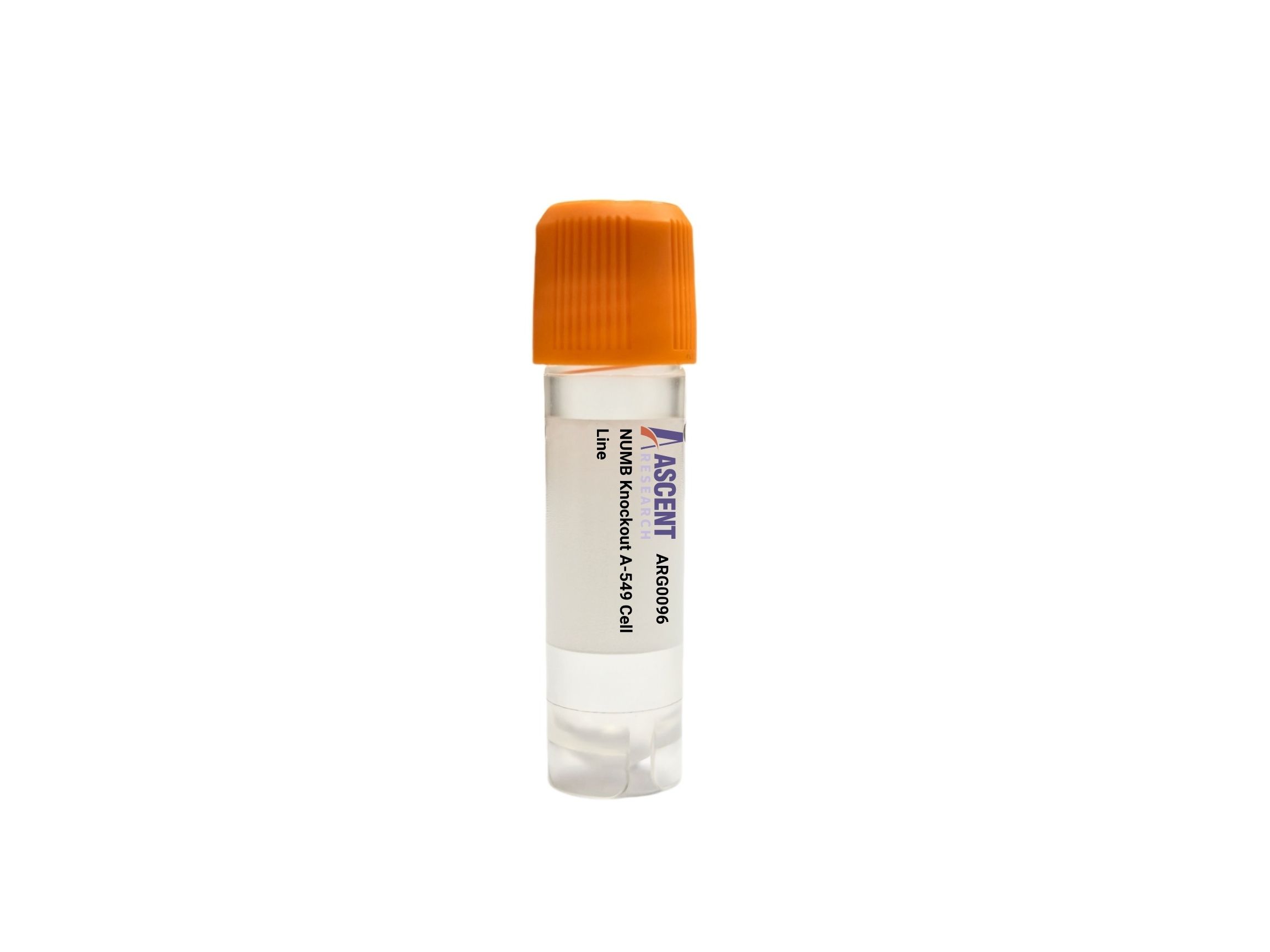
NUMB Knockout A-549 is a CRISPR/Cas9-edited human lung adenocarcinoma alveolar epithelial cell model with disruption of NUMB, an endocytic adaptor that negatively regulates NOTCH1 signaling and interfaces with the MDM2-TP53 axis. In the widely used A-549 background, this knockout supports mechanistic studies of Notch pathway control, vesicle trafficking, epithelial polarity, proliferation, apoptosis, EMT-related phenotypes, and lung cancer signaling. The model is suitable for western blotting, RT-qPCR, RNA-seq, immunofluorescence, Notch reporter assays, co-immunoprecipitation, migration/invasion assays, and drug sensitivity or synthetic lethality studies.
 COL3A1 Knockout CAL27 Polyclonal Cells
Cat. No. ARG11516
BCL2L2 Knockout NCI-H1299 Polyclonal Cells
Cat. No. ARG30519
KLF13 Knockout HT29 Polyclonal Cells
Cat. No. ARG33545
GSN Knockout HT29 Polyclonal Cells
Cat. No. ARG33297
NT5DC1 Knockout HEK293T Polyclonal Cells
Cat. No. ARG3509
NCKIPSD Knockout HEK293T Polyclonal Cells
Cat. No. ARG3312
COL3A1 Knockout CAL27 Polyclonal Cells
Cat. No. ARG11516
BCL2L2 Knockout NCI-H1299 Polyclonal Cells
Cat. No. ARG30519
KLF13 Knockout HT29 Polyclonal Cells
Cat. No. ARG33545
GSN Knockout HT29 Polyclonal Cells
Cat. No. ARG33297
NT5DC1 Knockout HEK293T Polyclonal Cells
Cat. No. ARG3509
NCKIPSD Knockout HEK293T Polyclonal Cells
Cat. No. ARG3312
The NUMB Knockout A-549 Cell Line is a CRISPR/Cas9-engineered human cell model in which the NUMB gene has been disrupted to eliminate functional gene expression. This stable knockout line is generated in A-549 cells, a human alveolar epithelial adenocarcinoma cell line, and provides an in vitro system for investigating NUMB-dependent mechanisms in epithelial cancer biology. The model is suited for studies requiring defined loss of an endocytic adaptor and cell fate determinant within a lung-derived epithelial background relevant to signaling, proliferation, differentiation, and therapeutic response.
A-549 cells are derived from human lung adenocarcinoma and exhibit characteristics associated with type II alveolar epithelial cells. As a widely used pulmonary epithelial model, A-549 supports investigation of epithelial barrier-associated biology, oncogenic signaling, host response pathways, and drug sensitivity in non-small cell lung cancer contexts. Its broad adoption in lung cancer research makes it a practical background for dissecting pathway-specific phenotypes while retaining disease relevance for studies of epithelial plasticity, tumor progression, and response to perturbation.
NUMB functions as an endocytic adaptor that acts upstream of membrane protein trafficking and signaling attenuation. A central role of NUMB is the negative regulation of Notch signaling through trafficking-dependent control of receptors such as NOTCH1 and NOTCH2, with downstream effects on RBPJ/MAML1-dependent transcriptional outputs including HES1 and HEY1. NUMB also interacts with ITCH, AP2 complex components such as AP2A1, and EPS15, linking receptor internalization and ubiquitin-mediated protein turnover to signal regulation. In parallel, NUMB interfaces with the TP53-MDM2 axis, influencing p53 protein abundance and associated proliferation and apoptosis programs. Its function is regulated by developmental differentiation cues, growth factor signaling, RB pathway status, p53, ASCL1, and alternative splicing regulators including RBFOX3 and QKI. Through these networks, NUMB contributes to epithelial polarity, asymmetric division programs, and epithelial-mesenchymal transition-related phenotypes.
In the A-549 background, NUMB loss provides a useful system for evaluating how altered trafficking and Notch restraint affect lung adenocarcinoma-associated signaling states. This context is particularly relevant for examining changes in epithelial organization, polarity outputs linked to E-cadherin, proliferative control, apoptotic susceptibility, and pathway dependence connected to tumor progression or metastatic behavior. Because A-549 is frequently used for drug-response studies, the model also supports analysis of how NUMB deficiency modifies sensitivity to pathway-directed or cytotoxic perturbations.
Applications include western blotting and RT-qPCR analysis of NUMB-linked pathway markers such as NOTCH1, HES1, HEY1, TP53, and MDM2; RNA-seq to define transcriptional consequences of NUMB loss; and Notch reporter assays to quantify signaling changes downstream of receptor activation. Immunofluorescence and flow cytometry can be used to assess polarity, cell-state transitions, and apoptosis, while co-immunoprecipitation is applicable to studies of interactions involving ITCH, MDM2, AP2, or EPS15. Researchers may further employ proliferation assays, apoptosis assays, migration and invasion assays, phospho-signaling analysis, and drug sensitivity studies to investigate EMT-associated phenotypes, therapeutic vulnerabilities, and synthetic lethal interactions in lung cancer-relevant settings. Researchers may contact Ascent Research for additional technical information, product details, or related gene-edited cell models.