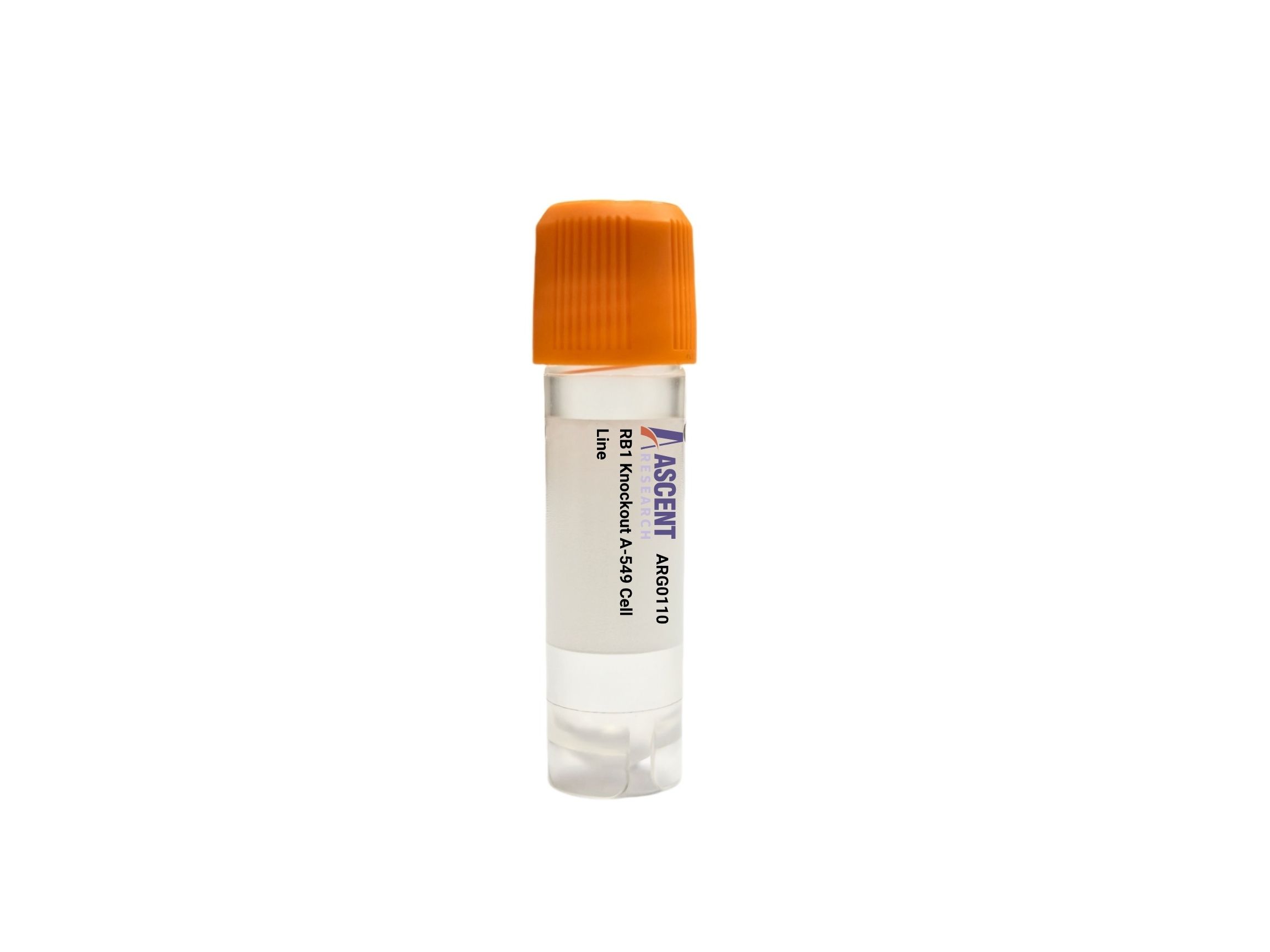
Genome-edited Cells
Lung
RB1 Knockout A-549 Cell Line is a human CRISPR/Cas9-edited lung alveolar epithelial adenocarcinoma model with disruption of the RB1 tumor suppressor gene. In A-549 cells, loss of pRB enables investigation of RB-E2F checkpoint failure, G1/S transition control, and proliferation-associated transcriptional programs involving E2F1, CCNE1, CDC6, and MCM2. Because RB1 is regulated by CDK4/6-Cyclin D and CDK2-Cyclin E signaling, this model is useful for lung cancer biology, senescence bypass, genome instability, and therapeutic response studies using assays such as western blotting, RNA-seq, flow cytometry, EdU/BrdU incorporation, and drug sensitivity profiling.
 CA2 Knockout HT29 Polyclonal Cells
Cat. No. ARG33210
FOSL2 Knockout HT29 Polyclonal Cells
Cat. No. ARG14965
FXR1 Knockout A549 Polyclonal Cells
Cat. No. ARG10792
ERGIC3 Knockout Raji Polyclonal Cells
Cat. No. ARG1574
CA2 Knockout HT29 Polyclonal Cells
Cat. No. ARG33210
FOSL2 Knockout HT29 Polyclonal Cells
Cat. No. ARG14965
FXR1 Knockout A549 Polyclonal Cells
Cat. No. ARG10792
ERGIC3 Knockout Raji Polyclonal Cells
Cat. No. ARG1574
 Rat Intestinal Myofibroblast Medium
Cat. No. ARM0249
Rat Intestinal Myofibroblast Medium
Cat. No. ARM0249
 Mouse Ureteral Epithelial Cells
Cat. No. ARP0497
Mouse Ureteral Epithelial Cells
Cat. No. ARP0497
The RB1 Knockout A-549 Cell Line is a human CRISPR/Cas9-engineered knockout model in which the RB1 gene has been disrupted to eliminate functional retinoblastoma protein (pRB) expression. This stable in vitro cell system is generated in the A-549 background, a human lung alveolar epithelial adenocarcinoma cell line, and is intended for mechanistic studies of tumor suppressor loss in pulmonary epithelial cancer cells. The model provides a defined platform for investigating RB1-dependent control of proliferation, transcriptional repression, and checkpoint regulation in a lung cancer-relevant cellular context.
A-549 cells are widely used as an experimental model for non-small cell lung cancer biology and epithelial tumor cell behavior. Their pulmonary epithelial origin makes them particularly useful for studying oncogenic signaling, growth control, metabolism, and therapeutic response in lung adenocarcinoma-associated settings. Because A-549 cells support diverse molecular and phenotypic assays, they are frequently used to examine cell-cycle regulation, drug sensitivity, epithelial signaling programs, and stress responses that are relevant to cancer progression and treatment.
RB1 encodes pRB, a central negative regulator of the G1/S transition. In its active hypophosphorylated state, pRB binds E2F family transcription factors including E2F1, E2F2, and E2F3 together with TFDP1/DP1, thereby repressing transcription of genes required for DNA replication and S-phase entry. pRB-mediated repression is further shaped through interactions with chromatin regulatory proteins such as HDAC1, SUV39H1, EZH2, and BRG1/SMARCA4. RB1 activity is regulated upstream by Cyclin D1-CCND1 complexes with CDK4 and CDK6, as well as Cyclin E-CCNE1 with CDK2, which phosphorylate pRB and relieve E2F repression; this axis is opposed by CDKN2A/p16INK4A, PP1 phosphatase, and contextual signals including TGF-beta and mitogenic growth factor pathways. Loss of RB1 is therefore expected to increase expression of E2F-responsive targets such as CCNE1, CDC6, MCM2, DHFR, TK1, and PCNA, linking the model to studies of DNA synthesis, checkpoint failure, senescence bypass, and genome instability relevant to lung cancer and other RB-pathway-driven malignancies.
In the A-549 background, RB1 deletion provides a useful system for examining how disruption of the RB-E2F checkpoint reshapes epithelial tumor cell behavior. This model can support analysis of altered G1 restriction point control, enhanced S-phase entry, changes in chromatin-associated transcriptional regulation, and interactions with TP53-CDKN1A-associated cell-cycle restraints. It is also relevant for investigating pathway dependencies that emerge when CDK4/6-RB signaling is uncoupled, as well as mechanisms of resistance or sensitivity in studies of cell-cycle-targeted therapeutics.
This knockout cell line is suited for western blotting and RT-qPCR analysis of RB-E2F pathway components, RNA-seq profiling of E2F-dependent transcriptional programs, and flow cytometry-based cell-cycle analysis to quantify G1/S redistribution. EdU or BrdU incorporation assays can be used to measure DNA replication entry, while ChIP-qPCR and co-immunoprecipitation can interrogate loss of pRB-associated transcriptional repression complexes. Additional applications include immunofluorescence-based phenotyping, apoptosis and colony formation assays, phospho-signaling studies of CDK pathway activity, and drug sensitivity experiments evaluating responses to CDK pathway modulators or agents that exploit proliferation-associated vulnerabilities. Researchers may contact Ascent Research for additional technical information, product details, or related gene-edited cell models.