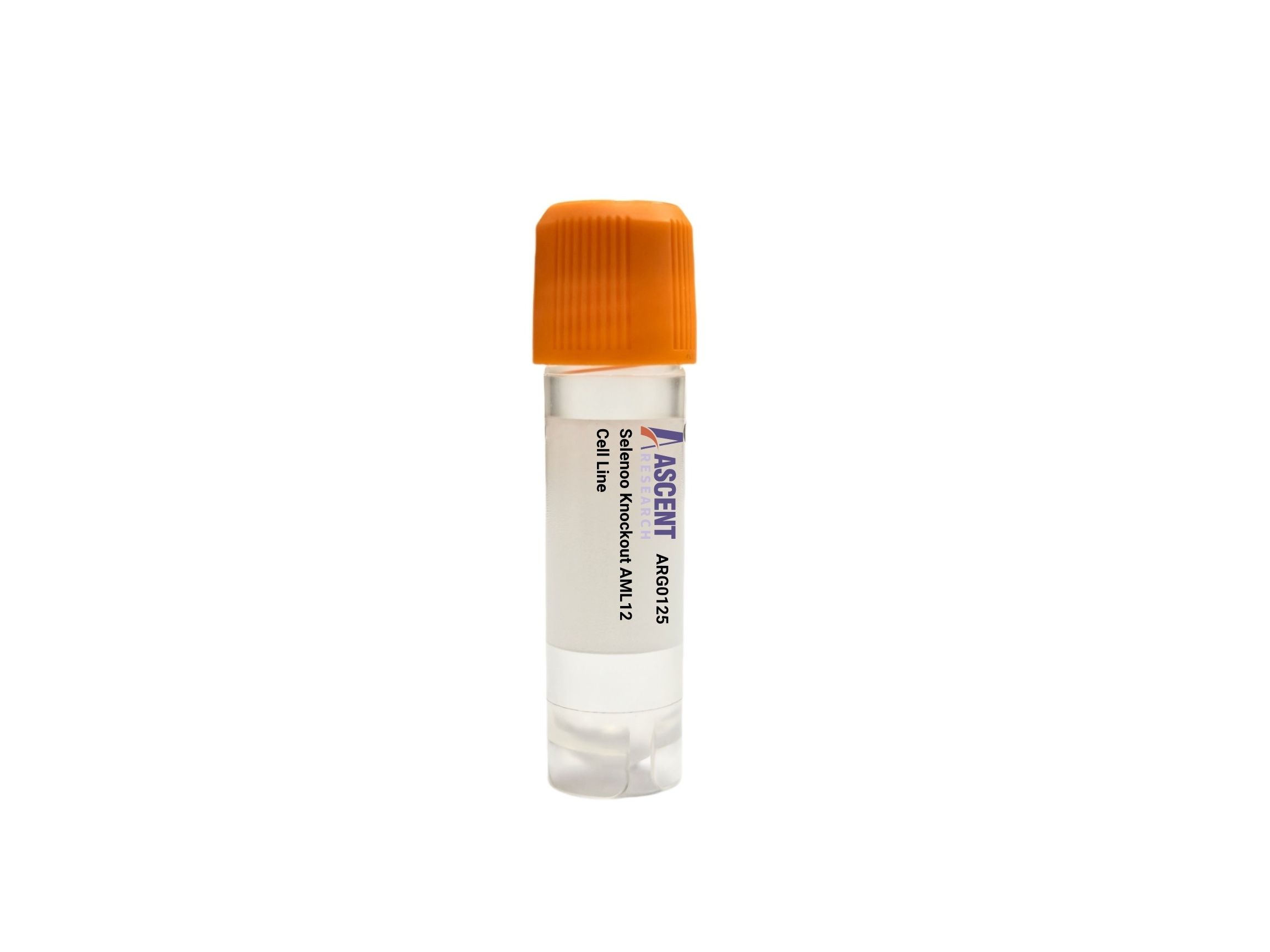
Genome-edited Cells
Liver
The Selenoo Knockout AML12 Cell Line is a CRISPR/Cas9-engineered mouse hepatocyte model with disruption of Selenoo in the nontransformed AML12 background. AML12 cells are widely used to study hepatic intermediary metabolism, lipid handling, oxidative stress, and mitochondrial signaling. SELENOO is a mitochondrial selenoprotein linked to redox homeostasis and protein AMPylation, functioning within pathways connected to selenium-dependent factors such as SECISBP2 and redox regulators including NRF2, GPX4, and TXNRD2. This knockout model supports studies of mitochondrial ROS control, ATP production, membrane potential, liver metabolic dysfunction, selenium biology, and oxidative stress using assays such as RNA-seq, Seahorse analysis, and mitochondrial ROS profiling.
 BTN2A1 Knockout NCI-H1975 Polyclonal Cells
Cat. No. ARG31376
AKIP1 Knockout A549 Polyclonal Cells
Cat. No. ARG31466
INPP5K Knockout HT29 Polyclonal Cells
Cat. No. ARG33459
HECTD3 Knockout Hela Polyclonal Cells
Cat. No. ARG37477
HSPB1 Knockout Hela Polyclonal Cells
Cat. No. ARG37416
BTN2A1 Knockout NCI-H1975 Polyclonal Cells
Cat. No. ARG31376
AKIP1 Knockout A549 Polyclonal Cells
Cat. No. ARG31466
INPP5K Knockout HT29 Polyclonal Cells
Cat. No. ARG33459
HECTD3 Knockout Hela Polyclonal Cells
Cat. No. ARG37477
HSPB1 Knockout Hela Polyclonal Cells
Cat. No. ARG37416
 Mouse Subcutaneous Microvascular Endothelial Cells
Cat. No. ARP0575
Mouse Subcutaneous Microvascular Endothelial Cells
Cat. No. ARP0575
The Selenoo Knockout AML12 Cell Line is a CRISPR/Cas9-engineered mouse hepatocyte model in which the Selenoo gene has been disrupted to eliminate functional gene expression. This stable knockout line is generated in AML12 cells, a nontransformed immortalized mouse hepatocyte cell line that preserves many features of liver parenchymal biology. The model is designed for studies requiring controlled loss of SELENOO function in a hepatocyte background relevant to mitochondrial redox regulation, metabolic signaling, and stress adaptation.
AML12 cells are widely used as an in vitro model of normal mouse hepatocytes because they support investigation of hepatic intermediary metabolism, lipid handling, detoxification pathways, and stress-response signaling without the extensive transformation-associated alterations present in many tumor-derived liver lines. Their utility spans glucose and lipid metabolism, oxidative stress, mitochondrial function, and hepatocellular signaling, making them particularly suitable for mechanistic studies of liver homeostasis and disease-associated metabolic remodeling. In this context, gene perturbation studies can be interpreted against a biologically relevant hepatocyte background linked to steatosis, insulin resistance, and oxidative liver injury.
SELENOO encodes a mitochondrial selenoprotein implicated in maintenance of mitochondrial redox homeostasis and ATP-dependent post-translational modification of mitochondrial proteins through AMPylation/transferase activity. Its expression and function are expected to be regulated by selenium availability, the selenocysteine incorporation machinery, and stress inputs including oxidative stress, mitochondrial stress, and the integrated stress response. Relevant pathway components include SECISBP2, EEFSEC, SEPSECS, PSTK, SEPHS2, and SCLY, which support selenoprotein biogenesis, as well as mitochondrial redox regulators such as GPX4, TXNRD2, SOD2, PRDX3, and the stress-responsive transcription factor NRF2. SELENOO interacts with mitochondrial protein substrates, redox-regulatory proteins, and mitochondrial chaperones, and acts upstream of measurable outputs including mitochondrial ROS levels, ATP production, mitochondrial membrane potential, antioxidant response gene expression, and broader stress-response signaling.
Loss of Selenoo in AML12 cells provides a focused system for analyzing how impaired mitochondrial redox buffering and altered mitochondrial protein regulation affect hepatocyte metabolic homeostasis. Because hepatocytes are highly dependent on mitochondrial oxidative metabolism and coordinated detoxification responses, this model is relevant for dissecting mechanisms linked to metabolic liver disease, hepatic steatosis, mitochondrial dysfunction, oxidative stress-related liver injury, and cardiometabolic phenotypes. The knockout background may also facilitate studies of pathway dependency under selenium modulation or oxidative challenge.
This cell line is suitable for integrated molecular and functional assays, including western blotting and RT-qPCR for pathway component expression, RNA-seq for transcriptional remodeling, mitochondrial ROS assays, cellular ATP quantification, mitochondrial membrane potential analysis, and Seahorse metabolic flux analysis to assess bioenergetic consequences of Selenoo loss. Additional applications include immunofluorescence to examine mitochondrial phenotypes, co-immunoprecipitation and mass spectrometry-based PTM analysis to investigate altered mitochondrial protein interactions or AMPylation-linked processes, and apoptosis or oxidative stress challenge assays to define stress sensitivity. These use cases support mechanistic studies in mitochondrial biology, hepatocyte redox regulation, selenium biology, and liver metabolism. Researchers may contact Ascent Research for additional technical information, product details, or related gene-edited cell models.