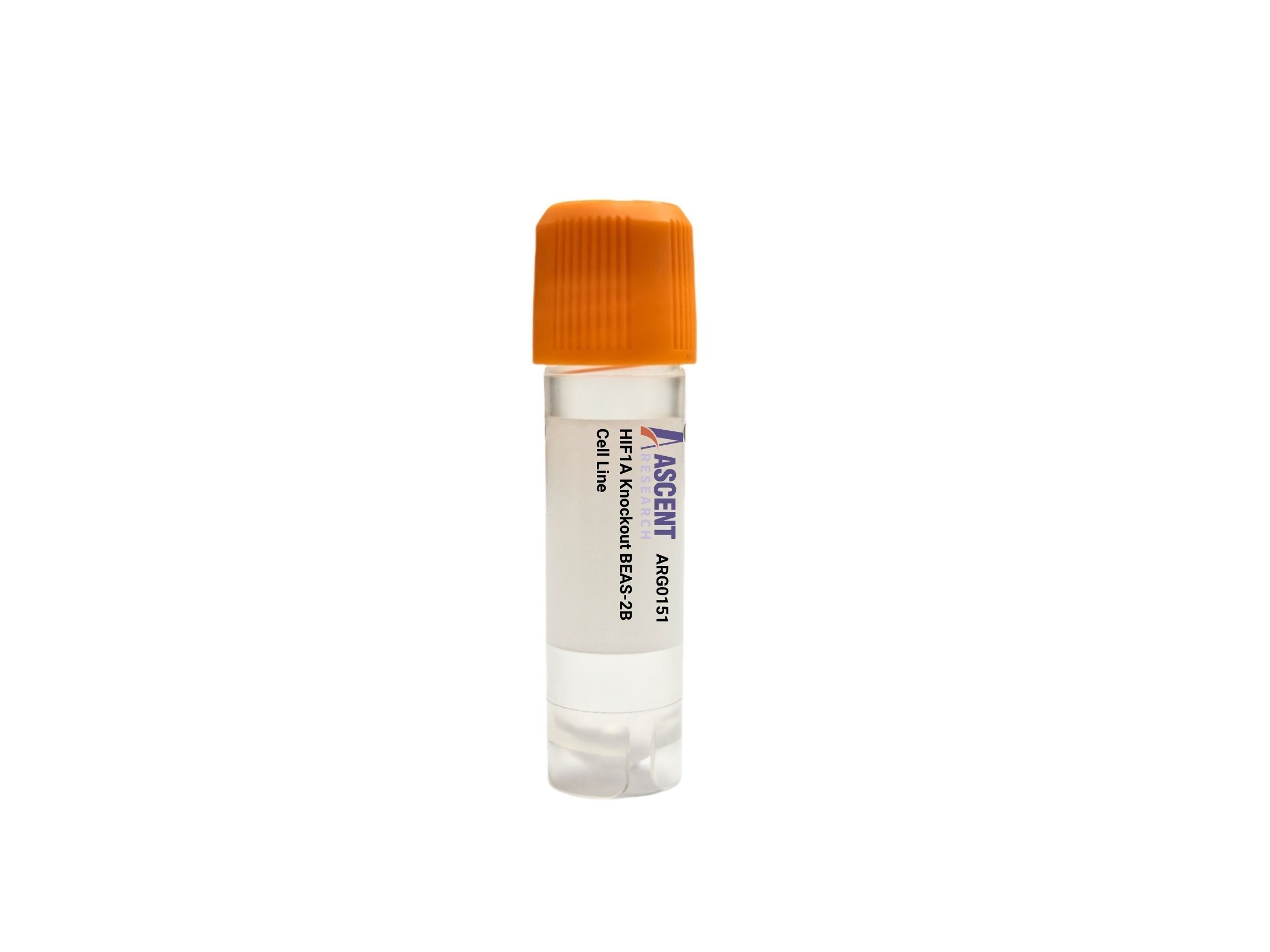
Genome-edited Cells
Lung (bronchus)
HIF1A Knockout BEAS-2B is a CRISPR/Cas9-edited human bronchial epithelial cell line with disruption of the oxygen-sensitive transcription factor HIF1A. In BEAS-2B airway barrier cells, HIF1A normally functions downstream of EGLN/PHD enzymes and VHL, forms a complex with ARNT/HIF1B under hypoxia, and promotes expression of targets including VEGFA, SLC2A1/GLUT1, LDHA, and CA9. This model is useful for studying hypoxia signaling, epithelial stress and inflammatory responses, metabolic reprogramming, pulmonary disease mechanisms, and target validation using RT-qPCR, western blotting, RNA-seq, HRE reporter assays, and metabolic or drug sensitivity assays.
 Tnfsf11 Knockout 4T1 Cell Line
Cat. No. ARG44173
Tnfsf11 Knockout 4T1 Cell Line
Cat. No. ARG44173
 EPHB3 Knockout HEK293 Polyclonal Cells
Cat. No. ARG12658
NTN1 Knockout SKOV3 Polyclonal Cells
Cat. No. ARG12412
MCEE Knockout MES-OV Polyclonal Cells
Cat. No. ARG6461
EPHA5 Knockout HEK293T Polyclonal Cells
Cat. No. ARG3986
EPHB3 Knockout HEK293 Polyclonal Cells
Cat. No. ARG12658
NTN1 Knockout SKOV3 Polyclonal Cells
Cat. No. ARG12412
MCEE Knockout MES-OV Polyclonal Cells
Cat. No. ARG6461
EPHA5 Knockout HEK293T Polyclonal Cells
Cat. No. ARG3986
 Rat Endothelial Progenitor Cell Medium
Cat. No. ARM0349
Rat Endothelial Progenitor Cell Medium
Cat. No. ARM0349
The HIF1A Knockout BEAS-2B Cell Line is a CRISPR/Cas9-engineered human bronchial epithelial cell model in which the HIF1A gene has been disrupted to eliminate functional HIF-1 alpha expression. This stable in vitro system is designed for investigation of hypoxia-responsive transcriptional control in airway epithelial cells. Because HIF1A is a central oxygen-sensitive regulatory factor, its deletion provides a defined genetic background for analyzing canonical and compensatory responses to low oxygen tension, inflammatory stimuli, and metabolic stress in a respiratory epithelial context.
BEAS-2B is an immortalized human bronchial epithelial cell line widely used to model airway epithelial biology, mucosal defense, xenobiotic response, oxidative stress, and pulmonary inflammatory signaling. As a barrier-forming airway epithelial model, BEAS-2B is relevant for studies of inhaled toxicants, environmental exposures, and epithelial adaptation to hypoxia and inflammation. The line is commonly applied in toxicology, lung disease research, and signal transduction studies because it captures important features of bronchial epithelial stress responses while remaining experimentally tractable for molecular perturbation, transcriptomic profiling, and pharmacologic interrogation.
HIF1A encodes the oxygen-labile subunit of the HIF-1 transcription factor complex. Under normoxia, HIF1A is regulated by EGLN1/PHD2, EGLN2/PHD1, and EGLN3/PHD3, which hydroxylate HIF1A and promote recognition by VHL, leading to proteasomal turnover. Under hypoxia, reduced prolyl hydroxylation stabilizes HIF1A, enabling complex formation with ARNT/HIF1B and recruitment of transcriptional cofactors such as EP300 and CREBBP. HIF1A activity is further influenced by HIF1AN/FIH1, MTOR, PI3K-AKT signaling, MAPK signaling, reactive oxygen species, TNF, and IL1B. Canonical downstream transcriptional targets include VEGFA, SLC2A1/GLUT1, LDHA, HK2, PDK1, CA9, BNIP3, EGLN3, PGK1, ENO1, and CXCL8, linking HIF1A to glycolysis, angiogenic signaling, survival pathways, oxidative stress adaptation, and inflammatory outputs relevant to lung cancer, COPD, asthma, pulmonary fibrosis, acute lung injury, and tumor hypoxia research.
In BEAS-2B cells, HIF1A loss is particularly informative because airway epithelial cells are continuously exposed to fluctuating oxygen availability, inflammatory mediators, and inhaled stressors. Disruption of HIF1A can therefore be used to define the extent to which epithelial metabolic reprogramming, hypoxia-induced gene expression, stress tolerance, and inflammatory crosstalk depend on the canonical HIF1A-ARNT axis. The model is suitable for distinguishing HIF1A-dependent effects from parallel signaling mediated by ROS, MTOR, PI3K-AKT, MAPK, or cytokine-driven pathways in bronchial epithelium.
This knockout cell line supports mechanistic studies using western blotting and immunofluorescence to assess HIF1A pathway proteins, RT-qPCR and RNA-seq to quantify changes in VEGFA, SLC2A1, LDHA, CA9, or CXCL8 expression, and ChIP-qPCR or HRE reporter assays to examine loss of hypoxia-responsive transcriptional activity. It is also applicable to co-immunoprecipitation studies of ARNT- or VHL-associated regulatory complexes, metabolic assays evaluating glycolytic adaptation, flow cytometry and apoptosis assays under hypoxic or inflammatory stress, and drug sensitivity studies involving hypoxia-modulating agents or pulmonary toxicant exposure. Researchers may contact Ascent Research for additional technical information, product details, or related gene-edited cell models.