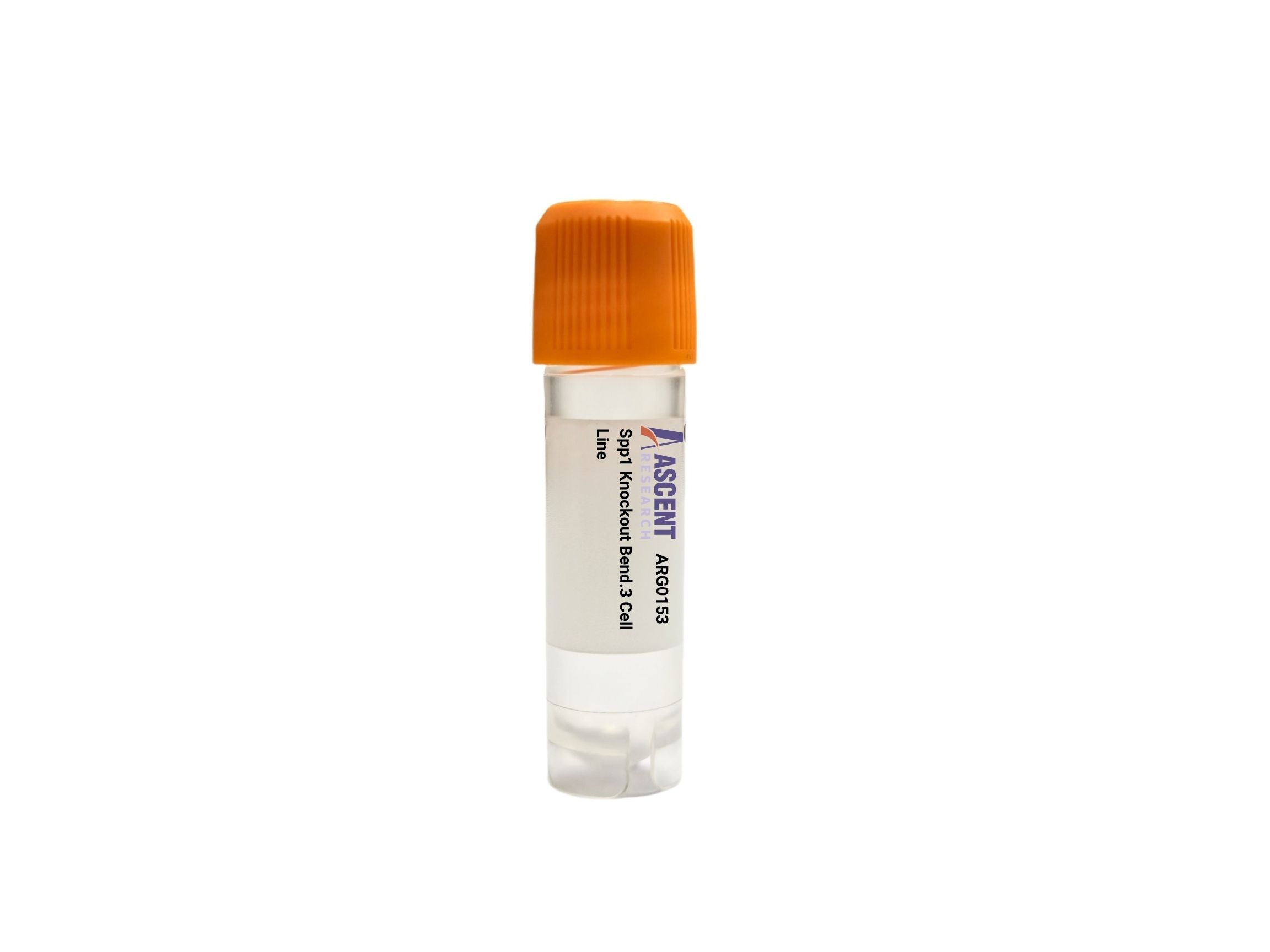
Genome-edited Cells
The Spp1 Knockout Bend.3 Cell Line is a CRISPR/Cas9-edited mouse brain microvascular endothelial model with disruption of Spp1, which encodes the secreted matricellular ligand osteopontin. In Bend.3 cells, SPP1 normally interacts with CD44 and integrins such as ITGAV/ITGB3 and ITGB1 to promote FAK/SRC, PI3K-AKT, MAPK/ERK, and inflammatory signaling linked to endothelial adhesion, migration, survival, and vascular remodeling. This knockout model is useful for studies of neurovascular inflammation, angiogenesis, leukocyte-endothelial interactions, hypoxia responses, and ECM signaling using assays including phospho-signaling analysis, ELISA, RT-qPCR, migration, adhesion, and barrier integrity testing.
 COMMD10 Knockout jurkat Polyclonal Cells
Cat. No. ARG13202
IL13RA1 Knockout Hela Polyclonal Cells
Cat. No. ARG26241
ATP11B Knockout SK-HEP-1 Polyclonal Cells
Cat. No. ARG32306
HACL1 Knockout HAP1 Polyclonal Cells
Cat. No. ARG36994
ECHDC1 Knockout AGS Polyclonal Cells
Cat. No. ARG40338
OSBPL8 Knockout MES-OV Polyclonal Cells
Cat. No. ARG6733
COMMD10 Knockout jurkat Polyclonal Cells
Cat. No. ARG13202
IL13RA1 Knockout Hela Polyclonal Cells
Cat. No. ARG26241
ATP11B Knockout SK-HEP-1 Polyclonal Cells
Cat. No. ARG32306
HACL1 Knockout HAP1 Polyclonal Cells
Cat. No. ARG36994
ECHDC1 Knockout AGS Polyclonal Cells
Cat. No. ARG40338
OSBPL8 Knockout MES-OV Polyclonal Cells
Cat. No. ARG6733
The Spp1 Knockout Bend.3 Cell Line is a CRISPR/Cas9-engineered murine endothelial model in which the Spp1 gene has been disrupted to eliminate functional osteopontin expression. This stable in vitro knockout line is generated in Bend.3 cells, an immortalized mouse brain microvascular endothelial cell line, and is designed for mechanistic studies of endothelial signaling, extracellular matrix communication, inflammatory activation, and vascular remodeling. As SPP1 is a secreted matricellular phosphoprotein with cytokine-like adhesive functions, its genetic ablation provides a defined system for examining loss-of-function effects on endothelial behavior in a central nervous system-relevant vascular background.
Bend.3 cells are widely used as a brain-derived microvascular endothelial model for investigating angiogenesis, leukocyte-endothelial interactions, and blood-brain barrier-associated signaling processes. As a CNS endothelial cell line, Bend.3 captures biological features relevant to neurovascular inflammation, adhesive regulation, and barrier-associated responses. This host context is particularly useful for studying molecular programs that couple endothelial activation to migration, matrix remodeling, and inflammatory gene expression, making it applicable to research in stroke, neuroinflammation, experimental autoimmune encephalomyelitis, tumor angiogenesis, and vascular injury.
SPP1/osteopontin functions as a secreted ECM-associated ligand that interacts with CD44 and multiple integrins, including ITGAV/ITGB3 and ITGA5/ITGB1, to mediate signaling downstream of cell-matrix engagement. Spp1 is regulated by inflammatory and stress-associated inputs such as TNF-alpha, IL-1beta, TGF-beta1, hypoxia, HIF-1alpha, NF-kB, SP1, RUNX2, oxidative stress, and VEGFA. In endothelial systems, SPP1 acts upstream of PTK2/FAK and SRC activation and promotes signaling through PI3K-AKT and MAPK1/3-ERK pathways, with downstream consequences for survival, motility, and inflammatory transcriptional responses. Its signaling network is linked to expression or regulation of MMP2, MMP9, VCAM1, ICAM1, and CCL2, connecting SPP1 to extracellular matrix organization, leukocyte adhesion, cytokine responses, and angiogenic remodeling.
In the Bend.3 background, Spp1 knockout is a relevant model for interrogating how loss of an endothelial adhesion ligand alters CNS microvascular phenotypes. The model supports analysis of pathway dependency in integrin-FAK-SRC signaling, inflammatory activation downstream of NF-kB, and adaptive responses to hypoxia or cytokine stimulation. It is also suitable for examining how osteopontin deficiency influences endothelial migration, adhesive interactions, and survival programs that contribute to vascular inflammation and tissue remodeling.
This cell line can be applied in western blot or phospho-signaling workflows to assess PTK2/FAK, AKT1, SRC, and ERK1/2 activation; in RT-qPCR, RNA-seq, ELISA, and immunofluorescence studies to quantify SPP1-associated inflammatory and matrix-remodeling programs; and in flow cytometry assays for VCAM1 and ICAM1 to examine endothelial activation states. Functional use cases include leukocyte adhesion or transmigration studies, adhesion and migration assays, tube formation assays, co-immunoprecipitation of integrin- or CD44-associated complexes, and barrier integrity experiments under basal conditions or after stimulation with TNF-alpha, IL-1beta, TGF-beta1, VEGFA, or hypoxia-mimetic paradigms. Researchers may contact Ascent Research for additional technical information, product details, or related gene-edited cell models.