Genome-edited Cells
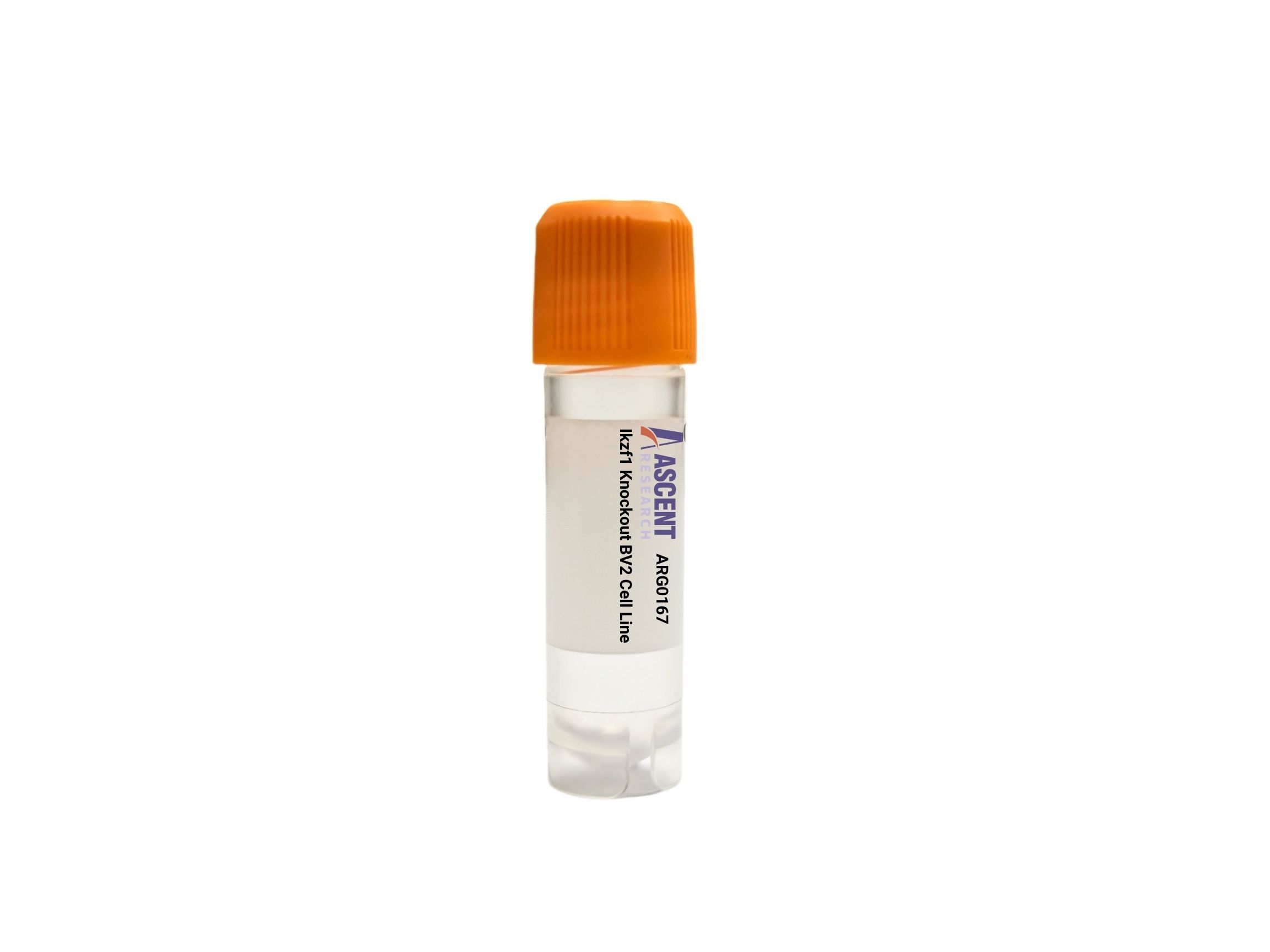
Ikzf1 Knockout BV2 is a CRISPR/Cas9-edited mouse microglial cell line with disruption of Ikzf1, encoding the chromatin-associated transcription factor Ikaros. In the BV2 microglia-like background, this model supports investigation of transcriptional and epigenetic regulation of innate immune activation, including responses downstream of TLR4, MYD88, STAT1, and RELA. IKZF1 normally regulates inflammatory and interferon-responsive genes such as Il6, Tnf, Il1b, Ccl2, and Cxcl10 through interactions with factors including HDAC1/2 and the NuRD complex. Suitable applications include neuroinflammation research, cytokine profiling, RNA-seq, ChIP-based studies, phagocytosis assays, and CRISPR loss-of-function analysis.
 CSNK1G1 Knockout A2780 Polyclonal Cells
Cat. No. ARG18305
ERGIC1 Knockout K562 Polyclonal Cells
Cat. No. ARG19454
ATG101 Knockout HEK293T Polyclonal Cells
Cat. No. ARG25773
ATXN1 Knockout Hela Polyclonal Cells
Cat. No. ARG37350
FMR1 Knockout PATU8988T Polyclonal Cells
Cat. No. ARG11359
LRRFIP1 Knockout Raji Polyclonal Cells
Cat. No. ARG1583
CSNK1G1 Knockout A2780 Polyclonal Cells
Cat. No. ARG18305
ERGIC1 Knockout K562 Polyclonal Cells
Cat. No. ARG19454
ATG101 Knockout HEK293T Polyclonal Cells
Cat. No. ARG25773
ATXN1 Knockout Hela Polyclonal Cells
Cat. No. ARG37350
FMR1 Knockout PATU8988T Polyclonal Cells
Cat. No. ARG11359
LRRFIP1 Knockout Raji Polyclonal Cells
Cat. No. ARG1583
The Ikzf1 Knockout BV2 Cell Line is a CRISPR/Cas9-engineered mouse microglial model in which the Ikzf1 gene has been disrupted to abolish functional IKZF1 expression. This gene-edited derivative of the BV2 host line provides a stable in vitro system for examining the consequences of IKZF1 loss in innate immune cells of central nervous system lineage. As IKZF1 encodes the zinc-finger transcription factor Ikaros, this knockout model is suited for studies of transcriptional control, chromatin-associated regulation, and inflammatory signal integration in microglia-like cells.
BV2 is an immortalized murine microglia-like cell line widely used as an experimental surrogate for central nervous system resident innate immune cells. The line is commonly applied to investigations of immune surveillance, phagocytosis, neuroinflammatory signaling, and neuron-glia communication under controlled in vitro conditions. Because BV2 cells respond to inflammatory stimulation and support analysis of cytokine production, activation state transitions, and stimulus-dependent transcriptional remodeling, they are a practical model for studying mechanisms relevant to neuroinflammation, multiple sclerosis, Alzheimer??s disease, and other CNS inflammatory disorders.
IKZF1 functions as a sequence-specific DNA-binding factor that regulates chromatin organization and transcriptional programs controlling immune cell differentiation and inflammatory gene expression. Mechanistically, IKZF1 interacts with chromatin regulatory and corepressor factors including HDAC1, HDAC2, SIN3A, the NuRD complex, CHD4, and CTBP1, and operates within broader transcriptional networks that include RUNX1, SPI1, GATA factors, IRF1, STAT1, and RELA. In stimulus-responsive immune contexts, IKZF1-mediated transcription is regulated downstream of TLR4 activation by LPS and by inflammatory cytokines such as IFN-gamma, with contributions from JAK-STAT, MAPK, and PI3K-AKT signaling. These pathways converge with MYD88-, TRIF-, and MAPK14-associated signaling to influence expression of downstream targets including Il6, Tnf, Il1b, Ccl2, Cxcl10, interferon-stimulated genes, and antigen presentation programs. Dysregulation of IKZF1 has established relevance to acute lymphoblastic leukemia and immunodeficiency, while its function in inflammatory transcription makes it pertinent to neuroinflammatory research.
Within the BV2 background, Ikzf1 disruption offers a defined system to investigate how loss of a chromatin-associated transcription factor reshapes microglial stimulus responses. This model can support mechanistic analysis of basal versus activated inflammatory states, altered Toll-like receptor responsiveness, changes in cytokine output, and rewiring of interferon- and NF-kB-linked transcriptional programs. It is also useful for evaluating how epigenetic regulatory dependencies influence microglial behavior under inflammatory challenge.
This knockout cell line can be applied in western blotting and RT-qPCR workflows to assess loss of IKZF1-related regulatory effects on Il6, Tnf, Il1b, Ccl2, or Cxcl10 expression after LPS or IFN-gamma stimulation. RNA-seq enables global profiling of transcriptional and interferon-responsive programs, while ChIP-qPCR or ChIP-seq can be used to examine changes in chromatin occupancy or chromatin-associated regulatory states involving IKZF1-linked networks and cofactors such as HDAC1/2 or CHD4. ELISA, cytokine secretion assays, and flow cytometry support quantitative characterization of inflammatory outputs and activation markers, whereas immunofluorescence and phagocytosis assays allow correlation of gene regulatory changes with microglial phenotype and function. Co-immunoprecipitation and phospho-signaling analyses may further assist studies of pathway connectivity downstream of TLR4, JAK-STAT, or MAPK signaling. Researchers may contact Ascent Research for additional technical information, product details, or related gene-edited cell models.