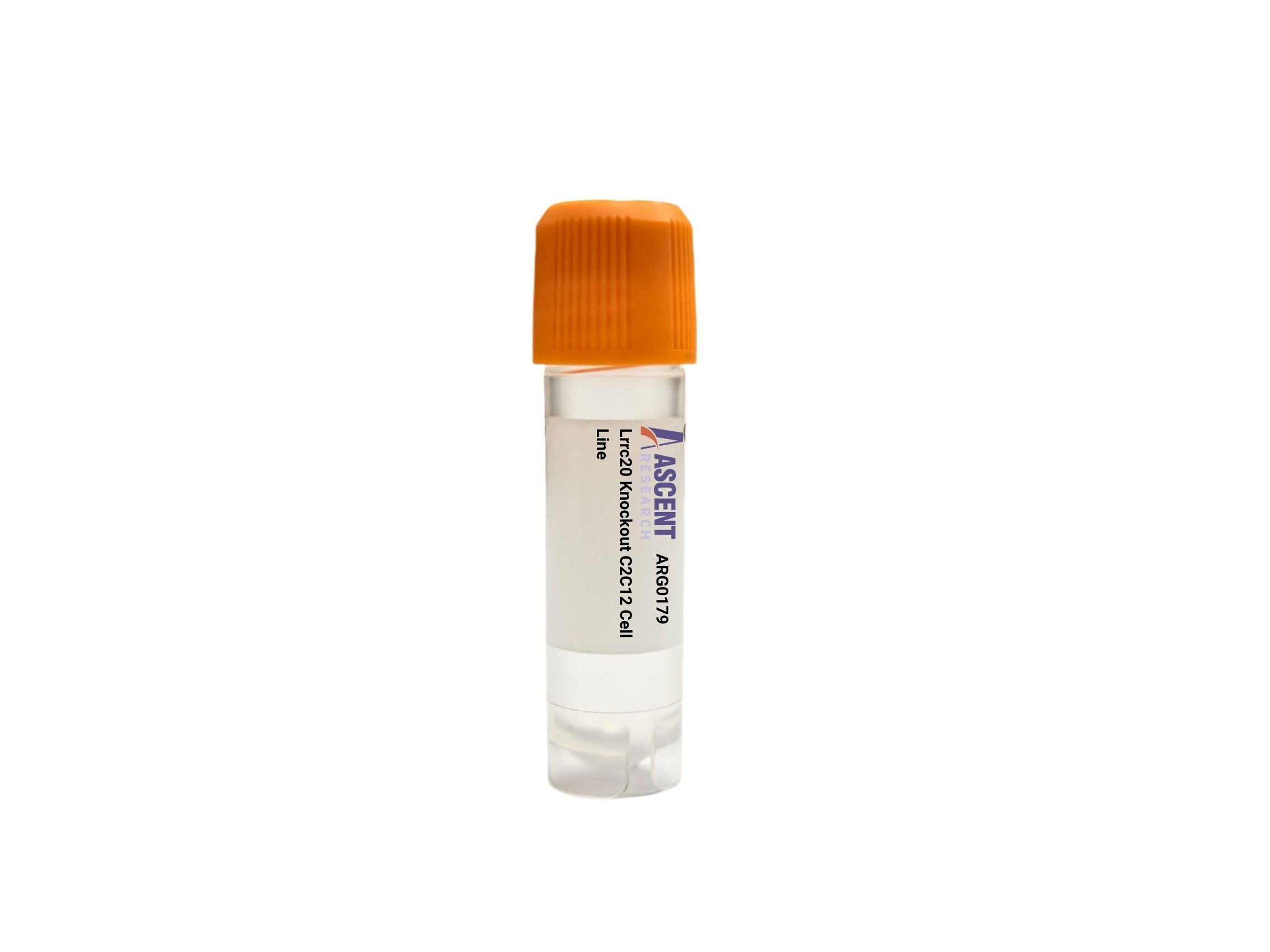
Genome-edited Cells
Lrrc20 Knockout C2C12 is a CRISPR/Cas9-engineered mouse myoblast cell line with disruption of the endogenous Lrrc20 gene in the widely used C2C12 skeletal muscle precursor background. LRRC20 is a poorly characterized leucine-rich repeat-containing protein likely involved in protein-protein interaction networks linked to myogenesis. In C2C12 cells, Lrrc20 can be studied in the context of differentiation cues regulated by MYOD1, MYOG, and MEF2C, with downstream readouts including MYH1, ACTA1, CKM, and DES expression, myotube morphology, and fusion. The model supports myogenic differentiation studies, transcriptomic profiling, proliferation assays, immunofluorescence, and proteomic interaction discovery.
 CAPN1 Knockout HCT116 Polyclonal Cells
Cat. No. ARG28748
CLCA2 Knockout Hela Polyclonal Cells
Cat. No. ARG8518
HRH1 Knockout MCF7 Polyclonal Cells
Cat. No. ARG36442
EDEM2 Knockout HT29 Polyclonal Cells
Cat. No. ARG40452
Dcaf11 Knockout RAW 264.7 Polyclonal Cells
Cat. No. ARG40222
DAZAP1 Knockout MES-OV Polyclonal Cells
Cat. No. ARG6810
CAPN1 Knockout HCT116 Polyclonal Cells
Cat. No. ARG28748
CLCA2 Knockout Hela Polyclonal Cells
Cat. No. ARG8518
HRH1 Knockout MCF7 Polyclonal Cells
Cat. No. ARG36442
EDEM2 Knockout HT29 Polyclonal Cells
Cat. No. ARG40452
Dcaf11 Knockout RAW 264.7 Polyclonal Cells
Cat. No. ARG40222
DAZAP1 Knockout MES-OV Polyclonal Cells
Cat. No. ARG6810
The Lrrc20 Knockout C2C12 Cell Line is a CRISPR/Cas9-engineered mouse myoblast model in which the endogenous Lrrc20 gene has been disrupted to eliminate functional gene expression. This stable in vitro system enables controlled investigation of LRRC20 loss-of-function in a skeletal muscle precursor background. Because C2C12 cells proliferate as myoblasts and can be induced to differentiate into multinucleated myotubes, the model is well suited for studying gene-dependent effects across distinct stages of myogenic progression.
C2C12 is a murine immortalized myoblast line originally derived from satellite cells and is widely used as a benchmark system for skeletal muscle biology. Under growth conditions, these cells support studies of proliferation and cell-cycle behavior, whereas serum withdrawal induces a robust differentiation program that recapitulates key features of myogenesis. Accordingly, C2C12 cells are broadly applied to research on muscle differentiation, contractile gene regulation, metabolic remodeling, atrophy-associated responses, and regenerative biology. Their extensive characterization makes them a useful platform for dissecting molecular determinants of skeletal muscle development and for comparing transcriptional and phenotypic consequences of targeted gene perturbation.
LRRC20 is a leucine-rich repeat-containing protein with limited functional characterization. Based on the established properties of leucine-rich repeat proteins, LRRC20 is most appropriately considered a candidate mediator of protein-protein interactions and a potential scaffolding or regulatory factor within differentiation-associated complexes. In muscle cells, Lrrc20 is expected to be examined in the context of myogenic differentiation cues, including serum withdrawal, and transcriptional programs regulated by MYOD1, MYOG, and MEF2 family members such as MEF2C. Downstream consequences of Lrrc20 disruption are not definitively established, but may be assessed through effects on myogenic marker expression and differentiation-linked transcriptional outputs, including representative components such as MYH1, ACTA1, CKM, and DES, as well as morphological changes accompanying myotube formation. Potential interacting factors are not well defined and are most appropriately investigated experimentally, including by proteomic discovery approaches.
Within the C2C12 background, Lrrc20 knockout provides a relevant system for determining whether LRRC20 functions upstream of, downstream of, or in parallel with canonical myogenic regulators. This context is particularly useful for evaluating how loss of LRRC20 influences myoblast proliferation, differentiation efficiency, fusion competence, and expression of muscle-specific gene programs relevant to skeletal muscle development disorders, myopathy research, regeneration studies, and sarcopenia-related biology.
This cell line can be applied in genotype-to-phenotype workflows that combine CRISPR genotype confirmation with differentiation time-course studies, RT-qPCR analysis of MYOD1, MYOG, MYH1, ACTA1, CKM, or DES, western blotting of muscle markers, and immunofluorescence staining for myosin heavy chain to quantify myotube formation. Additional use cases include proliferation assays, fusion index measurements, RNA-seq-based profiling of transcriptional changes after Lrrc20 loss, and co-immunoprecipitation or broader proteomic analysis to identify candidate LRRC20-associated complexes in myoblasts or differentiating myotubes. Researchers may contact Ascent Research for additional technical information, product details, or related gene-edited cell models.