Genome-edited Cells
Large intestine (colon)
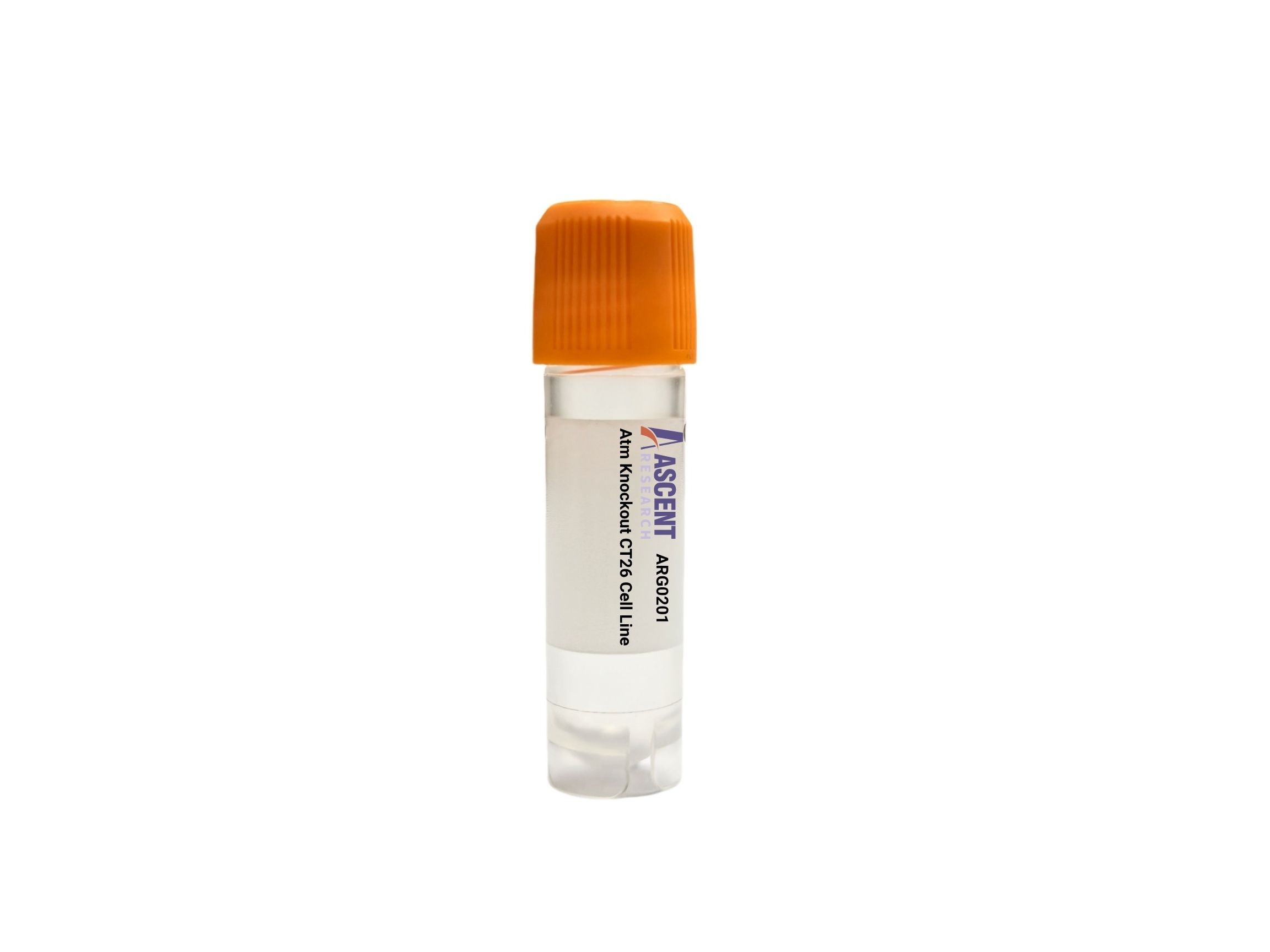
Atm Knockout CT26 is a CRISPR/Cas9-edited mouse colon carcinoma cell line with disruption of the Atm gene in the widely used BALB/c-derived CT26 syngeneic colorectal tumor model. ATM functions downstream of DNA double-strand breaks and the MRN complex (MRE11-RAD50-NBN) to phosphorylate targets including CHEK2, TP53, H2AX, and TRIM28, coordinating checkpoint signaling and DNA repair. This model supports studies of DNA damage response, genomic instability, radiosensitivity, PARP or ATR inhibitor response, colorectal cancer biology, and tumor-intrinsic effects relevant to immuno-oncology using assays such as phospho-signaling, ??H2AX/53BP1 imaging, cell-cycle analysis, and clonogenic survival.
 HK1 Knockout 786-O Polyclonal Cells
Cat. No. ARG25260
DNPH1 Knockout NCI-H1703 Polyclonal Cells
Cat. No. ARG39503
MAP3K21 Knockout THP-1 Polyclonal Cells
Cat. No. ARG7354
NACC1 Knockout HEK293T Polyclonal Cells
Cat. No. ARG3803
CRTAP Knockout AGS Polyclonal Cells
Cat. No. ARG2304
FAM8A1 Knockout Raji Polyclonal Cells
Cat. No. ARG1468
HK1 Knockout 786-O Polyclonal Cells
Cat. No. ARG25260
DNPH1 Knockout NCI-H1703 Polyclonal Cells
Cat. No. ARG39503
MAP3K21 Knockout THP-1 Polyclonal Cells
Cat. No. ARG7354
NACC1 Knockout HEK293T Polyclonal Cells
Cat. No. ARG3803
CRTAP Knockout AGS Polyclonal Cells
Cat. No. ARG2304
FAM8A1 Knockout Raji Polyclonal Cells
Cat. No. ARG1468
The Atm Knockout CT26 Cell Line is a CRISPR/Cas9-engineered murine colorectal cancer model in which the Atm gene has been disrupted to eliminate functional ATM expression. This stable knockout cell line is generated in CT26, a mouse colon carcinoma cell line with epithelial-like tumor characteristics, providing an in vitro system for analysis of ATM-dependent signaling in malignant intestinal cells. The model is intended for mechanistic studies of DNA damage signaling, checkpoint regulation, genome maintenance, and therapeutic response under defined experimental conditions.
CT26 is derived from BALB/c mouse colon carcinoma and is widely used as a syngeneic colorectal tumor model in cancer biology and immuno-oncology. Because CT26 cells are frequently employed in studies of tumor growth, treatment response, and antitumor immunity, they offer a relevant host background for evaluating how disruption of DNA damage response genes alters cancer cell behavior. In addition to its utility in in vitro molecular assays, CT26 is commonly used in translational workflows examining genotoxic stress responses, tumor-intrinsic signaling, and interactions between therapeutic perturbation and immune-competent host settings.
ATM is a serine/threonine kinase activated by DNA double-strand breaks and related chromatin lesions through the MRN complex, composed of MRE11, RAD50, and NBN. Following activation, ATM phosphorylates multiple substrates, including CHEK2, TP53, H2AX, and TRIM28/KAP1, thereby coordinating checkpoint activation, chromatin damage signaling, and DNA repair. ATM also functions within signaling networks involving MDC1, RNF8, RNF168, TP53BP1, and BRCA1, linking lesion recognition to repair pathway choice, homologous recombination, non-homologous end joining, and replication stress responses. Loss of ATM disrupts canonical double-strand break signaling and is highly relevant to research on ataxia-telangiectasia, radiation response, genomic instability syndromes, colorectal cancer, and DNA repair-deficient malignancy.
In the CT26 background, Atm deletion provides a practical system for investigating how impaired DNA damage checkpoint control reshapes colorectal tumor cell responses to ionizing radiation, oxidative stress, replication-associated damage, and chromatin injury. This context is particularly useful for studying altered TP53- and CHEK2-associated signaling outputs, defective cell-cycle arrest, apoptosis regulation, and dependencies on compensatory DNA repair pathways. The model can also support investigation of how ATM loss influences tumor cell intrinsic features relevant to syngeneic immunology and treatment sensitivity.
This knockout cell line is suitable for western blotting and phospho-signaling analysis of ATM pathway nodes, including damage-induced CHEK2, TP53, H2AX, or TRIM28 responses. Researchers may use immunofluorescence to quantify ??H2AX and 53BP1 foci, flow cytometry to assess checkpoint defects and cell-cycle redistribution, and apoptosis assays or clonogenic survival assays to measure radiosensitivity and genotoxic drug response. Additional applications include comet assay-based analysis of DNA break accumulation, RT-qPCR or RNA-seq profiling of stress-response programs, DNA repair reporter assays for pathway utilization, and pharmacologic studies involving PARP inhibitors, ATR inhibitor combinations, or irradiation-based treatment paradigms. Researchers may contact Ascent Research for additional technical information, product details, or related gene-edited cell models.