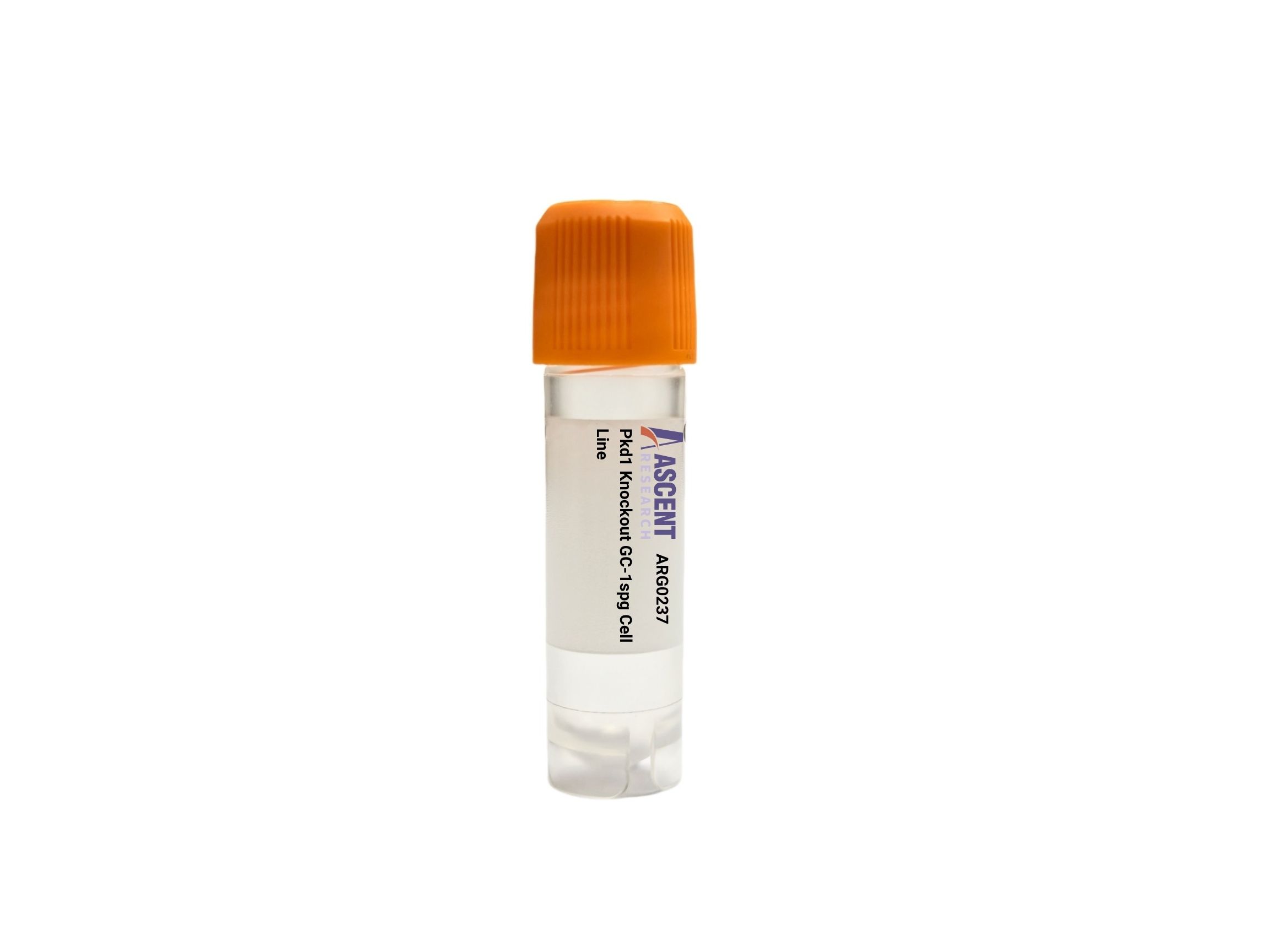
Genome-edited Cells
The Pkd1 Knockout GC-1spg Cell Line is a CRISPR/Cas9-edited knockout cell line derived from mouse spermatogonial cells (GC-1spg). It eliminates polycystin-1, a mechanosensory receptor that complexes with polycystin-2 to control calcium, cAMP, and mTOR signaling, impacting pathways mediated by G proteins, ERK, and transcription factors such as STAT3 and CREB. This model is valuable for studying polycystic kidney disease, ciliopathies, and male fertility defects. It enables investigations into mechanotransduction, spermatogenesis, and cilia biology, using assays like immunofluorescence for cilia markers, calcium imaging, and mTOR activity measurement.
 GET4 Knockout K562 Polyclonal Cells
Cat. No. ARG19221
EIF5A2 Knockout MES-OV Polyclonal Cells
Cat. No. ARG41088
FOXJ3 Knockout HEK293T Polyclonal Cells
Cat. No. ARG3347
LHFPL2 Knockout Raji Polyclonal Cells
Cat. No. ARG1357
GET4 Knockout K562 Polyclonal Cells
Cat. No. ARG19221
EIF5A2 Knockout MES-OV Polyclonal Cells
Cat. No. ARG41088
FOXJ3 Knockout HEK293T Polyclonal Cells
Cat. No. ARG3347
LHFPL2 Knockout Raji Polyclonal Cells
Cat. No. ARG1357
 Mouse Gastric Smooth Muscle Cells
Cat. No. ARP0464
Mouse Gastric Smooth Muscle Cells
Cat. No. ARP0464
 Prmt3 Knockout 3LL Cell Line
Cat. No. ARG0020
Prmt3 Knockout 3LL Cell Line
Cat. No. ARG0020
The Pkd1 Knockout GC-1spg Cell Line is a CRISPR/Cas9-edited knockout cell line derived from mouse GC-1spg spermatogonial cells. It features targeted disruption of Pkd1, encoding polycystin-1 (PC1). This loss-of-function model enables dissection of PC1 signaling in male germ cells. Supplied as a stable cell line, it ensures consistent experimental outcomes without recurrent transfection or selection.
GC-1spg cells originate from murine spermatogonial cells of the male germ cell lineage, crucial for spermatogenesis. They retain features of spermatogonial stem/progenitor cells, supporting proliferation and differentiation in vitro. Importantly, these cells express primary cilia, making them apt for investigating cilia-dependent pathways in germ cell development.
Polycystin-1 acts as a mechanosensor and signaling receptor, complexing with polycystin-2 (PKD2) at cilia and the plasma membrane. It is activated by fluid shear stress and extracellular matrix interactions, regulating intracellular calcium via G proteins and TRPC1. Downstream, PC1 orchestrates mTORC1, cAMP/PKA, and ERK cascades, influencing STAT3, CREB, TAZ/YAP, and NFAT. It interacts with E-cadherin, focal adhesion kinase, ??-catenin, and tuberin, governing cell adhesion, polarity, and proliferation. Loss of PC1 is linked to cystogenesis and ciliopathies.
In GC-1spg spermatogonial cells, Pkd1 knockout disrupts pathways critical for germ cell homeostasis. PC1-mediated mechanotransduction and mTOR modulation are essential for spermatogonial stem cell maintenance and differentiation. Loss of PC1 may impair cilia function, calcium signaling, and mTORC1 activity, leading to defective proliferation or apoptosis, and thereby male infertility. This model provides a platform to study how polycystin signaling integrates mechanical and chemical cues in testicular biology.
The knockout cell line is applicable for autosomal dominant polycystic kidney disease modeling, cilia biology, spermatogenesis research, and mechanotransduction studies. It supports drug screening targeting mTOR, cAMP, or calcium pathways, and male fertility investigations. Key assays include Western blotting for PC1, RT-qPCR for downstream targets, immunofluorescence for cilia markers (acetylated tubulin, Arl13b), calcium imaging, mTOR activity assays (phospho-S6), co-immunoprecipitation with PC2, and migration assays. For further information, contact Ascent Research.