Genome-edited Cells
Stomach
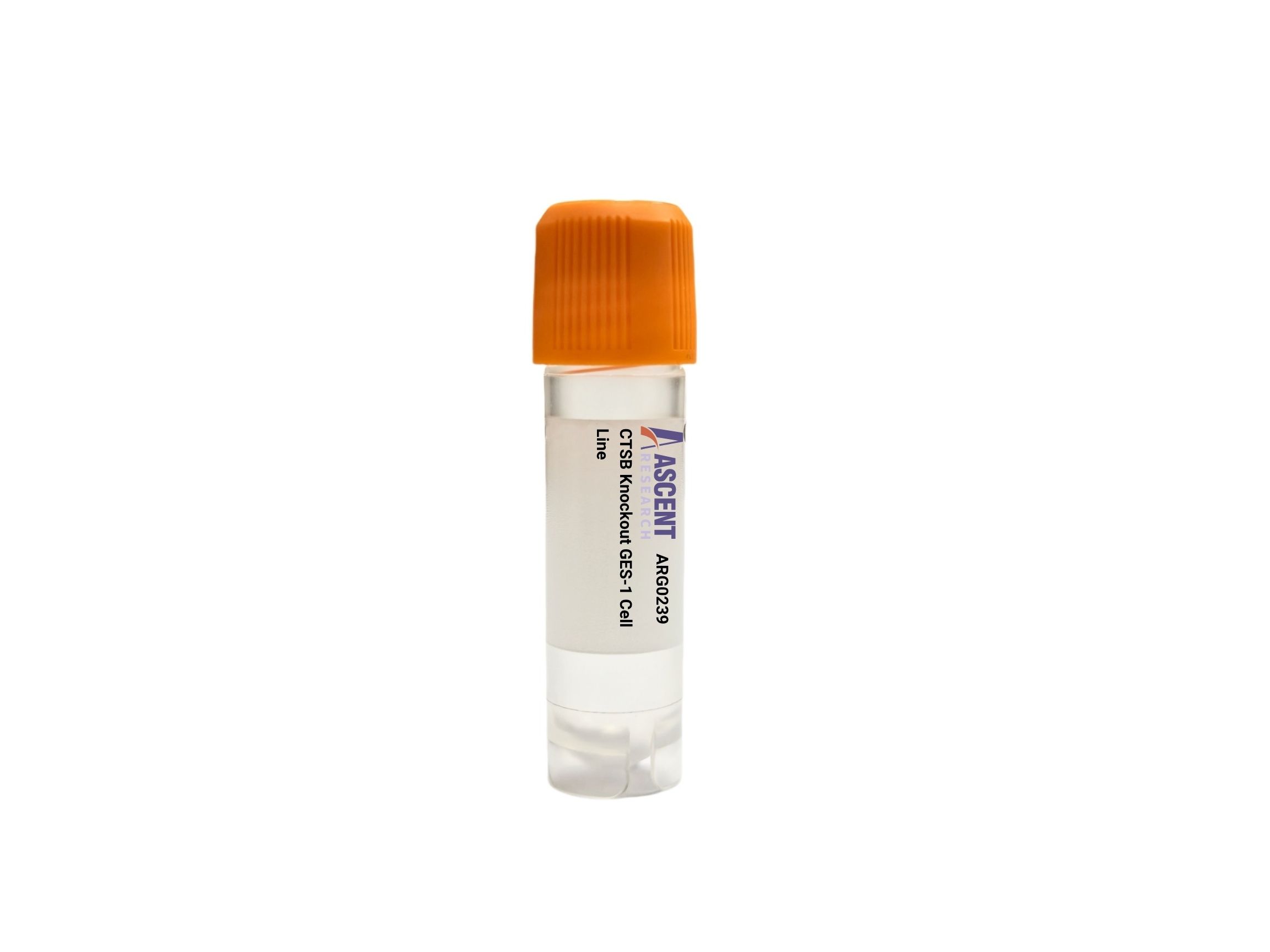
The CTSB Knockout GES-1 Cell Line is a CRISPR/Cas9-edited knockout cell line derived from immortalized human gastric epithelial GES-1 cells, harboring a targeted disruption of the CTSB gene that eliminates cathepsin B protease activity. Loss of cathepsin B impairs lysosomal proteolysis and autophagy flux, attenuating extracellular matrix degradation and inflammatory signaling. This model is valuable for studying gastric cancer progression, Helicobacter pylori infection, and autophagy mechanisms in a physiologically relevant epithelial context. Key molecular interactions include CTSB regulation by TNF-alpha and IL-1beta, its downstream effects on collagen degradation and NLRP3 inflammasome activation, and its interplay with autophagy markers LC3 and p62. Applications encompass western blotting, cathepsin B activity assays, migration assays, and drug response screens.
 CSPP1 Knockout SK-HEP-1 Polyclonal Cells
Cat. No. ARG16050
MDH1 Knockout Hela Polyclonal Cells
Cat. No. ARG9098
LEO1 Knockout Hela Polyclonal Cells
Cat. No. ARG8015
GSTK1 Knockout HT29 Polyclonal Cells
Cat. No. ARG33301
CCDC152 Knockout Hela Polyclonal Cells
Cat. No. ARG42967
CSPP1 Knockout SK-HEP-1 Polyclonal Cells
Cat. No. ARG16050
MDH1 Knockout Hela Polyclonal Cells
Cat. No. ARG9098
LEO1 Knockout Hela Polyclonal Cells
Cat. No. ARG8015
GSTK1 Knockout HT29 Polyclonal Cells
Cat. No. ARG33301
CCDC152 Knockout Hela Polyclonal Cells
Cat. No. ARG42967
 Rat Spinal Cord Fibroblast Medium
Cat. No. ARM0379
Rat Spinal Cord Fibroblast Medium
Cat. No. ARM0379
The CTSB Knockout GES-1 Cell Line is a CRISPR/Cas9-edited knockout cell line derived from the immortalized human gastric epithelial cell line GES-1. This product features CRISPR/Cas9-mediated disruption of the CTSB gene, which encodes the lysosomal cysteine protease cathepsin B, resulting in loss of cathepsin B protein expression and enzymatic activity. This knockout cell line provides a defined loss-of-function model to investigate cathepsin B-dependent processes in a gastric epithelial context.
The parental GES-1 cell line is an immortalized, non-tumorigenic human gastric epithelial cell model that retains normal epithelial morphology and functional characteristics. Established from fetal gastric mucosa, GES-1 cells are extensively utilized in gastric biology research, including studies of mucosal barrier function, Helicobacter pylori pathogenesis, and early gastric cancer development. Their epithelial nature and genetic stability make them an ideal platform for examining the roles of lysosomal enzymes in gastric cell physiology.
Cathepsin B (encoded by CTSB) is a multifunctional lysosomal cysteine protease with critical roles in intracellular protein turnover, autophagy, extracellular matrix (ECM) remodeling, and antigen processing. Transcription of CTSB is regulated by SP1 and ETS1, and its activity can be induced by inflammatory cytokines such as TNF-alpha and IL-1beta, as well as by reactive oxygen species. Upon activation, cathepsin B proteolytically processes a range of substrates, including collagen, uPA, Bid, and components of the NLRP3 inflammasome, thereby influencing ECM degradation, apoptosis, and inflammatory responses. It interacts with endogenous inhibitors cystatin C and cystatin B, the cell adhesion molecule E-cadherin, and other cysteine cathepsins. Within the autophagy-lysosomal system, CTSB cooperates with LAMP1, LAMP2, CTSD, LC3, p62, and Beclin-1 to regulate autophagic flux and lysosomal function.
Knockout of CTSB in GES-1 cells eliminates cathepsin B activity, leading to impaired lysosomal proteolysis and disrupted autophagy flux. This ablation attenuates the cells’ capacity for ECM degradation and may reduce invasive and inflammatory potential, making this line a valuable model for dissecting the contributions of cathepsin B to gastric epithelial pathology. In particular, it enables investigation of how loss of cathepsin B affects cellular responses to Helicobacter pylori infection, a major risk factor for gastric cancer, and to other stress stimuli that activate lysosomal pathways.
Researchers can employ the CTSB Knockout GES-1 Cell Line in a wide array of functional studies, including monitoring autophagy markers LC3 and p62 via western blotting, performing cathepsin B activity assays, conducting immunofluorescence for LAMP1 to assess lysosomal distribution, and evaluating cell migration and invasion through scratch wound and transwell assays. Apoptosis can be measured using Annexin V staining, while RT-qPCR can profile expression of autophagy-related genes. In addition, the line is applicable to high-throughput drug screening to identify compounds that modulate cathepsin B-dependent pathways. For further technical details, please contact Ascent Research.