Genome-edited Cells
Brain
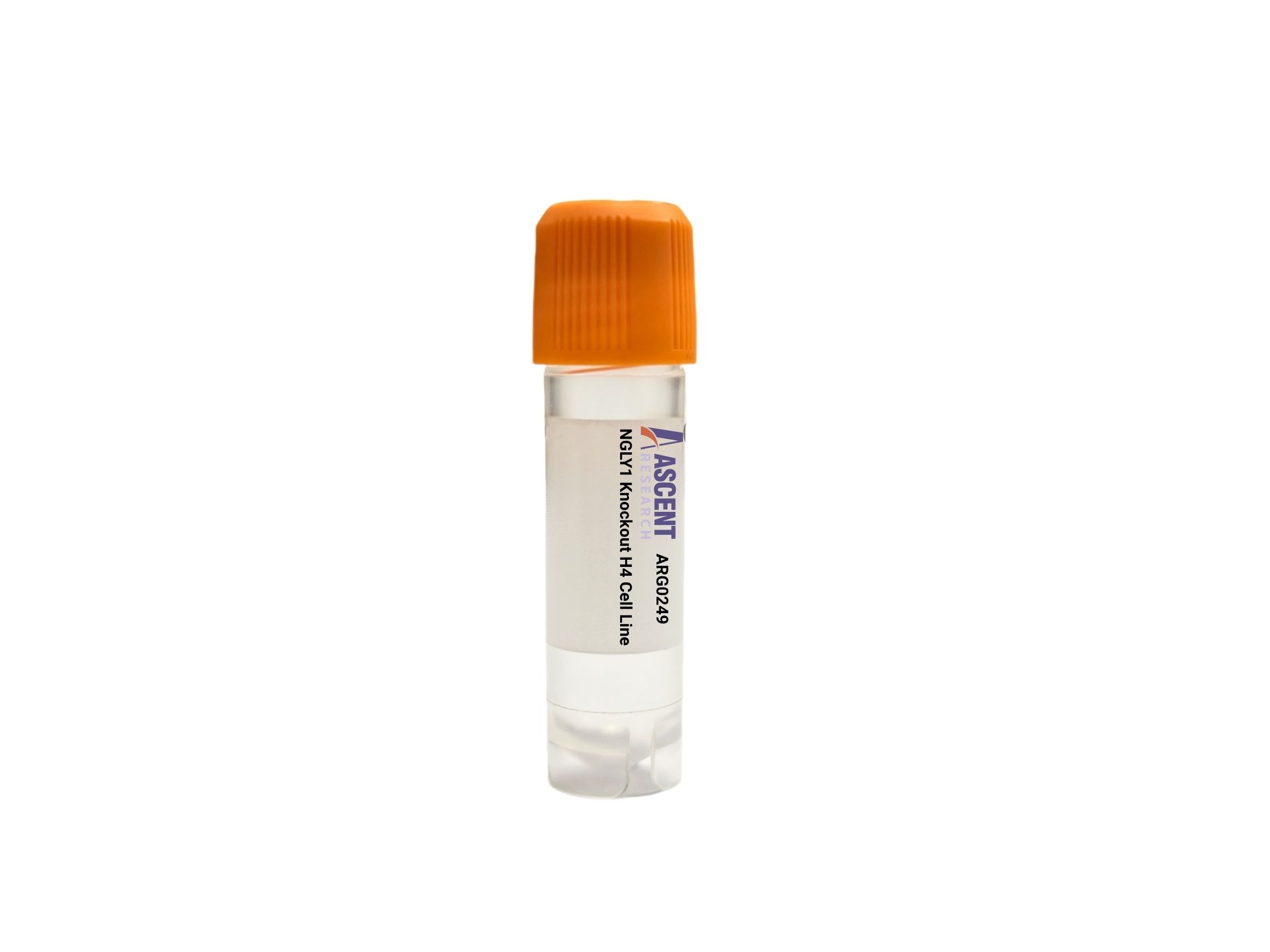
The NGLY1 Knockout H4 Cell Line is a CRISPR/Cas9-edited knockout cell line derived from H4 human neuroglioma cells, designed for constitutive disruption of N-glycanase 1. This model enables in-depth study of ER-associated degradation (ERAD) and Nrf1-mediated proteasome regulation in a neuronal-like background. NGLY1 deficiency, linked to congenital deglycosylation disorders, can be investigated using this tool. Applications span proteostasis research, therapeutic screening for proteotoxic stress, and neurological disease modeling, with assays such as Western blotting for Nrf1 activation, proteasome activity measurements, and ER stress reporters. Key interacting partners include VCP/p97 and the HRD1-SEL1L complex.
 Cynomolgus Monkey CD14+ Monocytes
Cat. No. ARP1043
Cynomolgus Monkey CD14+ Monocytes
Cat. No. ARP1043
 HOMER1 Knockout MES-OV Polyclonal Cells
Cat. No. ARG24560
ATP2B4 Knockout NCI-H1299 Polyclonal Cells
Cat. No. ARG30475
GPSM2 Knockout HAP1 Polyclonal Cells
Cat. No. ARG36999
JAG1 Knockout SKOV3 Polyclonal Cells
Cat. No. ARG36748
CES1 Knockout A549 Polyclonal Cells
Cat. No. ARG9987
HOMER1 Knockout MES-OV Polyclonal Cells
Cat. No. ARG24560
ATP2B4 Knockout NCI-H1299 Polyclonal Cells
Cat. No. ARG30475
GPSM2 Knockout HAP1 Polyclonal Cells
Cat. No. ARG36999
JAG1 Knockout SKOV3 Polyclonal Cells
Cat. No. ARG36748
CES1 Knockout A549 Polyclonal Cells
Cat. No. ARG9987
The NGLY1 Knockout H4 Cell Line is a CRISPR/Cas9-edited knockout cell line engineered to disrupt the NGLY1 gene in the H4 human neuroglioma background. This loss-of-function model enables targeted investigation of N-glycanase 1-dependent processes without the limitations of transient silencing. Using CRISPR/Cas9-mediated gene disruption, researchers can interrogate how constitutive ablation of NGLY1 influences cellular proteostasis, ER-associated degradation, and downstream signaling.
The H4 cell line, derived from human neuroglioma, exhibits adherent epithelial morphology and is widely used as a neuronal model. These cells express core components of the ubiquitin-proteasome system and ER stress machinery, making them well-suited for studying neurodegeneration-linked pathways and protein quality control. The H4 background provides a physiologically relevant environment to assess NGLY1 loss in a neurological context.
NGLY1 encodes a cytosolic N-glycanase that cleaves N-linked glycans from misfolded glycoproteins retrotranslocated from the endoplasmic reticulum, a critical step prior to proteasomal degradation. It operates within the ER-associated degradation (ERAD) pathway, interacting directly with VCP/p97, the HRD1-SEL1L ubiquitin ligase complex, EDEM1, and other ubiquitin-proteasome components. Upstream regulators include NFE2L1 (Nrf1) and ER stress transducers XBP1 and ATF4; downstream, NGLY1-mediated Nrf1 activation drives expression of proteasome subunit genes such as PSMB5 and PSMA5. Thus, NGLY1 couples ERAD efficiency to proteasome biogenesis.
In H4 neuroglioma cells, NGLY1 disruption impairs clearance of misfolded glycoproteins, leading to accumulation and elevated ER stress. This likely compromises Nrf1 processing and proteasome induction, sensitizing cells to proteotoxic conditions. The knockout line recapitulates key features of NGLY1 deficiency, a congenital deglycosylation disorder with neurological manifestations, and aids in dissecting ERAD defects in neuronal vulnerability.
Typical research applications include mechanistic studies of NGLY1 deficiency, screening of compounds that restore ERAD function, and investigation of proteostasis in cancer and neurodegeneration. Phenotypic characterization utilizes Western blotting for NGLY1 and Nrf1 activation, RT-qPCR for proteasome subunit genes, immunofluorescence for ubiquitin and ER markers, flow cytometry for apoptosis, and proteasome activity assays. Cell viability assays under ER stress and XBP1 splicing reporters evaluate cellular resilience. For additional information, please contact Ascent Research.