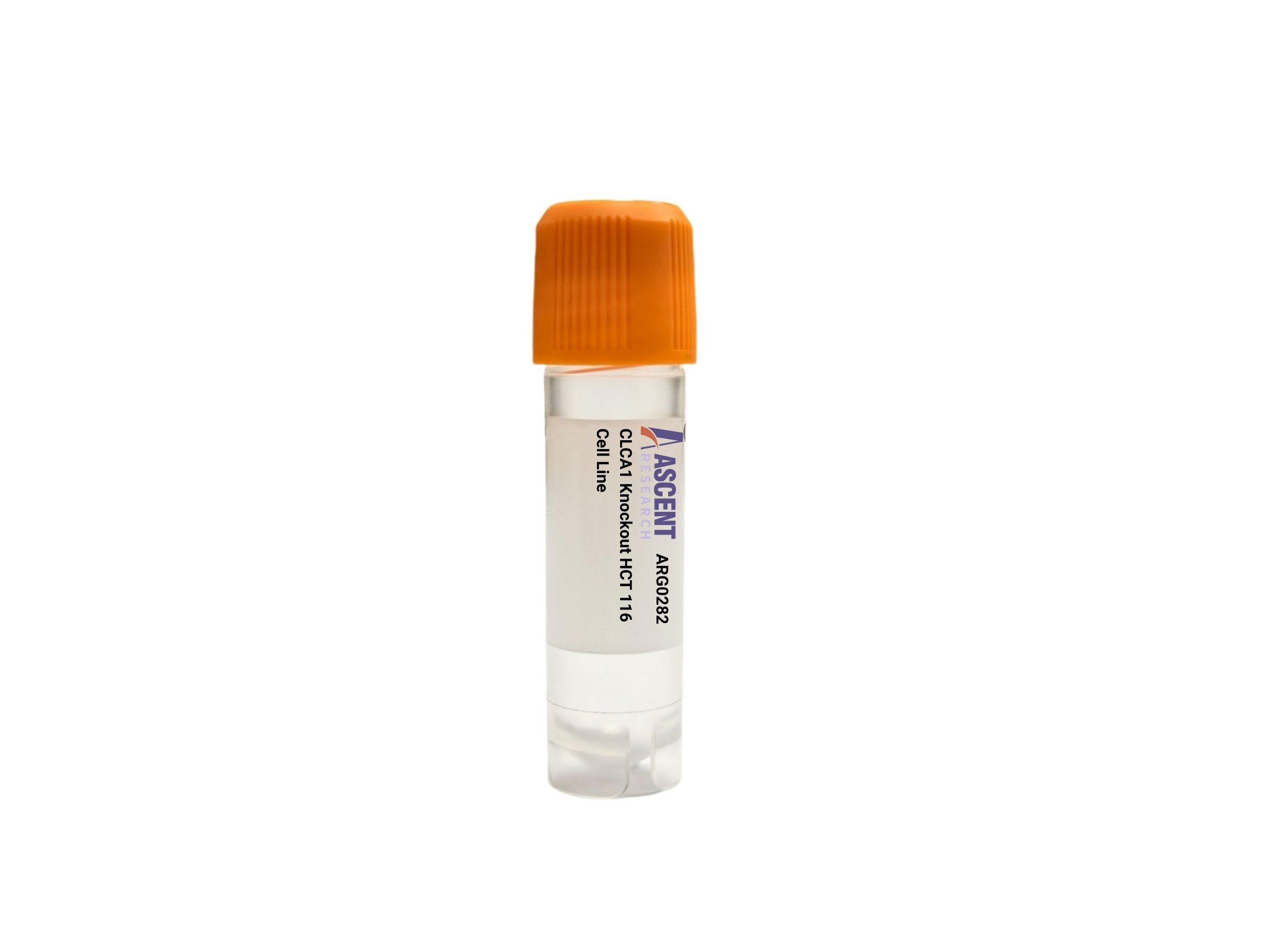
Genome-edited Cells
Large intestine (colon)
The CLCA1 Knockout HCT 116 Cell Line is a CRISPR/Cas9-edited colorectal carcinoma model with disrupted CLCA1 expression. CLCA1 is a calcium-activated chloride channel regulator that modulates chloride transport and mucus hydration in epithelial cells. In HCT 116 cells, which harbor mutant KRAS, this knockout facilitates investigation of ion channel functions in tumorigenesis and drug response. CLCA1 is regulated by IL-13/STAT6 signaling and interacts with CFTR and TMEM16A. Applications include chloride efflux, proliferation, migration, and transcriptomic analyses.
 PHF2 Knockout HT29 Polyclonal Cells
Cat. No. ARG13901
MSRA Knockout jurkat Polyclonal Cells
Cat. No. ARG12943
ACADS Knockout HGC-27 Polyclonal Cells
Cat. No. ARG29392
ASL Knockout NCI-H1299 Polyclonal Cells
Cat. No. ARG30436
CALR Knockout CaSki Polyclonal Cells
Cat. No. ARG41888
PHF2 Knockout HT29 Polyclonal Cells
Cat. No. ARG13901
MSRA Knockout jurkat Polyclonal Cells
Cat. No. ARG12943
ACADS Knockout HGC-27 Polyclonal Cells
Cat. No. ARG29392
ASL Knockout NCI-H1299 Polyclonal Cells
Cat. No. ARG30436
CALR Knockout CaSki Polyclonal Cells
Cat. No. ARG41888
 Rat Cardiac Fibroblasts
Cat. No. ARP0191
Rat Cardiac Fibroblasts
Cat. No. ARP0191
The CLCA1 Knockout HCT 116 Cell Line is a CRISPR/Cas9-edited knockout cell line designed to disrupt the expression of the CLCA1 gene in HCT 116 colorectal carcinoma epithelial cells. This engineered cell line provides a stable loss-of-function model for studying the biological roles of CLCA1, a calcium-activated chloride channel regulator, in epithelial cell physiology and disease. By eliminating CLCA1 function, researchers can investigate chloride transport regulation and its impact on cellular processes in a cancer-relevant background.
HCT 116 is a widely used human colorectal carcinoma epithelial cell line derived from a primary colon tumor. This cell line harbors a mutant KRAS oncogene, which drives constitutive activation of the RAS-MAPK signaling pathway, making it a valuable model for studying oncogenic signaling and tumor biology. HCT 116 cells exhibit typical epithelial morphology and retain many features of intestinal epithelial cells, including the expression of ion channels and transporters that are critical for maintaining mucosal barrier function and fluid homeostasis.
CLCA1 encodes a member of the calcium-activated chloride channel regulator family, which modulates chloride secretion across epithelial barriers. The protein is known to self-associate and interact with other key ion transport regulators, including the cystic fibrosis transmembrane conductance regulator (CFTR) and beta-catenin. CLCA1 is activated by intracellular calcium signals and is transcriptionally regulated by the IL-13/STAT6 signaling cascade, a pathway pivotal in mucosal immune responses. Downstream, CLCA1 promotes chloride efflux and mucus hydration, partly through functional interaction with TMEM16A (anoctamin-1). Additionally, the solute carrier SLC26A3 acts as a parallel chloride-bicarbonate exchanger in this regulatory network. Thus, CLCA1 sits at the nexus of calcium signaling, cytokine-induced transcription, and epithelial ion transport.
In the context of HCT 116 colorectal cancer cells, CLCA1 knockout allows dissection of its specific contributions to ion homeostasis, cell proliferation, and tumorigenic potential. Since CLCA1 may influence cellular chloride levels, its ablation could affect cell volume regulation, intracellular pH, and downstream signaling events linked to growth and survival. The presence of mutant KRAS provides a unique opportunity to study how oncogenic signaling intersects with ion channel function, potentially revealing novel vulnerabilities in colorectal cancer. Therefore, this model is particularly suited for investigating the crosstalk between chloride transport and tumor-promoting pathways.
Researchers can employ this cell line in diverse experimental settings, including chloride efflux assays to quantify channel activity, proliferation assays (MTT, colony formation), migration assays (wound healing), and global transcriptomic profiling via RNA-seq. Western blotting and RT-qPCR enable confirmation of knockout and assessment of compensatory changes in other ion channels or signaling molecules. This model also facilitates drug response studies for chloride channel modulators, aiding in the development of therapeutic strategies for diseases such as cystic fibrosis, asthma, and inflammatory bowel disease, where CLCA1 is implicated. For further technical details and purchasing information, please contact Ascent Research.