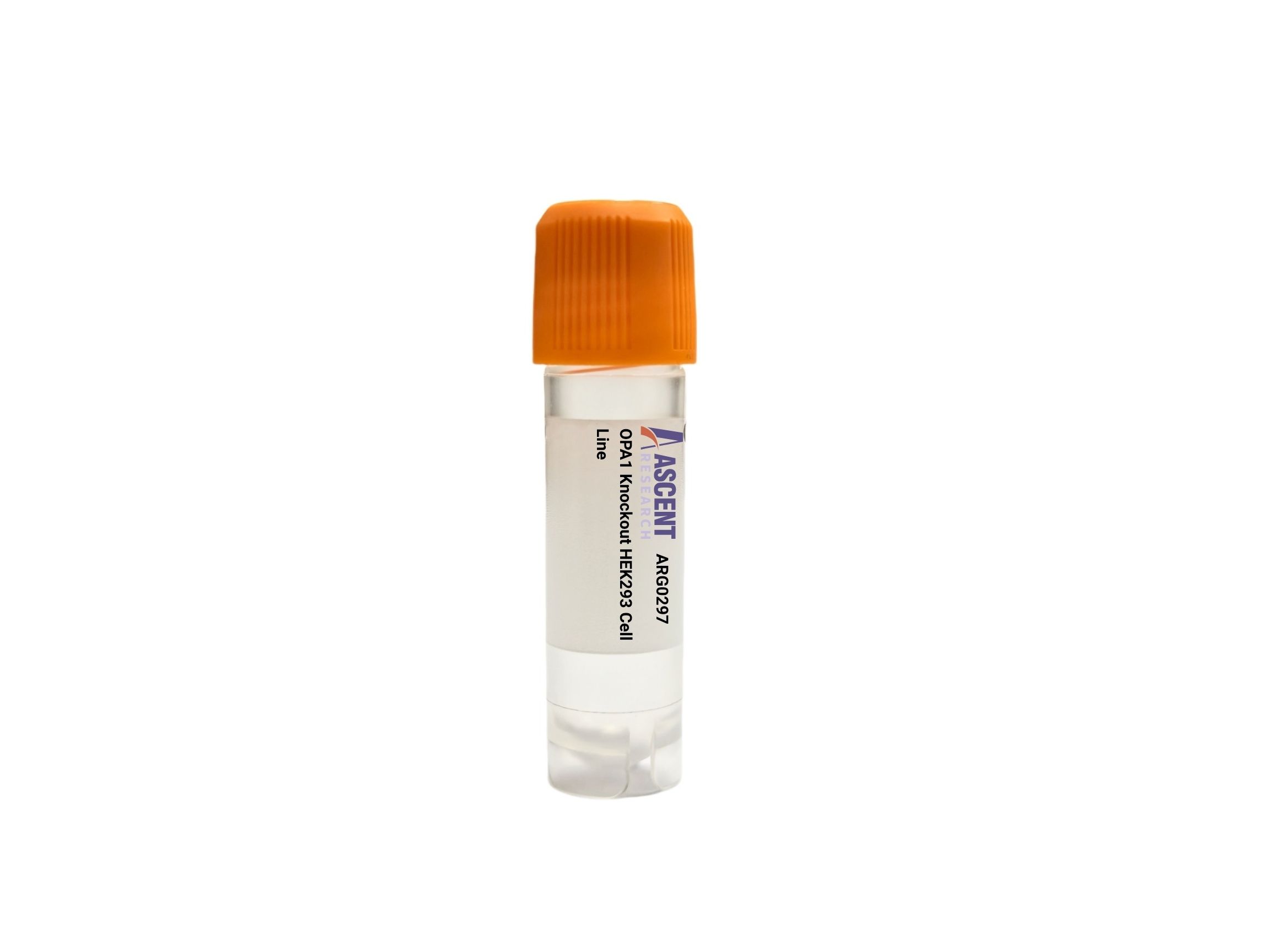
Genome-edited Cells
The OPA1 Knockout HEK293 Cell Line is a CRISPR/Cas9-edited human cell line that disrupts OPA1, a mitochondrial inner membrane GTPase essential for fusion and cristae organization. Derived from the HEK293 embryonic kidney epithelial line, this model provides a consistent platform to study mitochondrial dynamics and apoptosis, with links to MFN1, MFN2, and DRP1. Applications include visualization of mitochondrial morphology, metabolic profiling, apoptosis assays, and screening for fusion modulators. It is particularly suited for investigating dominant optic atrophy and neurodegeneration, where OPA1 dysfunction leads to network fragmentation and cytochrome c release.
 LENG9 Knockout NCI-H1975 Polyclonal Cells
Cat. No. ARG16318
ALDH7A1 Knockout NCI-H1975 Polyclonal Cells
Cat. No. ARG31100
HAT1 Knockout NCI-H1299 Polyclonal Cells
Cat. No. ARG30700
KDM3B Knockout HAP1 Polyclonal Cells
Cat. No. ARG27671
Cend1 Knockout Hela Polyclonal Cells
Cat. No. ARG7674
GNE Knockout AGS Polyclonal Cells
Cat. No. ARG2438
LENG9 Knockout NCI-H1975 Polyclonal Cells
Cat. No. ARG16318
ALDH7A1 Knockout NCI-H1975 Polyclonal Cells
Cat. No. ARG31100
HAT1 Knockout NCI-H1299 Polyclonal Cells
Cat. No. ARG30700
KDM3B Knockout HAP1 Polyclonal Cells
Cat. No. ARG27671
Cend1 Knockout Hela Polyclonal Cells
Cat. No. ARG7674
GNE Knockout AGS Polyclonal Cells
Cat. No. ARG2438
The OPA1 Knockout HEK293 Cell Line is a CRISPR/Cas9-edited HEK293-derived cell line with targeted disruption of the OPA1 gene. This loss-of-function model enables rigorous investigation of mitochondrial fusion, cristae architecture, and apoptosis. The stable inactivation produced by CRISPR/Cas9 methodology provides a consistent system for dissecting OPA1 function in a defined human background.
The parental HEK293 line is a human embryonic kidney epithelial cell line transformed with sheared adenovirus 5 DNA. It is widely used for its high transfectability and robust growth, supporting applications in heterologous expression and viral production. The human epithelial context maintains key mitochondrial quality control and apoptosis pathways, making it well-suited for studies of mitochondrial biology.
At the molecular level, OPA1 encodes an inner membrane dynamin-like GTPase that governs mitochondrial fusion and cristae stabilization. It undergoes proteolytic processing by YME1L1 and OMA1 in response to membrane potential changes, generating functionally distinct isoforms. OPA1 interacts with mitofusins MFN1 and MFN2 to promote fusion, counteracting the fission protein DRP1. Additional partners include prohibitin and the MICOS complex. OPA1 dysfunction leads to BAX-mediated cytochrome c release and caspase-9 activation, linking morphological control to apoptosis. OPA1 thus integrates bioenergetic signals to determine mitochondrial network status and cell fate.
Disruption of OPA1 in HEK293 cells recapitulates key disease phenotypes, including mitochondrial network fragmentation, cristae disruption, and impaired oxidative phosphorylation. These alterations sensitize cells to apoptosis, mirroring pathogenic mechanisms in dominant optic atrophy caused by OPA1 mutations. The HEK293 system’s ease of genetic manipulation facilitates rescue experiments and combinatorial perturbations, making it a valuable model for studying mitochondrial dysfunction in neurodegeneration and beyond.
This knockout cell line is suitable for diverse assays: mitochondrial morphology analysis with MitoTracker, OPA1 isoform profiling by Western blot, apoptosis quantification via Annexin V, and metabolic flux analysis with Seahorse. Co-immunoprecipitation can assess interactions with MFN1/MFN2, and qPCR tracks mtDNA copy number. The line supports drug screening for OPA1 modulators and modeling of dominant optic atrophy, sensorineural hearing loss, and neurodegenerative disorders. For further inquiries, contact Ascent Research.