Genome-edited Cells
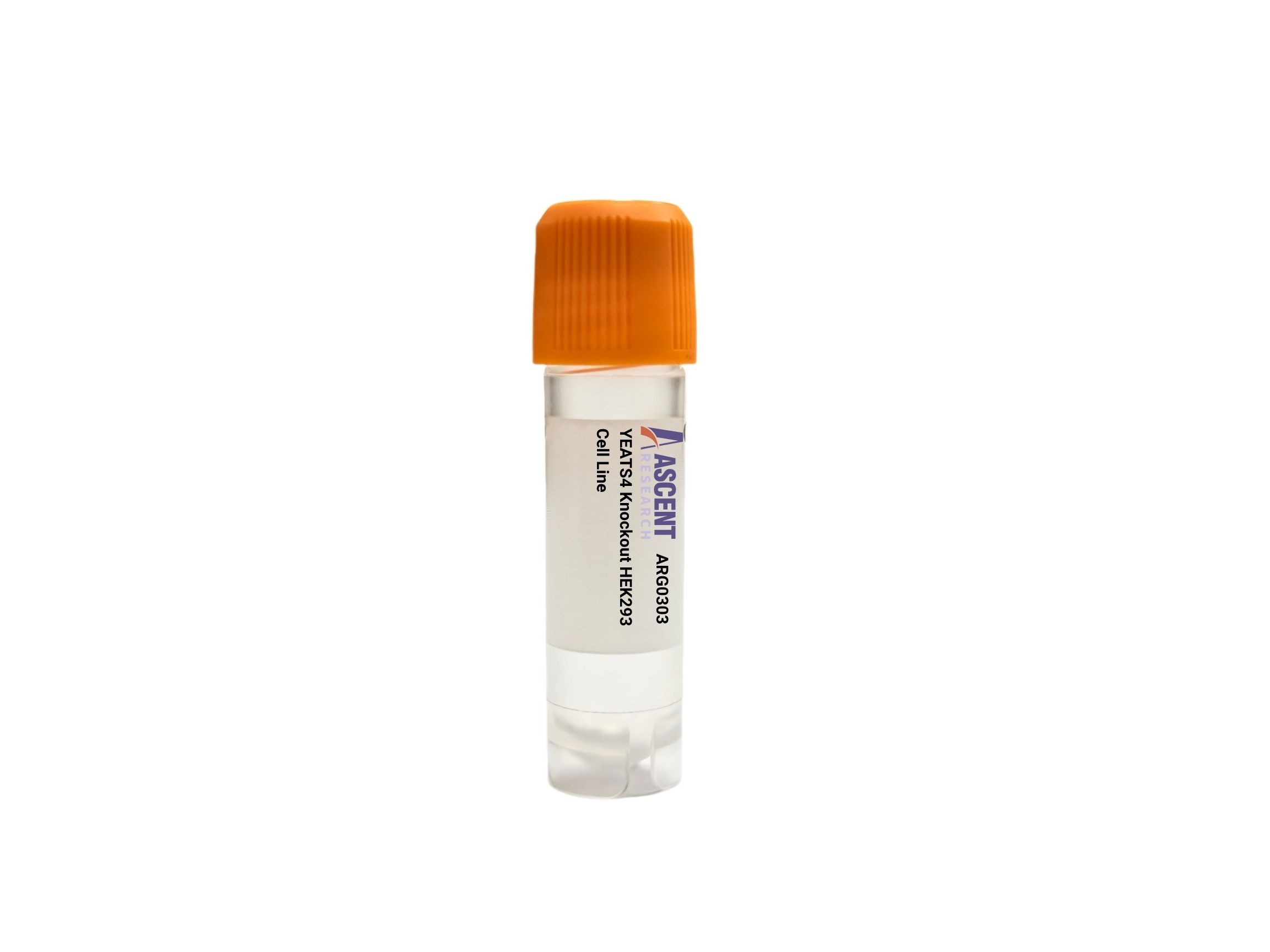
The YEATS4 Knockout HEK293 Cell Line is a CRISPR/Cas9-edited human embryonic kidney cell line that provides a stable loss-of-function model for the YEATS4 chromatin reader and transcriptional co-activator. YEATS4 recognizes acetylated histone H3 and assembles ATAC/SAGA histone acetyltransferase complexes containing KAT2A and TRRAP, linking MYC-driven growth signals to gene activation. This knockout line enables mechanistic studies of chromatin-mediated gene regulation in epithelial cells, with applications in Western blot, ChIP-qPCR, RT-qPCR, viability assays, and epigenetic drug discovery. It is particularly suited for investigating YEATS4??s role in cancer biology, including glioblastoma and breast cancer.
The YEATS4 Knockout HEK293 Cell Line is a CRISPR/Cas9-mediated gene-disrupted human embryonic kidney cell line for loss-of-function investigation of the YEATS4 (GAS41) chromatin reader. This stable model in HEK293 cells enables dissection of YEATS4-dependent histone acetylation reading and transcriptional co-activation. It is suitable for diverse biochemical, genomic, and cell-based assays, offering a consistent platform for epigenetic and cancer research.
Derived from human embryonic kidney epithelium transformed with adenovirus 5 DNA, HEK293 cells exhibit epithelial traits, high transfection efficiency, and robust protein expression. These properties make them ideal for studying gene regulation and signaling. In the knockout line, HEK293 provides a relevant context for interrogating YEATS4-mediated chromatin networks, as it retains functional MYC signaling and essential histone acetyltransferase complex components.
YEATS4 binds acetylated histone H3 (e.g., H3K14ac, H3K27ac) via its YEATS domain, recruiting the ATAC and SAGA histone acetyltransferase complexes, where it interacts with TRRAP, TAF10/TAF12, and KAT2A (GCN5/PCAF). This recruitment promotes local chromatin acetylation and transcriptional activation. YEATS4 functions downstream of MYC, which upregulates YEATS4, and in turn co-activates MYC targets like CCND1 and ribosomal protein genes to drive proliferation. It also engages stress-responsive transcriptional programs. CRISPR/Cas9-mediated disruption of YEATS4 impairs acetyl-histone recognition, attenuates ATAC/SAGA complex activity, and reduces expression of proliferation-associated genes.
HEK293 cells are an apt model for YEATS4 because they express upstream regulators KAT2A and TRRAP, enabling analysis of the co-activator??s role in growth signaling. Knockout of YEATS4 in this epithelial background blunts oncogenic phenotypes, such as colony formation, and sensitizes cells to stress, mirroring observations in glioblastoma and breast cancer. The line thus facilitates dissection of YEATS4-specific functions within the ATAC/SAGA complexes and epistasis experiments with other chromatin regulators.
Researchers can employ this line for Western blot confirmation of knockout, ChIP-qPCR of histone acetylation at target loci, RT-qPCR of CCND1 and ribosomal protein transcripts, and RNA-seq for global expression profiling. Functional readouts include cell viability, proliferation kinetics, and colony formation assays. Acetyl-histone peptide pull-downs assess disrupted reader interactions. The line also supports epigenetic drug screening and synthetic lethality studies relevant to cancer. For technical assistance, contact Ascent Research.