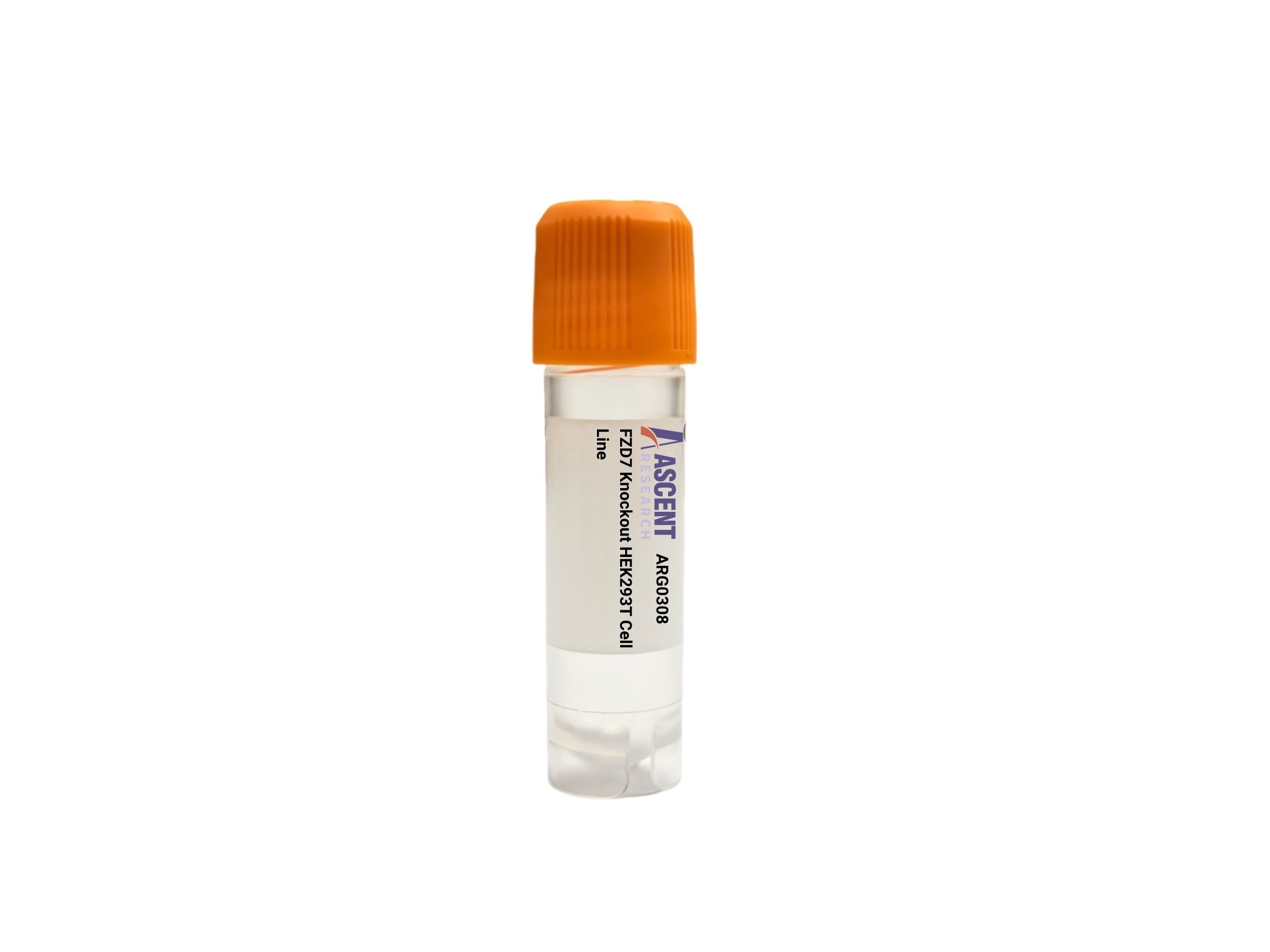
Genome-edited Cells
Kidney
The FZD7 Knockout HEK293T Cell Line is a CRISPR/Cas9?edited knockout cell line that abrogates Frizzled?7 receptor function. FZD7 mediates Wnt signaling by recruiting Dishevelled to promote ???catenin stabilization and TCF/LEF transcriptional activity, regulating targets like MYC and CCND1. This model allows dissection of Wnt pathway mechanisms and exploration of FZD7's role in cancer and development. Derived from HEK293T cells, the line offers high transfection efficiency for complementary studies and drug screening. Researchers can apply assays such as TOPFlash, ???catenin Western blotting, and migration assays to investigate Wnt?driven diseases including colorectal and breast cancers.
 CACNA1G Knockout HCT116 Polyclonal Cells
Cat. No. ARG34773
NTRK3 Knockout HT29 Polyclonal Cells
Cat. No. ARG14414
AAR2 Knockout NCI-H1299 Polyclonal Cells
Cat. No. ARG30170
KHSRP Knockout NCI-H1299 Polyclonal Cells
Cat. No. ARG30908
ACOT9 Knockout jurkat Polyclonal Cells
Cat. No. ARG33725
LY96 Knockout CaSki Polyclonal Cells
Cat. No. ARG9806
CACNA1G Knockout HCT116 Polyclonal Cells
Cat. No. ARG34773
NTRK3 Knockout HT29 Polyclonal Cells
Cat. No. ARG14414
AAR2 Knockout NCI-H1299 Polyclonal Cells
Cat. No. ARG30170
KHSRP Knockout NCI-H1299 Polyclonal Cells
Cat. No. ARG30908
ACOT9 Knockout jurkat Polyclonal Cells
Cat. No. ARG33725
LY96 Knockout CaSki Polyclonal Cells
Cat. No. ARG9806
The FZD7 Knockout HEK293T Cell Line is a CRISPR/Cas9-edited human cell line with targeted disruption of the FZD7 gene, enabling loss-of-function studies of Frizzled-7 receptor signaling. This model provides a clean genetic background for investigating Wnt pathway activation without pharmacological inhibition or transient knockdown.
The host cell, HEK293T, is a derivative of human embryonic kidney 293 cells that stably expresses SV40 large T antigen. This feature enhances episomal plasmid replication and drives high-level protein expression, making HEK293T widely used for viral production and transient transfection. The cells grow adherently and exhibit robust viability across standard culture conditions.
FZD7 encodes a seven-transmembrane receptor that binds Wnt ligands such as WNT3A and WNT1, initiating both canonical and non-canonical pathways. Upon ligand binding, FZD7 recruits Dishevelled (DVL) to the membrane. In the canonical branch, co-receptors LRP5/6 and R-spondins promote the disassembly of the destruction complex (AXIN, APC, GSK3??), stabilizing ??-catenin. ??-catenin then translocates to the nucleus and partners with TCF/LEF factors to transcribe targets like MYC, CCND1, and AXIN2. In non-canonical signaling, FZD7 can activate JNK and RhoA via DVL, and modulate CaMKII and NFAT through calcium fluxes, often engaging co-receptors ROR2, RYK, and G-proteins.
HEK293T cells endogenously express core Wnt pathway components, making them responsive to Wnt stimulation. Knocking out FZD7 removes the primary receptor for many Wnt ligands, thus attenuating both ??-catenin-dependent transcription and non-canonical outputs. The high transfectability of the HEK293T background further permits reintroduction of wild-type or mutant FZD7 constructs for structure?function analyses, enabling clean dissection of FZD7?specific contributions to downstream signaling events.
This knockout cell line supports diverse research applications in cancer biology, developmental signaling, and drug discovery. Typical assays include TOPFlash reporter measurements, Western blotting for ??-catenin protein levels, RT?qPCR for Wnt target gene expression, and migration/invasion studies. Co?immunoprecipitation with DVL can validate receptor?Cadaptor interactions, while flow cytometry for surface FZD7 confirms knockout efficiency. For further technical details or ordering information, please contact Ascent Research.