Genome-edited Cells
Kidney
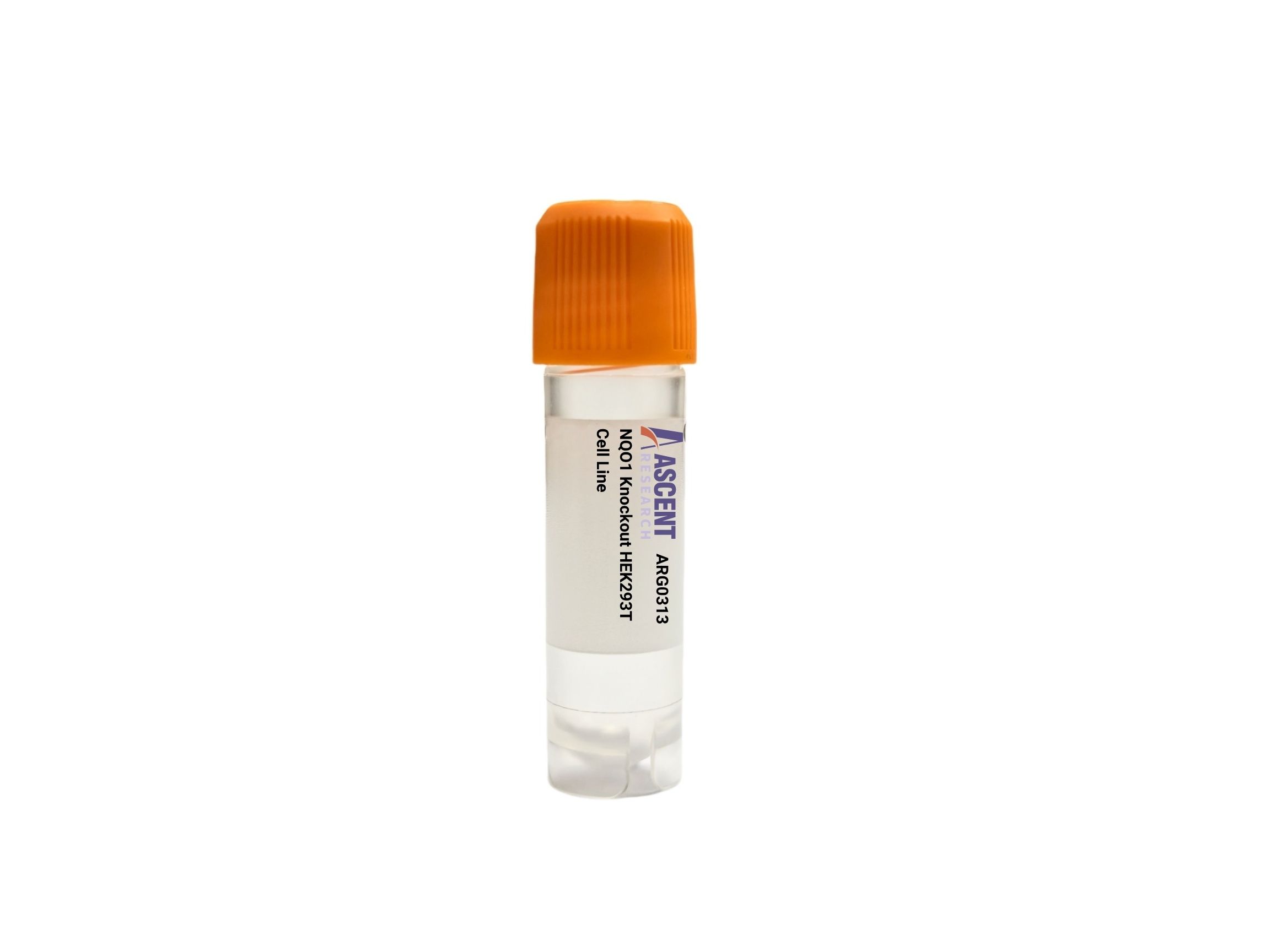
The NQO1 Knockout HEK293T Cell Line is a CRISPR/Cas9-edited knockout cell line that disrupts NQO1 gene expression, enabling loss-of-function studies of this key antioxidant and detoxification enzyme. NQO1 catalyzes quinone reduction and is regulated by NRF2, interacting with p53 to link redox balance and genomic stability. This model, in the widely used HEK293T background, is ideal for investigating oxidative stress responses, drug bioactivation, and p53 signaling. Applications include ROS detection, enzymatic assays, and drug sensitivity testing. Contact Ascent Research for details.
 MELK Knockout Jurkat Polyclonal Cells
Cat. No. ARG13055
ALG12 Knockout A549 Polyclonal Cells
Cat. No. ARG31468
BCL11B Knockout HEK293T Polyclonal Cells
Cat. No. ARG37839
CCNL2 Knockout Hela Polyclonal Cells
Cat. No. ARG43254
Cul5 Knockout PATU8988T Polyclonal Cells
Cat. No. ARG11306
MELK Knockout Jurkat Polyclonal Cells
Cat. No. ARG13055
ALG12 Knockout A549 Polyclonal Cells
Cat. No. ARG31468
BCL11B Knockout HEK293T Polyclonal Cells
Cat. No. ARG37839
CCNL2 Knockout Hela Polyclonal Cells
Cat. No. ARG43254
Cul5 Knockout PATU8988T Polyclonal Cells
Cat. No. ARG11306
 SK-N-AS
Cat. No. ARC0837
SK-N-AS
Cat. No. ARC0837
The NQO1 Knockout HEK293T Cell Line is a CRISPR/Cas9-edited knockout cell line in which the NQO1 gene has been disrupted to abolish protein expression. This model provides a defined loss-of-function platform for investigating the roles of NAD(P)H quinone dehydrogenase 1 in redox homeostasis, xenobiotic metabolism, and tumor suppressor pathways. The knockout was generated using CRISPR/Cas9-mediated gene editing, ensuring a stable, heritable disruption of the target locus.
The host HEK293T cell line is a derivative of human embryonic kidney cells that expresses the SV40 large T-antigen, enabling high transfection efficiency and episomal plasmid replication. As an epithelial cell line widely used in molecular biology, HEK293T supports robust protein expression, viral production, and gene function studies. Its well-characterized background makes it an ideal system for creating isogenic knockout models for downstream applications.
NQO1 encodes a flavoprotein that catalyzes obligate two-electron reduction of quinones to hydroquinones, bypassing semiquinone radicals and mitigating oxidative stress. This reaction is part of the NRF2?CKEAP1 antioxidant response pathway, where NRF2 transcriptionally activates NQO1 via the antioxidant response element (ARE). Beyond its enzymatic function, NQO1 physically binds and stabilizes p53, inhibiting its degradation and linking detoxification to genomic stability. Additional interacting factors such as HSP90, Parkin, and SIRT1 further embed NQO1 in networks governing protein folding, mitophagy, and metabolic sensing. Upstream regulators including HIF1A, AhR, and estrogen receptor modulate NQO1 expression under diverse conditions.
In HEK293T cells, elimination of NQO1 enables dissection of its contributions to basal and stress-induced cytoprotection. The knockout line facilitates study of NQO1-dependent p53 stabilization, HIF-1?? regulation, and NAD+/NADH homeostasis. Given the kidney-derived origin of the host, this model is also relevant for examining NQO1 function in renal detoxification and hormone-responsive pathways.
Typical applications include measuring NQO1 enzymatic activity, Western blotting and RT-qPCR for target validation, ROS detection assays (DCFDA), cell viability testing under oxidative challenge, p53 stabilization experiments, and drug sensitivity profiling with agents such as ??-lapachone and mitomycin C. This cell line supports research in oxidative stress, cancer biology, neuroprotection, and drug resistance. For further information, please contact Ascent Research.