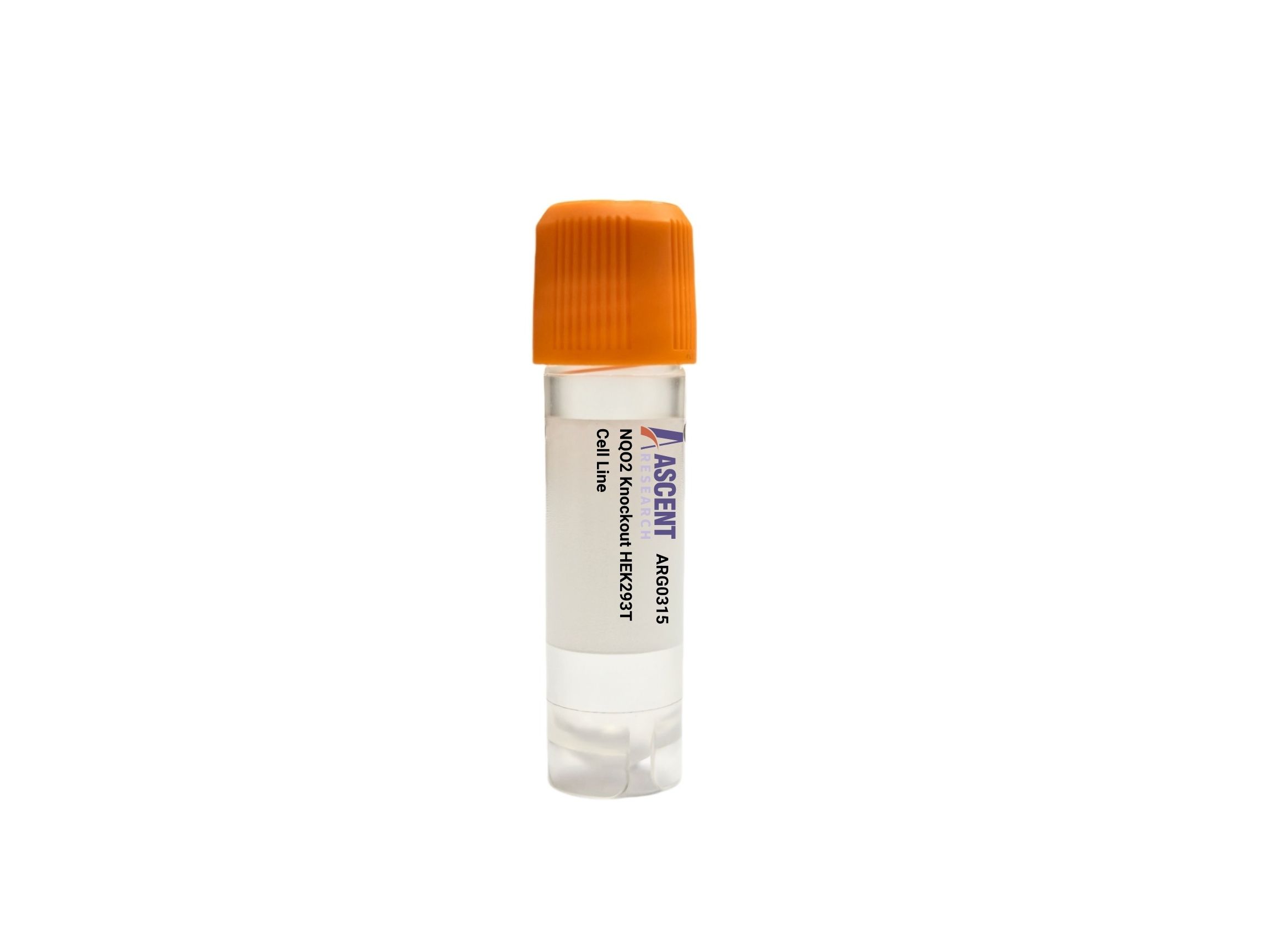
Genome-edited Cells
Kidney
The NQO2 Knockout HEK293T Cell Line is a CRISPR/Cas9-edited knockout cell panel derived from human embryonic kidney HEK293T cells. It features targeted disruption of NQO2, a quinone reductase regulated by Nrf2 and interacting with p53 and Hsp70. This model is ideal for studying oxidative stress, xenobiotic metabolism, and drug sensitivity. Applications include NQO2 substrate screening, chemoresistance research, and neurodegenerative disease modeling. Assays such as cell viability, ROS measurement, and co-immunoprecipitation are readily performed. The knockout background provides a clean platform for dissecting NQO2-dependent mechanisms.
 NUP210 Knockout A2780 Polyclonal Cells
Cat. No. ARG18992
MMAA Knockout A549 Polyclonal Cells
Cat. No. ARG10391
AGO1 Knockout Raji Polyclonal Cells
Cat. No. ARG21093
ANKRD54 Knockout HGC-27 Polyclonal Cells
Cat. No. ARG29532
DNTTIP1 Knockout A549 Polyclonal Cells
Cat. No. ARG39517
CAMK1D Knockout HCT116 Polyclonal Cells
Cat. No. ARG41938
NUP210 Knockout A2780 Polyclonal Cells
Cat. No. ARG18992
MMAA Knockout A549 Polyclonal Cells
Cat. No. ARG10391
AGO1 Knockout Raji Polyclonal Cells
Cat. No. ARG21093
ANKRD54 Knockout HGC-27 Polyclonal Cells
Cat. No. ARG29532
DNTTIP1 Knockout A549 Polyclonal Cells
Cat. No. ARG39517
CAMK1D Knockout HCT116 Polyclonal Cells
Cat. No. ARG41938
The NQO2 Knockout HEK293T Cell Line is a CRISPR/Cas9-edited knockout cell line derived from the HEK293T human embryonic kidney epithelial cell line. It offers a genetically defined loss-of-function model for the NQO2 gene, enabling unambiguous assessment of NQO2??s contributions to cellular physiology. The knockout eliminates NQO2 enzymatic activity, providing a clean system for mechanistic studies without background interference.
HEK293T cells are human embryonic kidney epithelial cells immortalized with adenovirus 5 DNA and engineered to express the SV40 large T antigen. This cell line is renowned for high transfectability and robust recombinant protein expression, making it an ideal host for gene-edited models. Its renal epithelial origin renders it particularly suitable for studying xenobiotic metabolism and oxidative stress responses relevant to kidney physiology and drug disposition.
NQO2 encodes a cytosolic flavoprotein that catalyzes two-electron reduction of quinones using dihydronicotinamide riboside (NRH) as an electron donor. This reaction contributes to detoxification or, through redox cycling, to reactive oxygen species generation. NQO2 expression is regulated by Nrf2 and AhR under oxidative stress and xenobiotic exposure. It interacts directly with p53, p73, and Hsp70, and influences downstream NF-??B signaling and p53 stabilization. NQO2 also processes substrates such as menadione and coenzyme Q, positioning it as a critical node connecting antioxidant defense, apoptosis, and xenobiotic metabolism.
In HEK293T cells, NQO2 knockout abrogates quinone metabolism, altering sensitivity to quinone-based drugs and oxidative stress. This model permits dissection of NQO2-dependent and -independent redox mechanisms, and the loss of NQO2-p53 interactions can be studied with respect to chemoresistance. The high transfectability of HEK293T enables efficient complementation with wild-type or mutant NQO2, facilitating structure-function studies. Additionally, the knockout background aids in characterizing the interplay with NQO1 and other redox partners.
Researchers employ this cell line to screen NQO2 substrates and inhibitors, investigate drug metabolism pathways, and model neurodegenerative and chemopreventive processes. Representative assays include NQO2 activity measurements, viability assays with quinone-based agents, western blotting for pathway components, ROS detection, NF-??B activation profiling, and co-immunoprecipitation of NQO2 interaction partners. The NQO2 Knockout HEK293T Cell Line is thus a versatile tool for molecular pharmacology and cell biology. For inquiries, contact Ascent Research.