Genome-edited Cells
Kidney
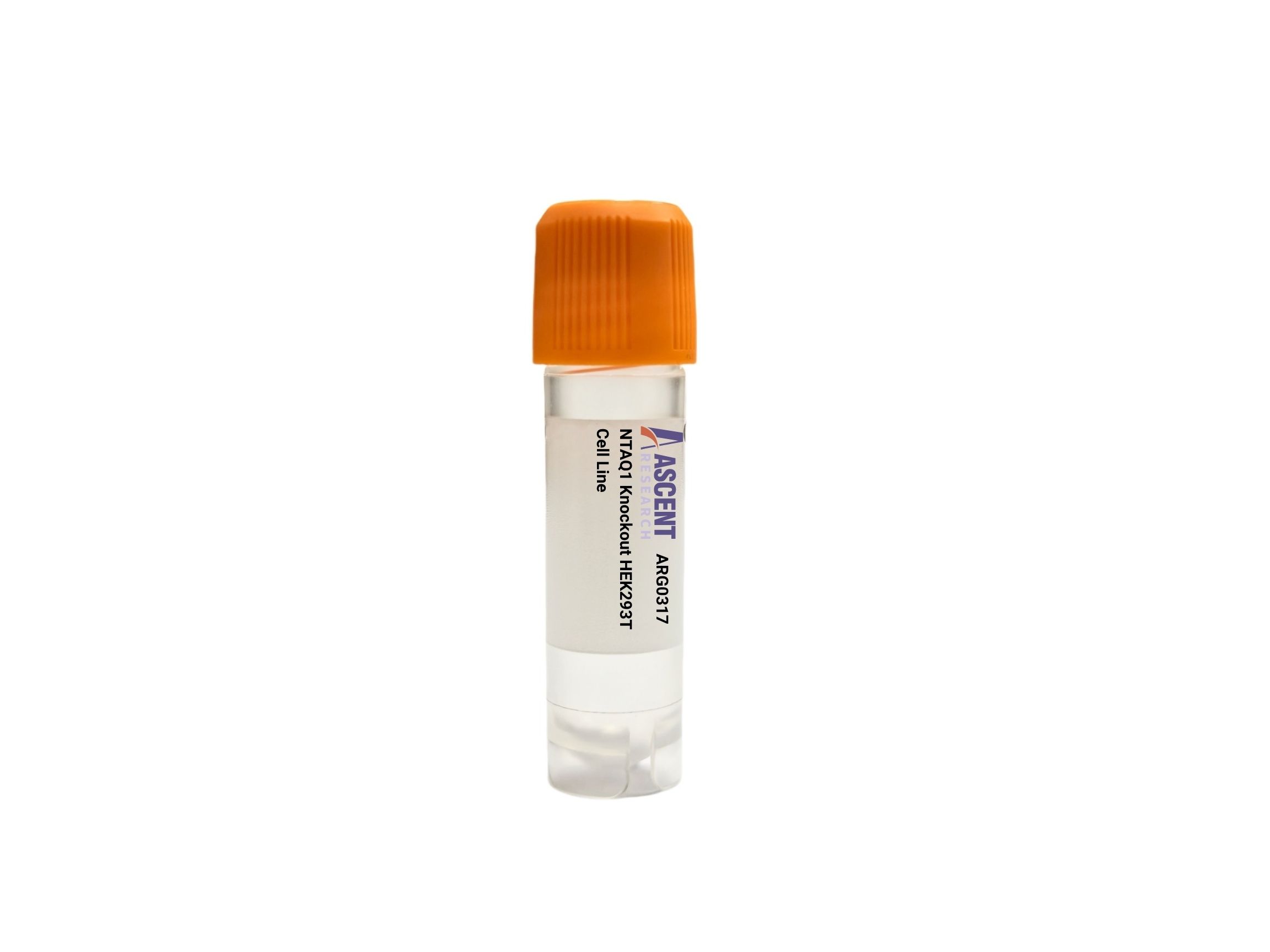
This NTAQ1 Knockout HEK293T Cell Line is a CRISPR/Cas9-edited human embryonic kidney cell model targeting the NTAQ1 gene, encoding N-terminal glutamine amidase. NTAQ1 catalyzes deamidation of N-terminal glutamine to glutamate, a key step in the N-end rule pathway that marks proteins for arginylation by ATE1, ubiquitination by UBR1/UBR2, and proteasomal degradation. Applications include studying protein turnover via cycloheximide chase and N-degron reporter assays, identifying NTAQ1 substrates through N-terminomics, and dissecting the ubiquitin-proteasome system. The HEK293T background ensures high transfectability for robust functional assays.
 GCLC Knockout HT29 Polyclonal Cells
Cat. No. ARG15081
GAS2L1 Knockout HT29 Polyclonal Cells
Cat. No. ARG13950
CUL5 Knockout jurkat Polyclonal Cells
Cat. No. ARG13041
ACOT8 Knockout Raji Polyclonal Cells
Cat. No. ARG21038
C17orf75 Knockout HGC-27 Polyclonal Cells
Cat. No. ARG29766
FLT1 Knockout HCT116 Polyclonal Cells
Cat. No. ARG7222
GCLC Knockout HT29 Polyclonal Cells
Cat. No. ARG15081
GAS2L1 Knockout HT29 Polyclonal Cells
Cat. No. ARG13950
CUL5 Knockout jurkat Polyclonal Cells
Cat. No. ARG13041
ACOT8 Knockout Raji Polyclonal Cells
Cat. No. ARG21038
C17orf75 Knockout HGC-27 Polyclonal Cells
Cat. No. ARG29766
FLT1 Knockout HCT116 Polyclonal Cells
Cat. No. ARG7222
The NTAQ1 Knockout HEK293T Cell Line is a CRISPR/Cas9-edited knockout cell line derived from human embryonic kidney HEK293T cells, designed for loss-of-function studies of the NTAQ1 gene (Homo sapiens). This model disrupts the N-terminal glutamine amidase NTAQ1, providing a clean genetic background to dissect the N-end rule pathway of protein degradation. The knockout is generated via CRISPR/Cas9-mediated gene disruption, creating a stable cell line suitable for routine transfection and downstream biochemical assays. It is supplied as a live cell line for basic research applications in cell biology and protein homeostasis.
HEK293T cells are a widely used derivative that stably expresses the SV40 large T antigen, promoting episomal replication and enabling high-level transient protein expression along with efficient production of lentiviral and retroviral vectors. Derived from human embryonic kidney, these cells offer a relevant cellular context for studying protein synthesis, folding, and degradation, particularly the ubiquitin-proteasome system. Their exceptional transfectability and robust recombinant protein output make them a preferred host for mechanistic dissection of protein turnover pathways and functional assays.
NTAQ1 encodes N-terminal glutamine amidase, which deamidates N-terminal glutamine to glutamate on protein substrates, initiating the N-end rule pathway. This creates an N-degron arginylated by ATE1, recognized by UBR1/UBR2 E3 ligases, and degraded by the 26S proteasome. NTAQ1 functions upstream of arginylation and ubiquitination, coupling N-terminal modification to proteasomal turnover. Its substrates include proteins with exposed N-terminal glutamine, which are processed through the ATE1-UBR-proteasome axis after deamidation.
In the HEK293T background, NTAQ1 knockout permits precise evaluation of how N-terminal glutamine deamidation influences protein stability. The line is well-suited for N-degron reporter assays, leveraging HEK293T??s high transfection efficiency to quantify substrate stabilization. Loss of NTAQ1 stabilizes proteins normally targeted for degradation, enabling measurement of half-life changes via cycloheximide chase experiments. This model also facilitates rescue experiments with NTAQ1 variants to probe structure-function relationships within the N-end rule pathway.
Typical applications include cycloheximide chase assays for protein turnover, N-degron reporter assays, and proteasome inhibition experiments. Mass spectrometry-based N-terminomics can identify novel substrates by comparing N-terminal modification profiles between knockout and wild-type cells. Western blotting and RT-qPCR confirm gene disruption and downstream effects. This knockout line also supports drug discovery screens for modulators of the N-end rule pathway. For further information, please contact Ascent Research.