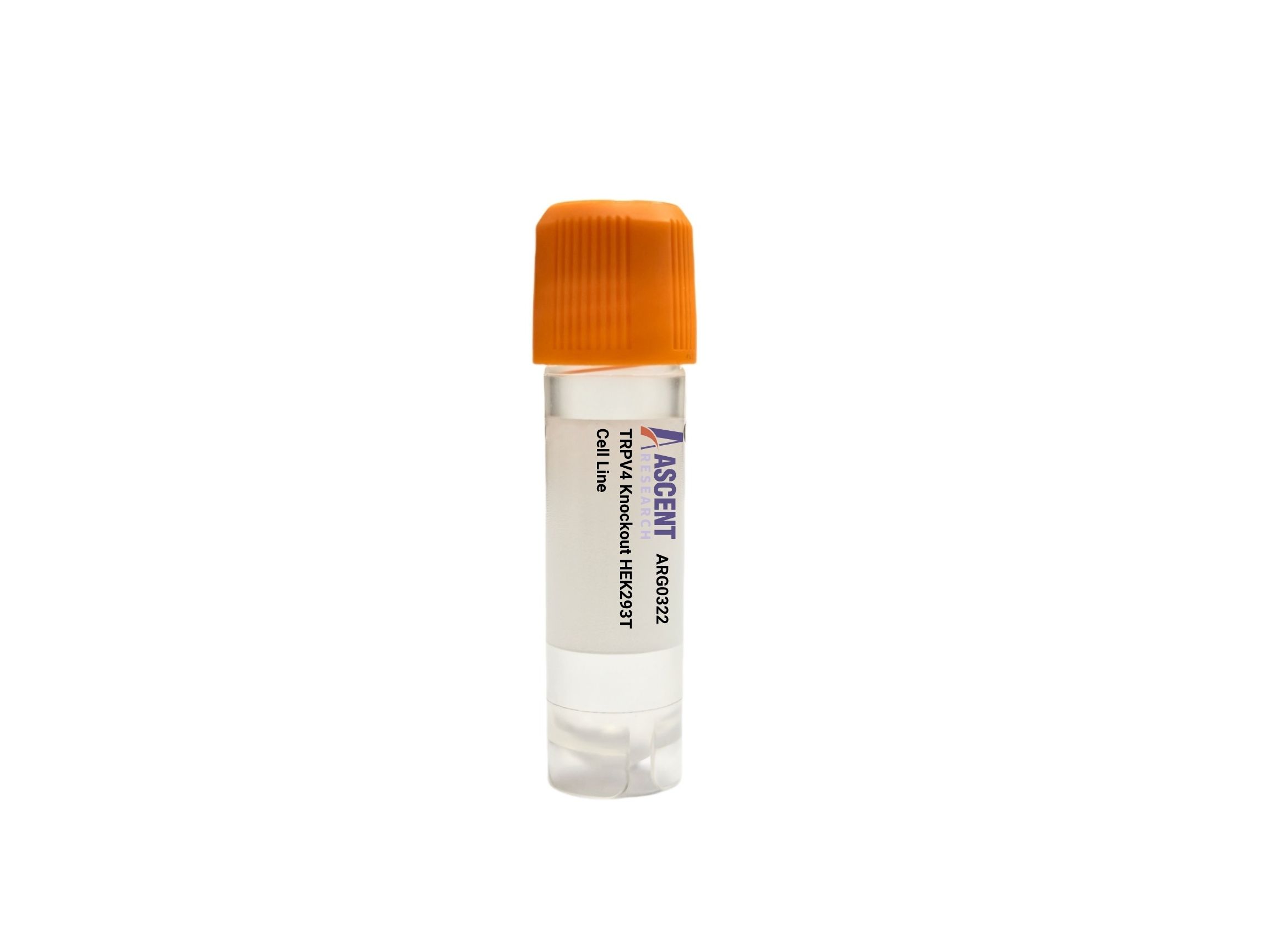
Genome-edited Cells
Kidney
The TRPV4 Knockout HEK293T Cell Line is a CRISPR/Cas9-edited knockout model in the HEK293T human embryonic kidney background, designed for investigating TRPV4-dependent signaling. This cell line provides a loss-of-function tool for dissecting the roles of TRPV4 as a polymodal calcium-permeable channel activated by mechanical, osmotic, and chemical stimuli. TRPV4-mediated calcium entry triggers calmodulin/calcineurin/NFAT and MAPK/ERK cascades, with implications in cell volume regulation, inflammation, and mechanotransduction. It is suitable for calcium imaging, electrophysiology, and disease modeling of skeletal dysplasias, neuropathies, and osteoarthritis.
 EPB41 Knockout NCI-H1975 Polyclonal Cells
Cat. No. ARG16659
CHEK1 Knockout HEK293 Polyclonal Cells
Cat. No. ARG12687
HBB Knockout HEK293T Polyclonal Cells
Cat. No. ARG26038
OTC Knockout HCT116 Polyclonal Cells
Cat. No. ARG7297
EPB41 Knockout NCI-H1975 Polyclonal Cells
Cat. No. ARG16659
CHEK1 Knockout HEK293 Polyclonal Cells
Cat. No. ARG12687
HBB Knockout HEK293T Polyclonal Cells
Cat. No. ARG26038
OTC Knockout HCT116 Polyclonal Cells
Cat. No. ARG7297
 Rabbit Bone Marrow Macrophage Medium
Cat. No. ARM0844
Rabbit Bone Marrow Macrophage Medium
Cat. No. ARM0844
 Rabbit Pulmonary Macrophages
Cat. No. ARP0671
Rabbit Pulmonary Macrophages
Cat. No. ARP0671
The TRPV4 Knockout HEK293T Cell Line is a CRISPR/Cas9-edited knockout cell line featuring targeted disruption of the TRPV4 gene. This loss-of-function model enables precise dissection of TRPV4-dependent cellular processes in the widely used HEK293T background, providing a reliable system for mechanistic studies and drug discovery efforts.
HEK293T cells are a human embryonic kidney line transformed with SV40 large T-antigen, facilitating high-level transgene expression and efficient transfection. They serve as a versatile platform for protein expression, ion channel research, and signaling pathway analysis, combining the advantages of renal epithelial origin with robust genetic manipulability.
TRPV4 is a polymodal non-selective cation channel activated by mechanical stretch, hypotonic swelling, heat, and chemical agonists including 4??-PDD and arachidonic acid. It functions as an osmosensor and mechanosensor, mediating calcium influx that triggers calmodulin, calcineurin, and CaMKII signaling, ultimately regulating transcription factors like NFAT and AP-1. The channel interacts with PACSIN2 and caveolin-1 and is modulated by PKA, PKC, and Src kinase. TRPV4-dependent calcium signals intersect with the MAPK/ERK and PI3K-Akt pathways, linking environmental stimuli to gene expression, cell volume control, and inflammatory responses.
Using HEK293T cells as the host provides a simplified, reproducible system to study TRPV4 function in isolation, free from the confounding influence of tissue-specific accessory proteins. This knockout model is particularly advantageous for investigating human TRPV4 mutations linked to skeletal dysplasias and neuropathies, as the human embryonic kidney background supports native-like channel properties while allowing facile transfection for structure-function analysis.
This cell line is ideal for calcium imaging assays using Fluo-4 or Fura-2, patch-clamp electrophysiology, and western blotting for phospho-ERK and other downstream effectors. It supports cell volume regulation and migration studies under mechanical or osmotic challenge and serves as a platform for high-throughput screening of TRPV4 modulators. The model is directly applicable to research on osteoarthritis, pulmonary edema, cardiac fibrosis, and TRPV4-related channelopathies. For more information, contact Ascent Research.