Genome-edited Cells
Kidney
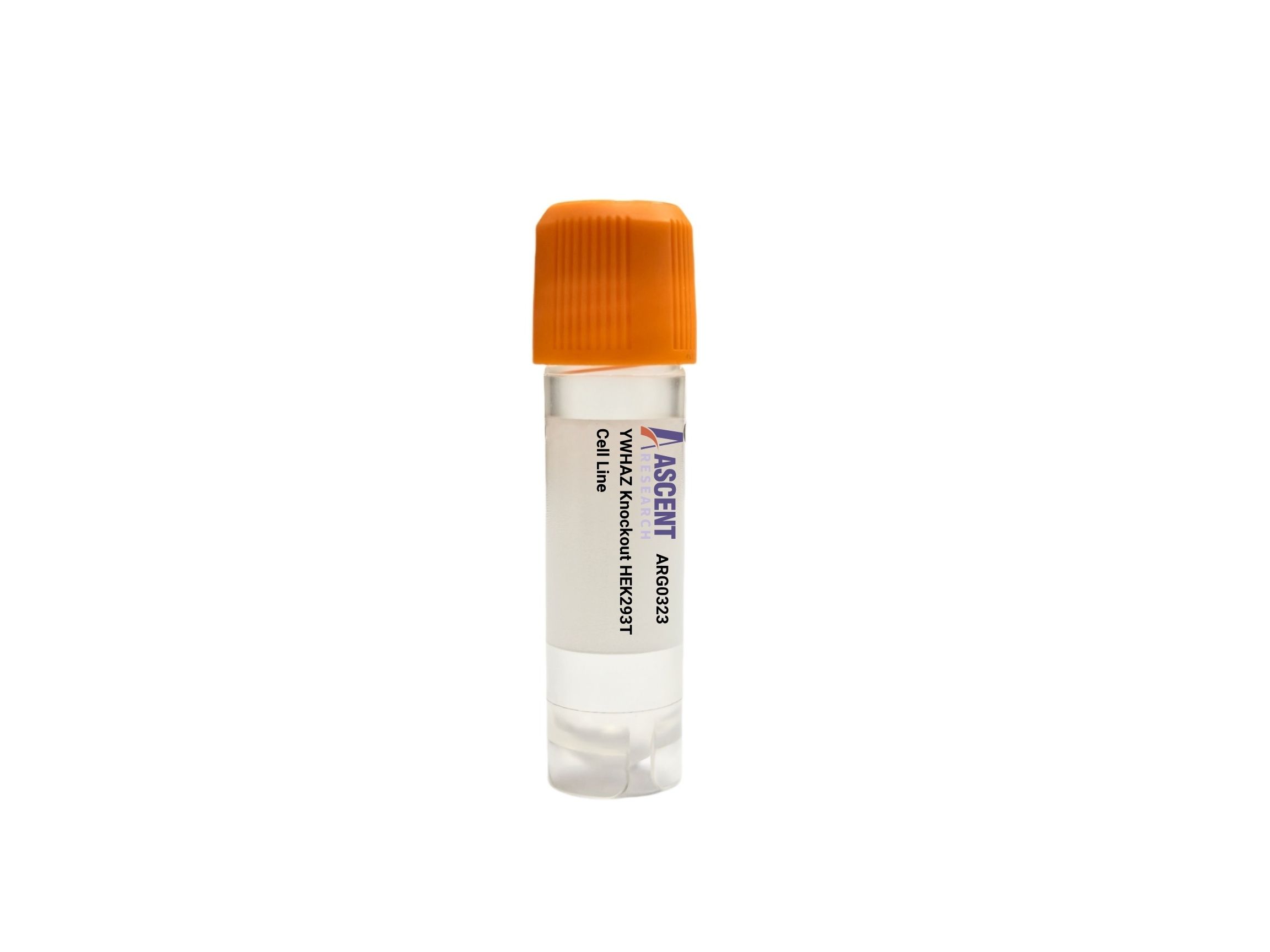
The YWHAZ Knockout HEK293T Cell Line is a CRISPR/Cas9-edited human cell line with targeted disruption of the 14-3-3 protein zeta gene. Derived from the HEK293T epithelial host, this loss-of-function model eliminates YWHAZ scaffold activity, perturbing key signaling networks including AKT/mTOR, RAF/MEK/ERK, and Hippo pathways that govern apoptosis, cell cycle, and metabolism. The cell line is suited for investigating 14-3-3-dependent regulation of client proteins such as BAD, FOXO factors, YAP, and p53. Applications include cancer, neurodegeneration, and metabolic disease research, employing techniques such as western blotting, co-immunoprecipitation, and functional assays for apoptosis, transcriptional activity, and drug response. The knockout line facilitates YWHAZ target validation and pathway dissection in a biologically relevant cellular context.
 ASB1 Knockout HAP1 Polyclonal Cells
Cat. No. ARG21923
ANKRD16 Knockout 786-O Polyclonal Cells
Cat. No. ARG24904
KRT18 Knockout AGS Polyclonal Cells
Cat. No. ARG35303
ACTA1 Knockout 769-P Polyclonal Cells
Cat. No. ARG35077
DLG5 Knockout HAP1 Polyclonal Cells
Cat. No. ARG38901
ASB1 Knockout HAP1 Polyclonal Cells
Cat. No. ARG21923
ANKRD16 Knockout 786-O Polyclonal Cells
Cat. No. ARG24904
KRT18 Knockout AGS Polyclonal Cells
Cat. No. ARG35303
ACTA1 Knockout 769-P Polyclonal Cells
Cat. No. ARG35077
DLG5 Knockout HAP1 Polyclonal Cells
Cat. No. ARG38901
 Rat Uterine Microvascular Endothelial Cell Medium
Cat. No. ARM0309
Rat Uterine Microvascular Endothelial Cell Medium
Cat. No. ARM0309
The YWHAZ Knockout HEK293T Cell Line is a genetically engineered human cell line generated by CRISPR/Cas9-mediated disruption of the YWHAZ gene. This loss-of-function model abolishes expression of the 14-3-3 protein zeta/delta (YWHAZ), providing a defined system for investigating YWHAZ-dependent signaling networks. The cell line is supplied as a ready-to-use knockout cell pool derived from the widely used HEK293T background, enabling rigorous functional studies without the need for transient knockdown approaches.
HEK293T cells are human embryonic kidney epithelial cells immortalized with adenovirus type 5 DNA and stably expressing the SV40 large T antigen. This derivative of the original HEK293 line supports high-level episomal replication of vectors containing the SV40 origin of replication, making it a preferred host for recombinant protein expression and lentiviral/retroviral production. Additionally, HEK293T cells retain key signaling machinery, including responsive PI3K/AKT, MAPK/ERK, and Hippo pathways, rendering them an appropriate background for dissecting YWHAZ-mediated signal transduction.
YWHAZ encodes the 14-3-3 protein zeta, a phosphoserine/phosphothreonine-binding scaffold that governs the subcellular localization and activity of many client proteins. It is phosphorylated by AKT, PKA, and PKC downstream of growth factor receptors, and subsequently interacts with effectors such as BAD, FOXO transcription factors, YAP, TSC2, and p53. Through these interactions, YWHAZ modulates PI3K/AKT and MAPK/ERK pro-survival signaling, Hippo pathway-mediated growth control, and p53-dependent cell cycle arrest. By tethering RAF1 and PI3K, YWHAZ facilitates signal propagation, while its binding to MDM2 influences p53 stability. Disruption of YWHAZ scaffolding dismantles these regulatory complexes, leading to altered apoptosis (via BAX/BCL2/Caspase-3), cell cycle progression (through CDC25 and p27), and metabolic reprogramming.
In the HEK293T background, constitutive expression of SV40 large T antigen dampens p53 and Rb checkpoints, rendering the cells reliant on growth factor-driven survival signals. YWHAZ knockout in this context is predicted to attenuate AKT and ERK phosphorylation, de-repress FOXO-mediated transcription, and disrupt YAP cytoplasmic retention, thereby sensitizing cells to apoptotic inducers. The high transfectability of HEK293T also facilitates rescue experiments using exogenous YWHAZ mutants, enabling detailed structure-function analyses.
Researchers can employ this knockout cell line to delineate YWHAZ-dependent mechanisms in cancer, neurodegeneration, and metabolic diseases. Standard assays include western blotting for phospho-AKT (Ser473) or phospho-ERK1/2 (Thr202/Tyr204), co-immunoprecipitation of RAF1 or p53, and immunofluorescence for YAP nuclear translocation. Functional readouts such as flow cytometry for Annexin V staining, RT-qPCR for FOXO1/3 target genes, and luciferase-based reporters for FOXO or YAP transcriptional activity provide quantitative pathway insights. Migration and drug sensitivity assays further extend the model??s utility in drug discovery and target validation studies. For further details, please contact Ascent Research.