Genome-edited Cells
Kidney
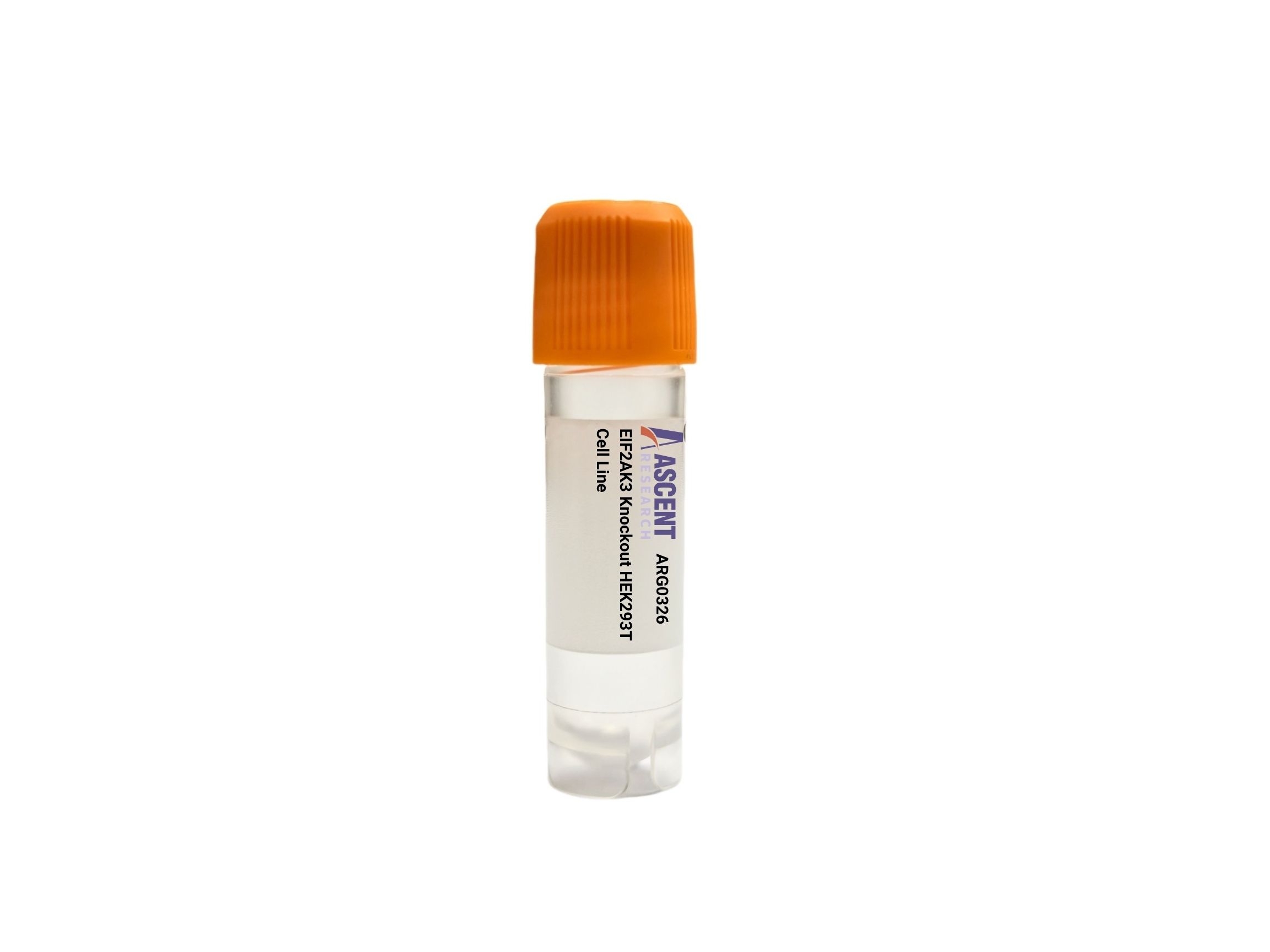
The EIF2AK3 Knockout HEK293T Cell Line is a CRISPR/Cas9-edited knockout cell line that disrupts the PERK kinase, a central mediator of the unfolded protein response. Derived from the widely used HEK293T human embryonic kidney epithelial line, this loss-of-function model enables dissection of the PERK-eIF2??-ATF4 signaling axis, which controls translational reprogramming and stress-induced gene expression under ER stress. By eliminating PERK, researchers can investigate its role in phosphorylating eIF2?? and inducing ATF4 and CHOP, key effectors in adaptation and apoptosis. Applications include Western blot, reporter assays, and viability studies under ER stress inducers, facilitating drug screening and pathway analysis in cancer and neurodegenerative disease research.
 FAM3C Knockout A2780 Polyclonal Cells
Cat. No. ARG18247
MB Knockout NCI-H1299 Polyclonal Cells
Cat. No. ARG17455
ARFGAP2 Knockout HGC-27 Polyclonal Cells
Cat. No. ARG29580
CASP6 Knockout 143B Polyclonal Cells
Cat. No. ARG42469
IFT80 Knockout huh-7 Polyclonal Cells
Cat. No. ARG28377
FAM3C Knockout A2780 Polyclonal Cells
Cat. No. ARG18247
MB Knockout NCI-H1299 Polyclonal Cells
Cat. No. ARG17455
ARFGAP2 Knockout HGC-27 Polyclonal Cells
Cat. No. ARG29580
CASP6 Knockout 143B Polyclonal Cells
Cat. No. ARG42469
IFT80 Knockout huh-7 Polyclonal Cells
Cat. No. ARG28377
 TC-1 Luciferase Stable Cell Line
Cat. No. ARG0786
TC-1 Luciferase Stable Cell Line
Cat. No. ARG0786
The EIF2AK3 Knockout HEK293T Cell Line is a CRISPR/Cas9-edited cell line in which the EIF2AK3 gene, encoding the PERK kinase, has been disrupted to create a loss-of-function model. This tool allows rigorous examination of PERK-dependent signaling within the unfolded protein response (UPR) and integrated stress response (ISR). By eliminating PERK function, the cell line enables investigation of the PERK-eIF2??-ATF4 signaling axis in a human background.
HEK293T cells, derived from human embryonic kidney epithelia transformed with adenovirus 5 DNA and stably expressing SV40 large T antigen, are widely utilized for transient protein expression and lentivirus production due to their high transfection efficiency. This epithelial line offers a robust platform for ER stress studies, with well-characterized UPR responses and compatibility with standard genetic manipulation.
EIF2AK3 (PERK) is an ER transmembrane kinase that activates upon ER stress via GRP78 dissociation, oligomerization, and autophosphorylation. It then phosphorylates eIF2?? to inhibit global translation while selectively increasing ATF4 translation. ATF4 promotes transcription of CHOP (DDIT3) and GADD34 (PPP1R15A), while PERK’s phosphorylation of NRF2 promotes antioxidant responses and its association with TRAF2 links to NF-??B signaling. The kinase is regulated by upstream ER stressors and interacting partners such as P58IPK.
In HEK293T, PERK knockout removes a central UPR branch, enabling deconvolution from IRE1?? and ATF6 pathways. This is critical for studying PERK-specific contributions to cell fate under ER stress agents like tunicamycin. Because PERK integrates multiple stress signals, its knockout provides a simplified system to dissect translational control and crosstalk with other pathways. The high transfectability of HEK293T permits reconstitution with PERK mutants for structure-function analyses. The model is relevant to diseases such as Wolcott-Rallison syndrome, diabetes, neurodegeneration, and cancer.
The cell line is suited for monitoring p-eIF2??, ATF4, and CHOP via Western blot; RT-qPCR of UPR markers; ATF4-luciferase reporter assays; immunoprecipitation; and viability/apoptosis assays under ER stress. It facilitates drug screening for UPR modulators, investigation of cancer cell vulnerability, and validation of PERK pathway components. For further information, please contact Ascent Research.