Genome-edited Cells
Kidney
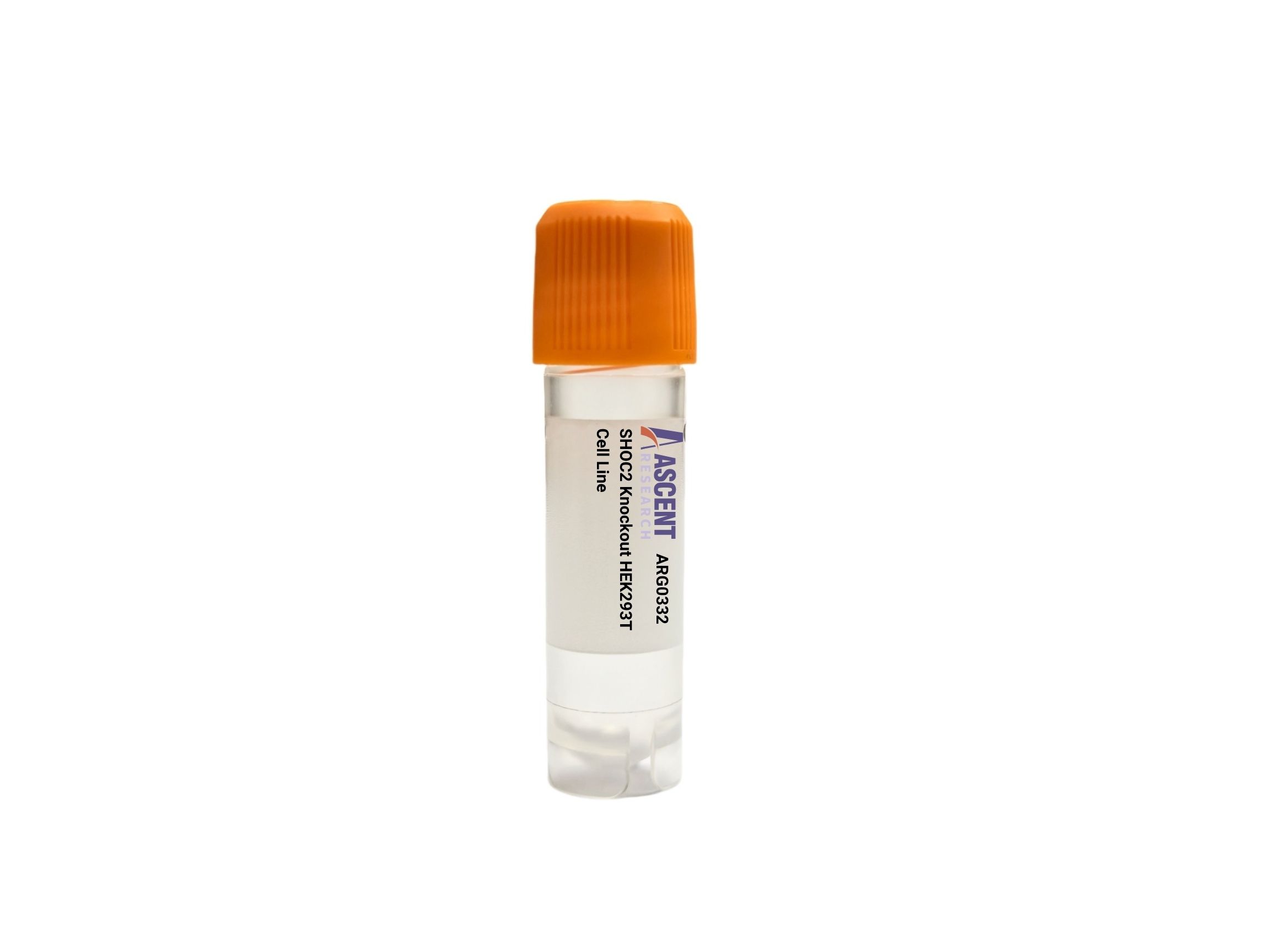
The SHOC2 Knockout HEK293T Cell Line is a CRISPR/Cas9-edited human cell model with targeted disruption of the SHOC2 gene. SHOC2 functions as a scaffold protein that links RAS GTPases to PP1C phosphatase, facilitating RAF dephosphorylation and activation of downstream MAPK/ERK signaling. It interacts with MRAS, PP1C, and RAF1, and integrates inputs from receptor tyrosine kinases such as EGFR and FGFR. This knockout cell line, established in the high-transfectability HEK293T background, is ideal for investigating RAS?CSHOC2?CRAF signaling nodes. Applications include western blot-based assessment of ERK phosphorylation, co-immunoprecipitation of SHOC2 complexes, drug sensitivity profiling with MEK inhibitors, and functional studies of SHOC2 mutations associated with Noonan syndrome and cancer.
 MEX3D Knockout HT29 Polyclonal Cells
Cat. No. ARG13975
ADRA2C Knockout HAP1 Polyclonal Cells
Cat. No. ARG21715
HMGCL Knockout HAP1 Polyclonal Cells
Cat. No. ARG22554
ID3 Knockout KYSE30 Polyclonal Cells
Cat. No. ARG36310
CC2D1A Knockout Raji Polyclonal Cells
Cat. No. ARG42832
MEX3D Knockout HT29 Polyclonal Cells
Cat. No. ARG13975
ADRA2C Knockout HAP1 Polyclonal Cells
Cat. No. ARG21715
HMGCL Knockout HAP1 Polyclonal Cells
Cat. No. ARG22554
ID3 Knockout KYSE30 Polyclonal Cells
Cat. No. ARG36310
CC2D1A Knockout Raji Polyclonal Cells
Cat. No. ARG42832
 Rat Satellite Glial Cells
Cat. No. ARP0343
Rat Satellite Glial Cells
Cat. No. ARP0343
The SHOC2 Knockout HEK293T Cell Line is a genetically engineered human cell product generated through CRISPR/Cas9-mediated disruption of the SHOC2 gene. This knockout model provides a loss-of-function system for investigating SHOC2-dependent molecular mechanisms. SHOC2 encodes a scaffold protein critical for RAS-to-RAF signal transduction, and its ablation allows researchers to dissect the control of MAPK/ERK pathway activation in a tractable cellular context.
The host cell line, HEK293T, is a widely used human embryonic kidney epithelial derivative that stably expresses the SV40 large T antigen, conferring high transfection efficiency and facilitating episomal replication of plasmids carrying the SV40 origin. This cell line is a mainstay in cell biology and biochemistry for overexpression studies, protein interaction analyses, and signaling experiments due to its ease of manipulation and robust growth characteristics.
SHOC2 functions as an essential scaffold that physically bridges RAS GTPases with the catalytic subunit of protein phosphatase 1 (PP1C). This interaction enables PP1C-mediated dephosphorylation of an inhibitory regulatory site on RAF kinases, including BRAF and RAF1, thereby promoting their kinase activity and downstream signal propagation. In the MAPK/ERK pathway, SHOC2 operates downstream of RAS and upstream of RAF?CMEK?CERK signaling. It interacts with MRAS, PP1C, and RAF1, and its function is modulated by upstream receptor tyrosine kinases such as EGFR and FGFR, as well as by RAS isoforms HRAS, KRAS, and NRAS. Downstream, SHOC2-dependent RAF activation leads to MEK and ERK phosphorylation and subsequent regulation of transcription factors like ELK1, ultimately influencing cellular responses to growth factors.
In the HEK293T background, endogenous expression of core MAPK pathway components provides a physiologically relevant setting for examining SHOC2??s scaffolding role. Disruption of SHOC2 is expected to impair RAF dephosphorylation and attenuate ERK activation in response to growth factor stimulation or oncogenic RAS signals. This makes the knockout line a valuable tool for dissecting signal flow in a high-transfectability host. Researchers can employ western blotting to measure phospho-ERK levels, co-immunoprecipitation to assess SHOC2?CRAS complex formation, and ERK pathway reporter assays to quantify transcriptional output. Additionally, proliferation assays and MEK inhibitor sensitivity studies can help delineate the contribution of SHOC2 to cell growth pathways implicated in Noonan syndrome, RASopathies, and various cancers.
This cell line supports a broad range of research applications, from basic RAS signaling studies to translational cancer biology. It can be used to screen small-molecule inhibitors targeting the MAPK cascade, investigate mechanisms of resistance to RAF or MEK inhibitors, and characterize oncogenic RAS variants in an isogenic background. In the context of developmental disorders, the knockout line enables functional analysis of SHOC2 mutations associated with Noonan syndrome and other RASopathies. For further details about this product, please contact Ascent Research.