Genome-edited Cells
Uterus (cervix)
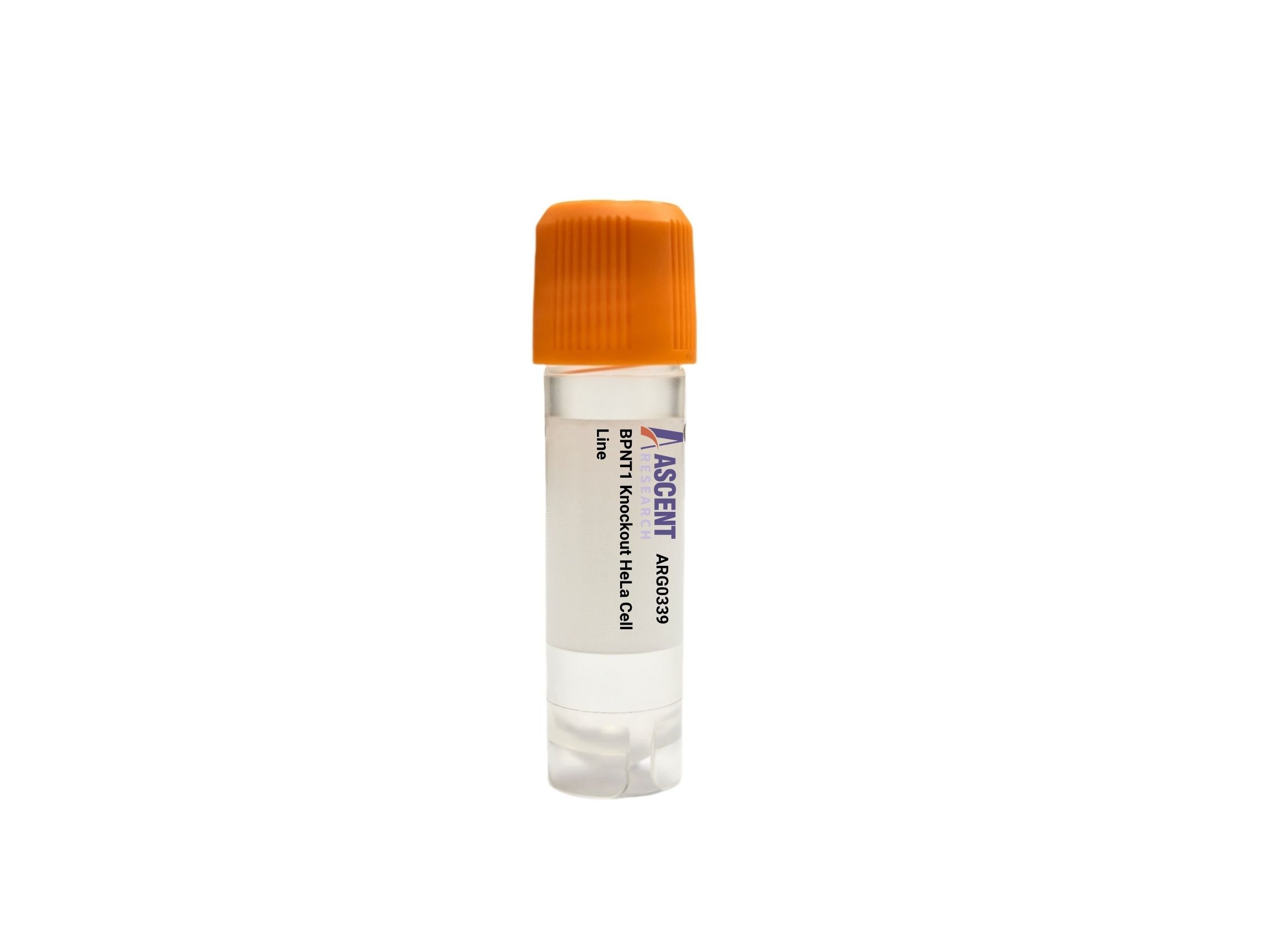
The BPNT1 Knockout HeLa Cell Line is a CRISPR/Cas9-edited derivative of HeLa human cervical adenocarcinoma cells. BPNT1 encodes a PAP/PAPS phosphatase; its disruption leads to PAP accumulation, which inhibits IMPase and INPP1, thereby impairing inositol phosphate recycling and PIP2-dependent signaling, mimicking lithium's mood-stabilizing mechanism. Applications include lithium signaling studies, bipolar disorder research, sulfur metabolism pathway analysis, and skeletal dysplasia modeling. Representative assays encompass LC-MS quantification of PAP and PAPS, HPLC-based inositol phosphate profiling, IMPase activity measurements, and calcium imaging for phosphoinositide signaling.
 CEP78 Knockout A2780 Polyclonal Cells
Cat. No. ARG18467
MREG Knockout HT29 Polyclonal Cells
Cat. No. ARG14660
ACAP2 Knockout 786-O Polyclonal Cells
Cat. No. ARG24795
AP4S1 Knockout huh-7 Polyclonal Cells
Cat. No. ARG27927
BAIAP2L1 Knockout SK-HEP-1 Polyclonal Cells
Cat. No. ARG32326
CEP78 Knockout A2780 Polyclonal Cells
Cat. No. ARG18467
MREG Knockout HT29 Polyclonal Cells
Cat. No. ARG14660
ACAP2 Knockout 786-O Polyclonal Cells
Cat. No. ARG24795
AP4S1 Knockout huh-7 Polyclonal Cells
Cat. No. ARG27927
BAIAP2L1 Knockout SK-HEP-1 Polyclonal Cells
Cat. No. ARG32326
 GRB2 Knockout ST Cell Line
Cat. No. ARG0768
GRB2 Knockout ST Cell Line
Cat. No. ARG0768
The BPNT1 Knockout HeLa Cell Line is a CRISPR/Cas9-edited HeLa derivative in which the BPNT1 gene has been disrupted, creating a stable loss-of-function model. This cell line enables dissection of BPNT1-dependent processes in phosphoinositide and sulfur metabolism without reliance on inhibitory drugs.
HeLa cells, the host for this knockout line, are immortalized human cervical adenocarcinoma epithelial cells isolated in 1951 from Henrietta Lacks. HPV-18 positive and genetically stable, they serve as a standard model in cancer biology, virology, and cell signaling research, providing a well-characterized platform for gene disruption studies.
BPNT1 encodes a magnesium-dependent inositol monophosphatase family protein that catalyzes dephosphorylation of PAP and PAPS to AMP and inorganic phosphate. Through this activity, BPNT1 regulates both sulfur metabolism and phosphoinositide signaling, functioning at a key metabolic node. The enzyme is directly inhibited by lithium, connecting its function to lithium-responsive neuropsychiatric conditions. In the knockout cell line, loss of BPNT1 activity leads to PAP and PAPS accumulation. Elevated PAP acts as a competitive inhibitor of inositol phosphate phosphatases, including IMPase (IMPA1/2) and inositol polyphosphate 1-phosphatase (INPP1), impairing dephosphorylation of inositol monophosphates and disrupting regeneration of phosphatidylinositol 4,5-bisphosphate (PIP2). Consequently, production of the calcium-mobilizing second messenger IP3 is reduced, recapitulating a lithium-mimetic state. Additionally, the transcription factor NRF2 is implicated as a potential upstream regulator under oxidative stress, adding a redox-sensitive layer of control over BPNT1 expression.
Within the HeLa cellular environment, the BPNT1 knockout provides a tractable system for studying lithium-sensitive phosphoinositide dynamics. HeLa cells express IMPase and INPP1 and maintain phospholipase C-coupled receptor signaling, allowing direct measurement of PIP2 turnover and calcium flux. Eliminating BPNT1 avoids off-target effects of lithium, enabling dissection of BPNT1-specific actions. This model integrates nucleotide metabolism, sulfation, and inositide signaling, bridging neuropharmacology and cancer biology.
This cell line supports applications in lithium signaling, bipolar disorder research, sulfur metabolism, sulfation pathway analysis, skeletal dysplasia modeling, and inositol phosphate signaling studies. Representative assays include Western blotting for BPNT1 ablation, LC-MS quantification of PAP/PAPS, inositol phosphate profiling, IMPase activity measurements, calcium imaging, and lithium sensitivity assays. RNA-seq can be used for transcriptomic profiling. For further details, please contact Ascent Research.