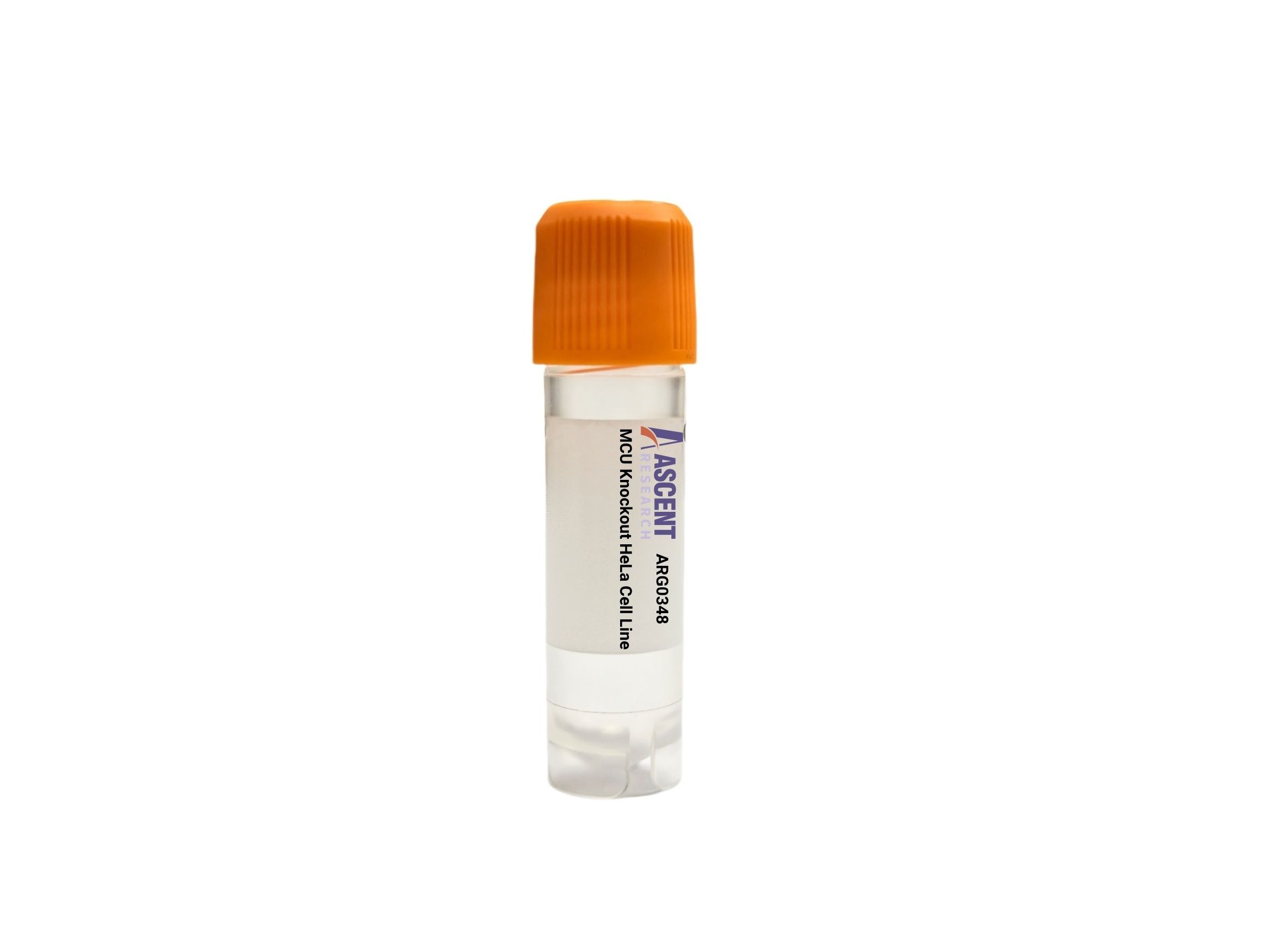
Genome-edited Cells
Uterus (cervix)
The MCU Knockout HeLa Cell Line is a CRISPR/Cas9-edited cell line with targeted disruption of MCU, the pore-forming subunit of the mitochondrial calcium uniporter. Derived from human HeLa epithelial cells, this model eliminates MCU-dependent mitochondrial calcium uptake, enabling precise investigation of metabolism, apoptosis, and calcium signaling. MCU??s regulation by MICU1/MICU2 and its downstream effects on pyruvate dehydrogenase and caspase activation highlight its central role in mitochondrial physiology. Ideal for studies of oxidative phosphorylation, mitochondrial calcium dynamics, and cell death pathways, the knockout line supports applications such as Rhod-2 AM imaging, Seahorse metabolic profiling, and high-throughput drug discovery. It provides a reliable, cancer-relevant platform for dissecting MCU-dependent mechanisms and validating potential therapeutic interventions.
 ATP2C2 Knockout HAP1 Polyclonal Cells
Cat. No. ARG21988
CTTNBP2NL Knockout jurkat Polyclonal Cells
Cat. No. ARG13237
LILRB4 Knockout NCI-H1703 Polyclonal Cells
Cat. No. ARG12558
FERMT1 Knockout A549 Polyclonal Cells
Cat. No. ARG10941
HOOK3 Knockout NCI-H1975 Polyclonal Cells
Cat. No. ARG31659
KDM6A Knockout HAP1 Polyclonal Cells
Cat. No. ARG27673
ATP2C2 Knockout HAP1 Polyclonal Cells
Cat. No. ARG21988
CTTNBP2NL Knockout jurkat Polyclonal Cells
Cat. No. ARG13237
LILRB4 Knockout NCI-H1703 Polyclonal Cells
Cat. No. ARG12558
FERMT1 Knockout A549 Polyclonal Cells
Cat. No. ARG10941
HOOK3 Knockout NCI-H1975 Polyclonal Cells
Cat. No. ARG31659
KDM6A Knockout HAP1 Polyclonal Cells
Cat. No. ARG27673
The MCU Knockout HeLa Cell Line is a CRISPR/Cas9-edited knockout cell line featuring targeted disruption of the MCU gene, which encodes the pore-forming subunit of the mitochondrial calcium uniporter. This loss-of-function model enables rigorous dissection of mitochondrial calcium uptake and its downstream effects in a stable, renewable cellular context. Providing a critical control for comparative studies against wild-type HeLa cells, the cell line facilitates investigation of MCU-dependent metabolic and apoptotic processes within an adherent epithelial model.
HeLa cells are a human epithelial cell line derived from cervical adenocarcinoma, characterized by HPV18-positivity, aneuploidy, and immortalized growth. Despite genomic complexity, HeLa cells maintain functional mitochondrial machinery and apoptotic pathways, providing a consistent and well-characterized host for gene-editing studies. Their widespread use in cancer and metabolic research ensures translational relevance, making them an ideal background for MCU knockout generation.
MCU constitutes the principal channel of the mitochondrial calcium uniporter complex, mediating rapid calcium influx into the mitochondrial matrix at ER-mitochondria contact sites in response to high-cytosolic calcium microdomains. The channel is allosterically regulated by MICU1 and MICU2, which set the calcium uptake threshold, while EMRE and MCUB contribute to complex assembly. Upstream regulators include calcium, MICU1, MICU2, EMRE, and reactive oxygen species, and downstream targets encompass pyruvate dehydrogenase phosphatase, TCA cycle enzymes, and caspase activation, linking MCU activity to oxidative metabolism and apoptotic execution. Interacting factors such as MCUR1 and SLC25A23 further fine-tune MCU function, and representative pathway components include VDAC, IP3R, and the MCU holocomplex.
In HeLa cells, MCU disruption ablates the primary route for mitochondrial calcium import, creating a powerful platform to dissect metabolism-apoptosis crosstalk. Loss of MCU decouples calcium signaling from pyruvate dehydrogenase phosphatase activation and TCA cycle stimulation, thereby altering oxidative phosphorylation and cellular bioenergetics. The knockout also impairs calcium-induced mitochondrial permeability transition, offering insight into apoptosis resistance mechanisms relevant to cancer. The HPV18-positive, aneuploid background provides a disease-relevant context for examining how mitochondrial calcium dynamics influence oncogenic signaling, stress responses, and therapeutic vulnerability.
This cell line supports mitochondrial calcium imaging with Rhod-2 AM, JC-1 membrane potential assays, and Seahorse metabolic profiling. It facilitates apoptosis signaling studies via Annexin V and caspase assays, expression analysis by western blotting and RT-qPCR, and high-throughput drug screens. For further information, please contact Ascent Research.