Genome-edited Cells
Uterus (cervix)
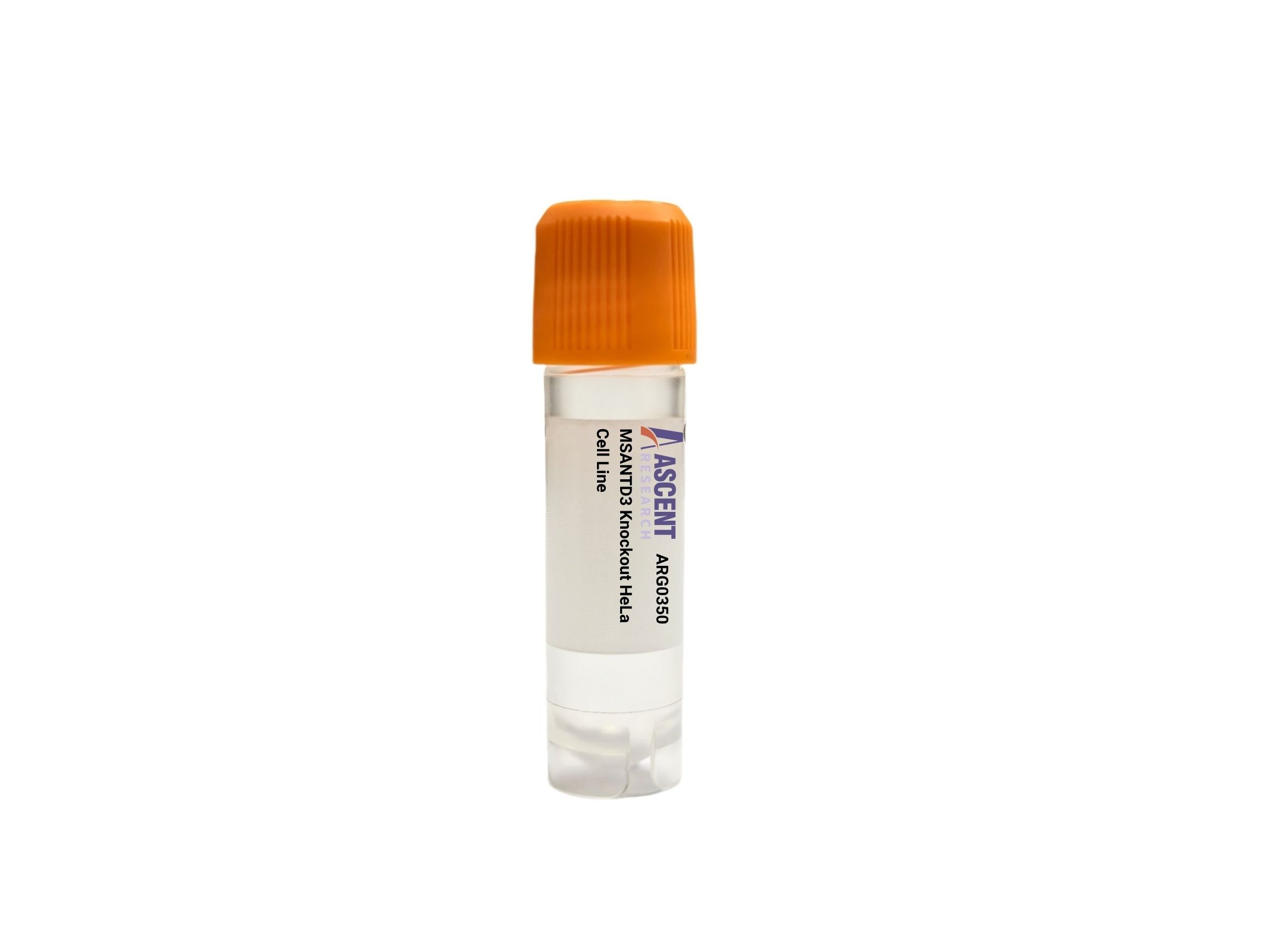
The MSANTD3 Knockout HeLa Cell Line is a CRISPR/Cas9-edited knockout cell product derived from HeLa cervical carcinoma cells, providing a defined loss-of-function model for studying MSANTD3, a Myb/SANT domain-containing protein implicated in transcriptional regulation. By eliminating MSANTD3 expression, this model enables investigation of its role in cancer cell phenotypes and gene control. The HeLa background, with its HPV-18-driven transformation, offers a relevant context for assessing effects on proliferation, migration, and drug response. Applications include validation by Western blotting and RT-qPCR, functional assays, and transcriptomic profiling, making it a versatile tool for transcriptional biology and oncology research.
 IL27RA Knockout Hela Polyclonal Cells
Cat. No. ARG26255
APAF1 Knockout HGC-27 Polyclonal Cells
Cat. No. ARG29555
ITIH2 Knockout HGC-27 Polyclonal Cells
Cat. No. ARG30070
ADPGK Knockout Hela Polyclonal Cells
Cat. No. ARG37458
C2CD3 Knockout A549 Polyclonal Cells
Cat. No. ARG41379
MICU1 Knockout Raji Polyclonal Cells
Cat. No. ARG1764
IL27RA Knockout Hela Polyclonal Cells
Cat. No. ARG26255
APAF1 Knockout HGC-27 Polyclonal Cells
Cat. No. ARG29555
ITIH2 Knockout HGC-27 Polyclonal Cells
Cat. No. ARG30070
ADPGK Knockout Hela Polyclonal Cells
Cat. No. ARG37458
C2CD3 Knockout A549 Polyclonal Cells
Cat. No. ARG41379
MICU1 Knockout Raji Polyclonal Cells
Cat. No. ARG1764
The MSANTD3 Knockout HeLa Cell Line is a CRISPR/Cas9-edited knockout cell line featuring targeted disruption of the MSANTD3 gene in HeLa cells. This loss-of-function model allows researchers to investigate the role of MSANTD3 in transcriptional regulation and cancer cell biology. The knockout eliminates functional protein expression, providing a clean genetic background for comparative studies. The cell line is ideal for functional genomics experiments that require a stable, homogeneous MSANTD3-null population, enabling elucidation of the gene??s contributions to oncogenic processes.
HeLa cells are an HPV-18-positive cervical adenocarcinoma line widely used in biomedical research. These immortalized epithelial cells grow robustly and retain key cancer-relevant signaling pathways. HPV oncoproteins E6 and E7 inactivate p53 and Rb, respectively, creating a transformation-prone environment that is valuable for studying tumor biology. The well-characterized HeLa genome and extensive experimental track record make this host a suitable system to dissect the functional consequences of MSANTD3 knockout in a human cancer setting.
MSANTD3 contains a Myb/SANT domain predicted to bind DNA in a sequence-specific manner, placing it within a family of transcriptional regulators and chromatin modifiers. Although its precise function remains undefined, the domain architecture strongly suggests involvement in transcriptional control, either by directly modulating target gene expression or by participating in chromatin remodeling complexes. As upstream activators and downstream effectors are currently unknown, this knockout model offers an unbiased platform to map MSANTD3??s regulatory network through genomic and proteomic approaches.
In HeLa cells, MSANTD3 knockout can reveal whether the protein contributes to cancer hallmarks such as unchecked proliferation, enhanced migration, or altered drug sensitivity. Because HeLa cells are already transformed, loss of a putative tumor suppressor or oncogene may shift cellular behavior in measurable ways. The HPV oncoprotein context further provides an opportunity to study crosstalk between viral transformation and host transcriptional regulators. Thus, this model is a strategic tool for investigating MSANTD3 as a potential target or biomarker in cervical or other cancers.
Researchers can utilize this knockout line in diverse applications, including Western blotting, RT-qPCR, and immunofluorescence to confirm gene disruption and assess downstream changes. Functional assays such as proliferation, motility, and drug sensitivity screens quantify biological impacts. For deeper pathway analysis, RNA sequencing or chromatin assays can identify MSANTD3-dependent transcriptional programs. These studies collectively help define MSANTD3??s role in cancer cell biology. For additional details, please contact Ascent Research.