Genome-edited Cells
Uterus (cervix)
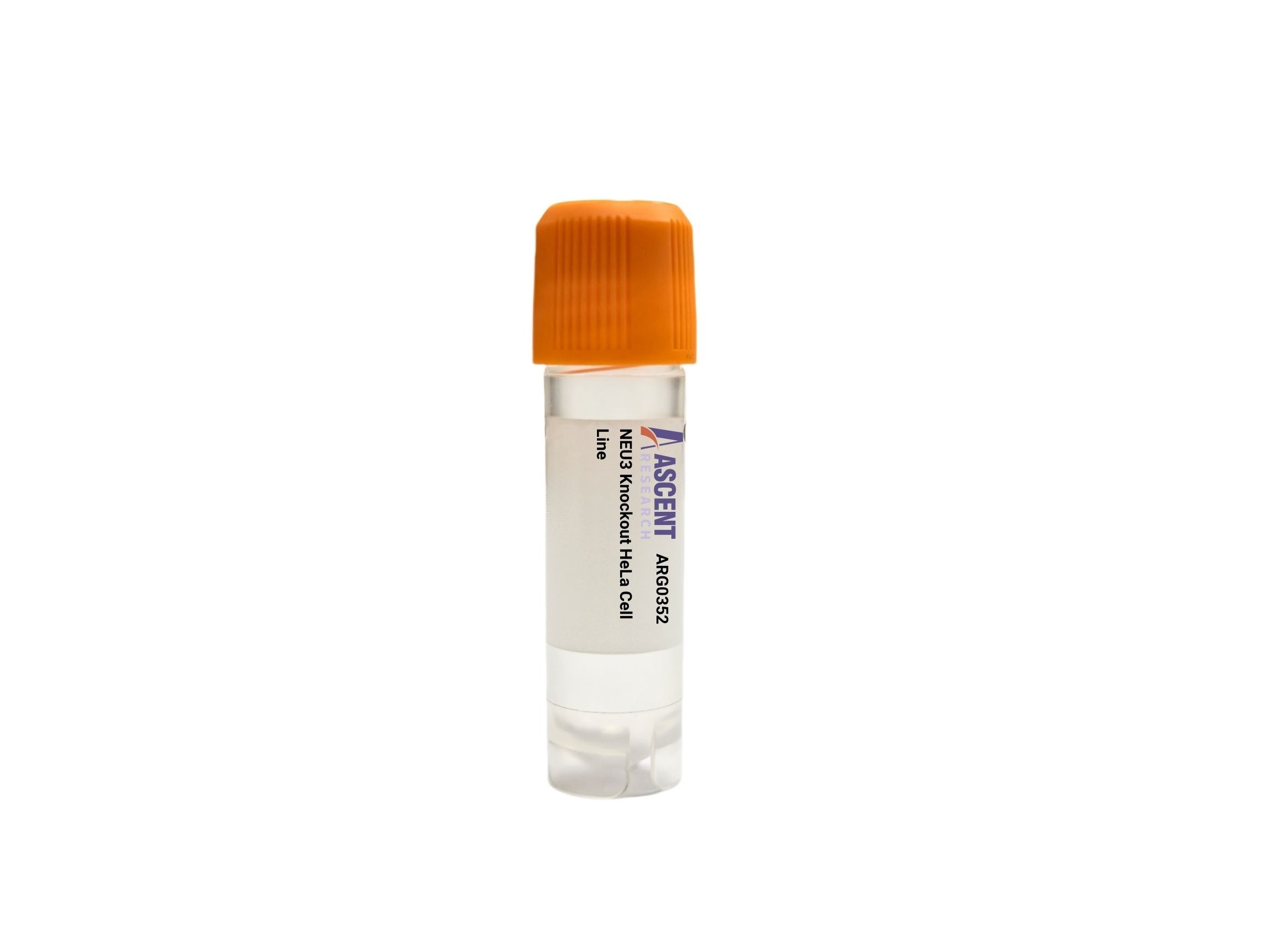
The NEU3 Knockout HeLa Cell Line is a CRISPR/Cas9-edited HeLa cell model with targeted disruption of the NEU3 gene, eliminating the plasma membrane sialidase that modulates ganglioside composition. It enables investigation of NEU3??s role in EGFR signaling, cell adhesion, and apoptosis, relevant to cervical and colorectal cancer research. Key features include abrogation of ganglioside GM3, GD1a, and GD1b hydrolysis, altering downstream ERK1/2 and AKT pathways. Applicable for ganglioside profiling, migration assays, and drug resistance studies using western blotting, LC-MS, and flow cytometry.
 GCC2 Knockout A2780 Polyclonal Cells
Cat. No. ARG18952
MMADHC Knockout A549 Polyclonal Cells
Cat. No. ARG10212
HDLBP Knockout 786-O Polyclonal Cells
Cat. No. ARG25241
ITM2B Knockout A549 Polyclonal Cells
Cat. No. ARG34269
ECHDC1 Knockout K562 Polyclonal Cells
Cat. No. ARG40344
MTX3 Knockout AGS Polyclonal Cells
Cat. No. ARG2234
GCC2 Knockout A2780 Polyclonal Cells
Cat. No. ARG18952
MMADHC Knockout A549 Polyclonal Cells
Cat. No. ARG10212
HDLBP Knockout 786-O Polyclonal Cells
Cat. No. ARG25241
ITM2B Knockout A549 Polyclonal Cells
Cat. No. ARG34269
ECHDC1 Knockout K562 Polyclonal Cells
Cat. No. ARG40344
MTX3 Knockout AGS Polyclonal Cells
Cat. No. ARG2234
The NEU3 Knockout HeLa Cell Line is a CRISPR/Cas9-edited knockout cell line derived from HeLa cells, with targeted disruption of the NEU3 gene. This loss-of-function model enables dissection of NEU3-dependent ganglioside modulation in a human epithelial cancer background. By eliminating NEU3 sialidase activity, the line facilitates investigation of cell surface glycosylation impacts on signaling and disease.
HeLa cells are a human cervical adenocarcinoma epithelial cell line, HPV18-positive and hypertriploid, serving as a classic cervical cancer model. Their adherent epithelial morphology and rapid growth make them ideal for oncology research. The NEU3 knockout derivative provides a genetically modified comparator for studying glycosylation-driven phenotypes in a well-characterized cancer context.
NEU3 encodes a plasma membrane sialidase that hydrolyzes sialic acids from gangliosides GM3, GD1a, and GD1b, thereby remodeling lipid rafts and modulating EGFR activation. NEU3 is regulated by EGF/EGFR, PKC, MEK/ERK, and SP1, and induced by PMA. Downstream, it enhances phosphorylation of EGFR, ERK1/2, AKT, and FAK, and influences Bcl-2-mediated apoptosis. NEU3 interacts with caveolin-1 and integrin ??1, linking ganglioside metabolism to adhesion and growth factor signaling.
In HeLa cells, NEU3 knockout disrupts ganglioside balance, altering EGFR and integrin signaling, which affects proliferation, migration, and survival. This line is particularly relevant for cervical cancer research, enabling studies on how NEU3-mediated ganglioside remodeling contributes to tumor progression and drug resistance. It also facilitates exploration of cross-talk between ganglioside metabolism and insulin signaling, given HeLa??s use in metabolic studies. The knockout model supports rigorous comparison with parental controls to elucidate NEU3??s role in cancer cell biology.
Researchers can utilize this cell line for western blotting and RT-qPCR to confirm knockout and pathway readouts, ganglioside TLC/LC-MS for glycolipid profiling, and flow cytometry for surface ganglioside detection. Functional assays include proliferation, migration/invasion, EGFR phosphorylation, and apoptosis analyses. Co-immunoprecipitation can probe NEU3 interactions with caveolin-1 or integrin ??1. Applications encompass studies of EGFR signaling, drug resistance, and ganglioside-mediated apoptosis in cervical and colorectal cancer models. For inquiries, please contact Ascent Research.