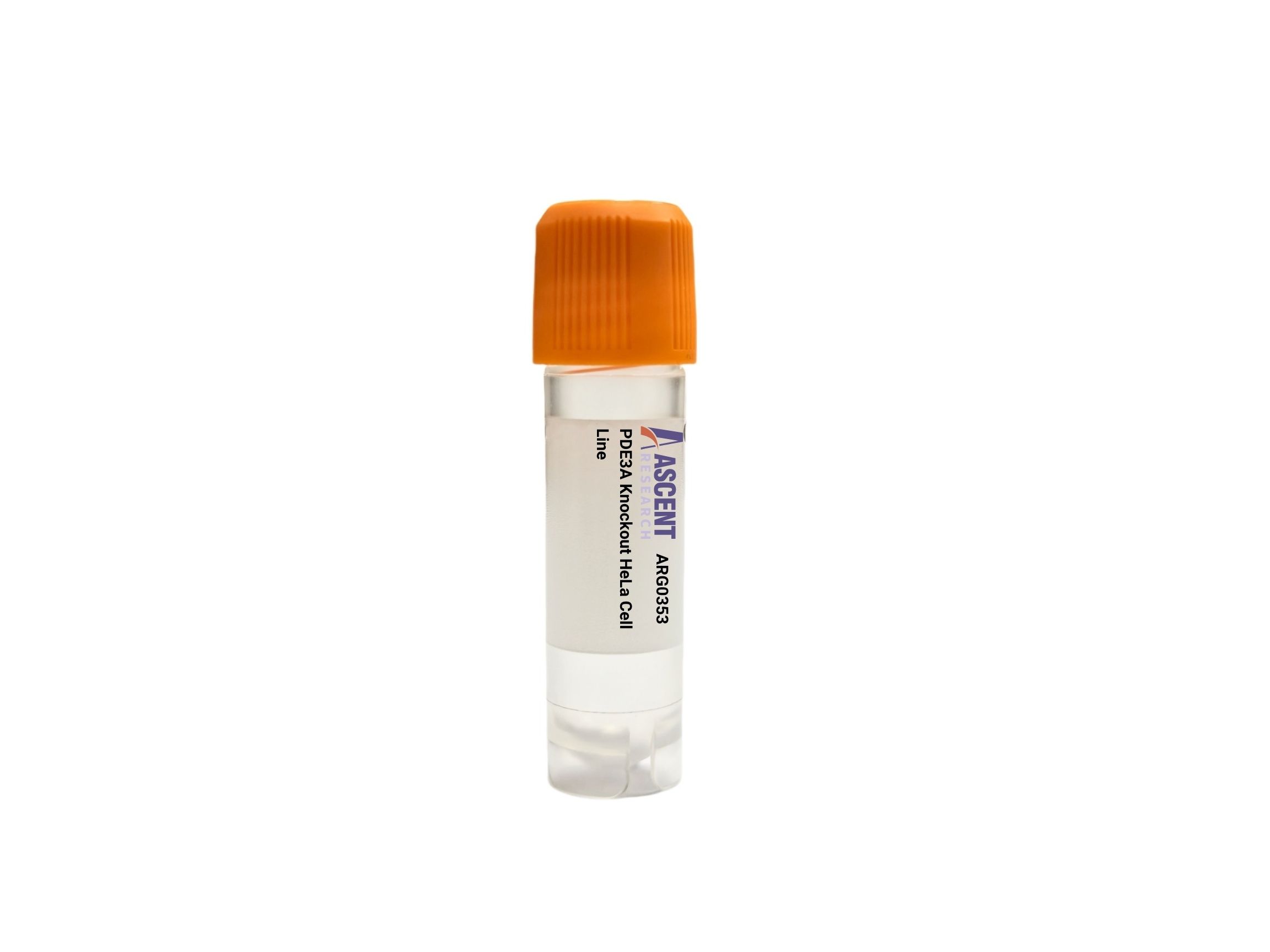
Genome-edited Cells
Uterus (cervix)
The PDE3A Knockout HeLa Cell Line is a CRISPR/Cas9-edited knockout cell line derived from the HPV18-positive cervical adenocarcinoma HeLa cell line. It features targeted disruption of the PDE3A gene, which encodes a dual-specificity cAMP/cGMP phosphodiesterase that attenuates PKA and PKG signaling. Knockout elevates basal cAMP, sustaining PKA activation and altering CREB-dependent transcription, with upstream regulation by ??-adrenergic receptors and insulin receptor/Akt. This model is ideal for investigating cAMP/PKA signaling, phosphodiesterase biology, and cervical cancer mechanisms. Applications include functional assays (e.g., cAMP ELISA, Western blotting), transcriptional profiling (RT-qPCR, RNA-seq), and drug screening for PDE3 inhibitors. Researchers can employ it for studies on cell proliferation, apoptosis, and migration in a disease-relevant cellular context.
 CAMSAP2 Knockout HGC-27 Polyclonal Cells
Cat. No. ARG29806
LYRM7 Knockout HT29 Polyclonal Cells
Cat. No. ARG13942
ARHGEF18 Knockout 786-O Polyclonal Cells
Cat. No. ARG24977
AP1G1 Knockout AGS Polyclonal Cells
Cat. No. ARG26584
CAMSAP2 Knockout HGC-27 Polyclonal Cells
Cat. No. ARG29806
LYRM7 Knockout HT29 Polyclonal Cells
Cat. No. ARG13942
ARHGEF18 Knockout 786-O Polyclonal Cells
Cat. No. ARG24977
AP1G1 Knockout AGS Polyclonal Cells
Cat. No. ARG26584
 ARD
Cat. No. ARC0051
ARD
Cat. No. ARC0051
 Rat Endometrial Stromal Fibroblasts
Cat. No. ARP0306
Rat Endometrial Stromal Fibroblasts
Cat. No. ARP0306
The PDE3A Knockout HeLa Cell Line is a human cell line in which the PDE3A gene has been disrupted via CRISPR/Cas9-mediated gene editing. This knockout cell line, derived from the HeLa host, provides a stable loss-of-function model for studying phosphodiesterase 3A (PDE3A) in a cervical adenocarcinoma background. The gene disruption eliminates PDE3A expression, enabling investigation of its role in cyclic nucleotide signaling without residual activity. It is suitable for acute and long-term experiments in signal transduction, cancer biology, and pharmacology.
The parental HeLa line is an HPV18-positive epithelial cell line from cervical adenocarcinoma, widely used for its robust growth and well-characterized molecular features. HeLa cells retain hallmarks of cervical cancer, including aberrant proliferation and altered apoptosis, with active kinase networks. HPV18 E6/E7 oncoproteins drive cell cycle dysregulation and genomic instability, providing a relevant context for studying phosphodiesterase-mediated signaling in cervical carcinogenesis.
PDE3A encodes a cAMP/cGMP phosphodiesterase that hydrolyzes cyclic nucleotides, terminating PKA and PKG signals. ??-adrenergic receptors activate adenylyl cyclase to produce cAMP, which stimulates PKA and Epac, leading to CREB phosphorylation and gene transcription. PDE3A degrades cAMP, acting as a feedback regulator. cGMP competitively inhibits PDE3A, integrating cGMP-PKG and cAMP pathways. Upstream regulators include insulin receptor/Akt and calcium/calmodulin, while 14-3-3 proteins, AKAPs, and PRKAR2A scaffold PDE3A in subcellular compartments. In the knockout line, loss of PDE3A elevates basal cAMP, causing sustained PKA activation and altered CREB-dependent transcription, impacting downstream effectors like Epac and PKG.
In HeLa cells, PDE3A disruption highlights its role in cAMP-dependent processes critical for cervical cancer behavior. Without PDE3A, enhanced PKA signaling affects proliferation, apoptosis, migration, and drug sensitivity. The HPV18 background adds complexity, as viral oncoproteins intersect with host cAMP pathways; sustained PKA may modulate viral gene expression or the transcriptome to alter tumorigenic properties. This knockout line thus helps dissect PDE3A integration of hormonal and metabolic signals with oncogenic pathways, revealing vulnerabilities in cervical cancer cells dependent on cyclic nucleotide control.
This cell line supports diverse applications. cAMP ELISA, Western blotting, and immunofluorescence quantify cAMP levels and PKA phosphorylation. Transcriptional profiling via RT-qPCR or RNA-seq elucidates PDE3A-dependent gene networks, including CREB targets. Functional assays (MTT, Transwell migration, flow cytometry) assess proliferation, motility, and apoptosis. For drug screening, PDE3 inhibitor sensitivity assays with PDE3A-null controls validate target specificity. This model advances phosphodiesterase research and its therapeutic relevance. For inquiries, contact Ascent Research.