Genome-edited Cells
Uterus (cervix)
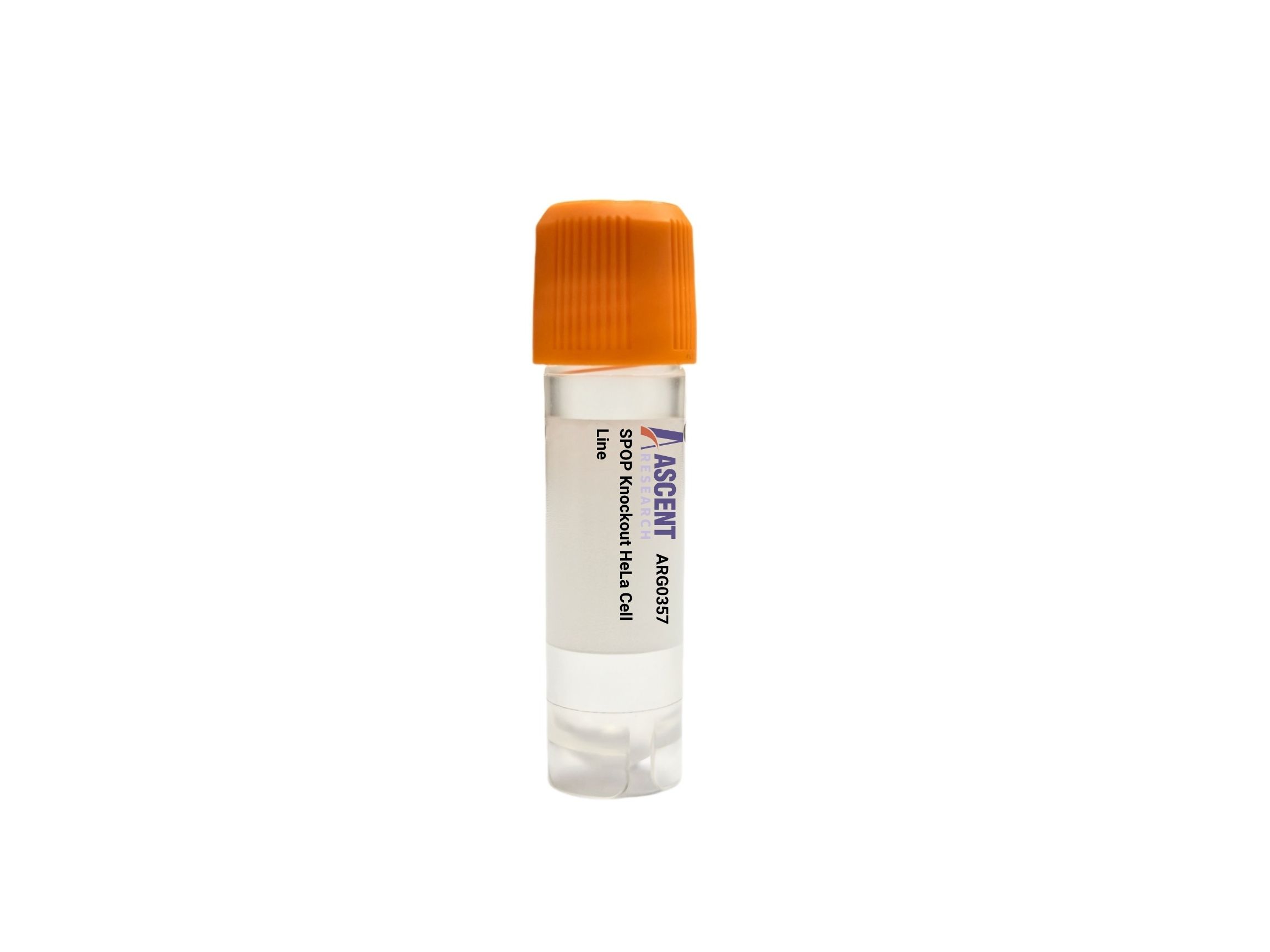
The SPOP Knockout HeLa Cell Line is a CRISPR/Cas9-edited human cervical adenocarcinoma epithelial cell line with targeted disruption of the SPOP gene. SPOP serves as a substrate adaptor for the CUL3-RBX1 E3 ligase, directing proteins such as the androgen receptor (AR) and BRD4 for ubiquitination and degradation, thereby regulating hormone signaling and other critical pathways. This knockout model is a key tool for investigating SPOP??s role in cancer, particularly in prostate and endometrial cancers where SPOP mutations are frequent. Researchers can utilize this cell line to study substrate stabilization, hormone signaling, and proteasome-mediated degradation using assays like Western blotting and co-immunoprecipitation.
 CIDEB Knockout A2780 Polyclonal Cells
Cat. No. ARG18945
GCLC Knockout HT29 Polyclonal Cells
Cat. No. ARG15081
Hdac1 Knockout RAW 264.7 Polyclonal Cells
Cat. No. ARG23547
IKZF5 Knockout A2780 Polyclonal Cells
Cat. No. ARG29208
ACSL5 Knockout NCI-H1975 Polyclonal Cells
Cat. No. ARG31010
GANAB Knockout MES-OV Polyclonal Cells
Cat. No. ARG6744
CIDEB Knockout A2780 Polyclonal Cells
Cat. No. ARG18945
GCLC Knockout HT29 Polyclonal Cells
Cat. No. ARG15081
Hdac1 Knockout RAW 264.7 Polyclonal Cells
Cat. No. ARG23547
IKZF5 Knockout A2780 Polyclonal Cells
Cat. No. ARG29208
ACSL5 Knockout NCI-H1975 Polyclonal Cells
Cat. No. ARG31010
GANAB Knockout MES-OV Polyclonal Cells
Cat. No. ARG6744
The SPOP Knockout HeLa Cell Line is a CRISPR/Cas9-edited cell line derived from Homo sapiens, designed to disrupt SPOP and ablate protein expression. This loss-of-function model provides a stable and renewable resource for investigating the biological consequences of SPOP deletion in a well-characterized epithelial cancer cell background. Supplied as a viable cell line, it is suitable for expansion and downstream molecular and cellular assays.
The parental HeLa cell line is an immortalized human cervical adenocarcinoma epithelial model, widely utilized in cancer biology and cell signaling research. HeLa cells are HPV18-positive, with E6 and E7 oncoproteins that inactivate the tumor suppressors p53 and Rb, respectively. This genetic context creates a permissive environment for studying oncogenic pathways and stress responses, making it a relevant host for examining the ubiquitin-proteasome system in cancer.
SPOP encodes the speckle-type POZ protein, a substrate recognition adaptor for the CUL3-RBX1 E3 ubiquitin ligase complex. Its MATH domain binds substrates such as the androgen receptor (AR), the ETS transcription factor ERG, the steroid receptor coactivator NCOA3/SRC-3, the BET protein BRD4, and the Hedgehog effectors GLI2 and GLI3, targeting them for ubiquitination and proteasomal degradation. SPOP thereby regulates multiple signaling networks, including nuclear hormone receptor, HIF-1, and DNA damage response pathways. Upstream regulators include TP53, ESR1, HIF1A, and miR-145, while downstream targets involve CD274/PD-L1. Knockout of SPOP disrupts CRL3-SPOP-mediated turnover, leading to stabilization and accumulation of substrate proteins and perturbation of these pathways.
In the HeLa context, SPOP knockout amplifies dysregulation of tumor suppressor and oncogenic networks already compromised by HPV oncoproteins. The loss of SPOP-mediated degradation is expected to elevate levels of AR, BRD4, and other substrates, potentially enhancing transcriptional programs driving proliferation, survival, and altered apoptosis. Given HeLa??s defective p53 and Rb checkpoints, this model offers a valuable platform to dissect SPOP-dependent mechanisms without confounding feedback from intact tumor suppressors, enabling precise analysis of how substrate stabilization influences cancer-related phenotypes.
Researchers can employ this SPOP knockout cell line in a wide range of experimental applications, including prostate and endometrial cancer studies where SPOP mutations are prevalent, investigation of the ubiquitin-proteasome pathway, and validation of therapeutic targets. Representative assays include Western blotting for substrate accumulation (e.g., AR, BRD4), co-immunoprecipitation for residual protein interactions, ubiquitination assays with the proteasome inhibitor MG132, and functional readouts such as cell proliferation, apoptosis, and hormone-responsive luciferase reporter assays for AR or ESR1 signaling. The model is also suited for drug screening and mechanistic studies on DNA damage and Hedgehog pathway signaling. For additional information, please contact Ascent Research.