Genome-edited Cells
Kidney
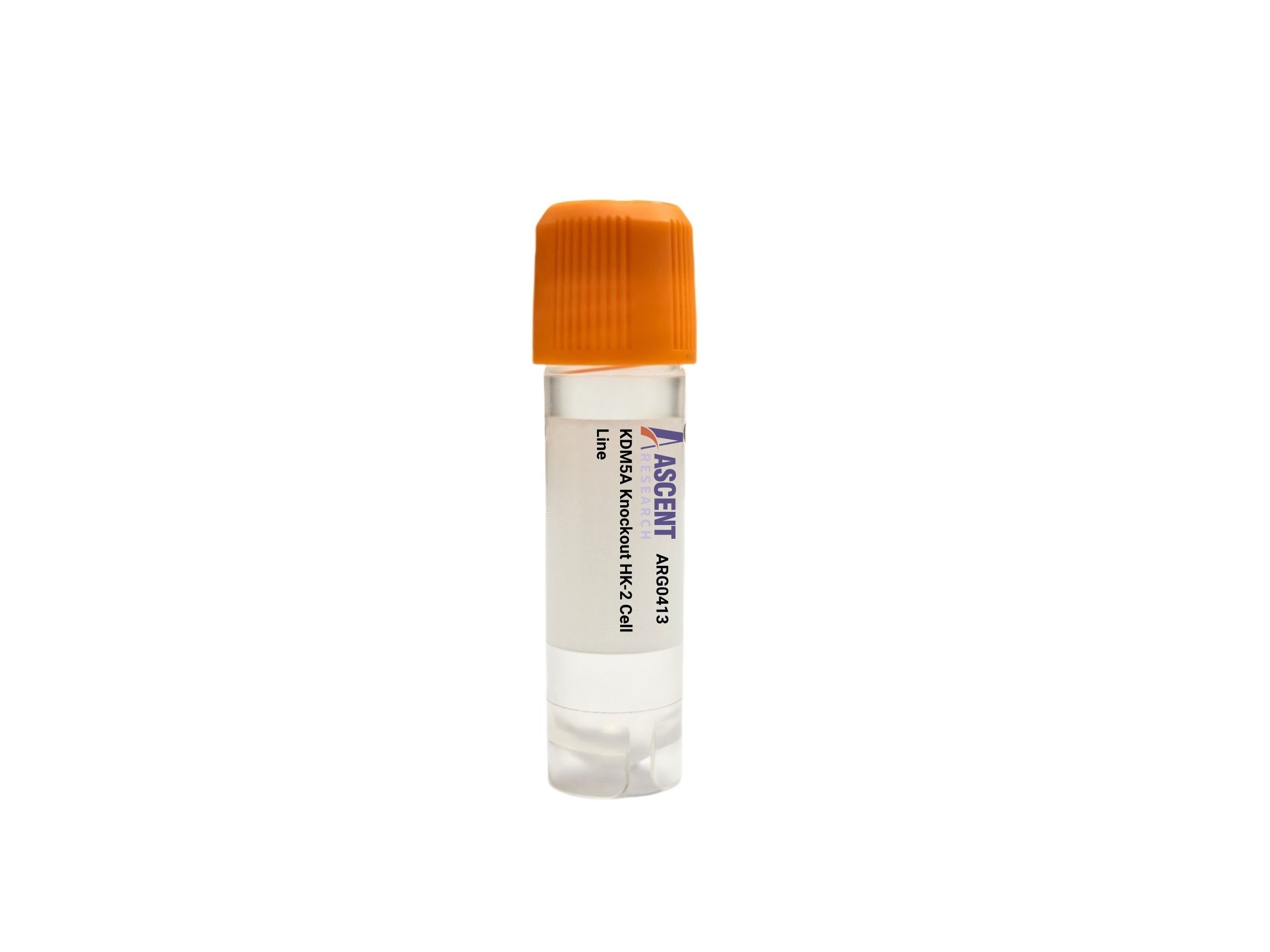
The KDM5A Knockout HK-2 Cell Line is a CRISPR/Cas9-edited human proximal tubule epithelial cell model with targeted disruption of the KDM5A gene, encoding a histone H3K4 demethylase. This knockout abolishes KDM5A-mediated transcriptional repression, affecting key targets such as CCND1, CDKN1A, and MYC. Derived from the HK-2 immortalized cell line, the model is ideal for studying epigenetic regulation in renal epithelial injury and carcinoma. It enables investigations into hypoxia and RB pathway crosstalk, and supports assays including ChIP-qPCR, proliferation, and RNA-seq.
 DBT Knockout A2780 Polyclonal Cells
Cat. No. ARG18587
CYP1B1 Knockout HT29 Polyclonal Cells
Cat. No. ARG14452
ARF5 Knockout A2780 Polyclonal Cells
Cat. No. ARG28756
BTN1A1 Knockout Hela Polyclonal Cells
Cat. No. ARG36081
KDM6A Knockout HAP1 Polyclonal Cells
Cat. No. ARG27673
DBT Knockout A2780 Polyclonal Cells
Cat. No. ARG18587
CYP1B1 Knockout HT29 Polyclonal Cells
Cat. No. ARG14452
ARF5 Knockout A2780 Polyclonal Cells
Cat. No. ARG28756
BTN1A1 Knockout Hela Polyclonal Cells
Cat. No. ARG36081
KDM6A Knockout HAP1 Polyclonal Cells
Cat. No. ARG27673
 22Rv1 Luciferase Stable Cell Line
Cat. No. ARG0006
22Rv1 Luciferase Stable Cell Line
Cat. No. ARG0006
The KDM5A Knockout HK-2 Cell Line is a CRISPR/Cas9-edited knockout cell line featuring targeted disruption of the KDM5A gene in the human HK-2 proximal tubule epithelial cell background. This model enables loss-of-function studies of KDM5A, a histone H3K4 demethylase involved in transcriptional repression. The cell line is supplied as a live culture and is designed for advanced epigenetic research.
HK-2 cells are an immortalized line derived from normal human kidney proximal tubule epithelium. They retain key differentiated functions such as polarized transport and metabolic activity, making them a standard model for renal physiology, drug transport, and injury responses. The well-characterized stable phenotype of HK-2 cells ensures reproducible experimental outcomes in studies of renal epithelial biology.
KDM5A functions as an H3K4me3 demethylase that represses gene expression. Its activity is regulated by upstream factors including HIF-1??, Notch intracellular domain, RB1, and miR-34a. KDM5A interacts with co-repressor complexes containing SIN3B, HDAC1, HDAC2, and REST. Key downstream targets include CCND1, CDKN1A, MYC, and CDH1, whose promoters it demethylates. Through these interactions, KDM5A integrates signals from hypoxia, Notch, and RB pathways to control cell cycle progression, differentiation, and epithelial function. For example, under hypoxia, HIF-1?? modulates KDM5A expression, affecting VEGF and EPO regulation.
Knockout of KDM5A in HK-2 cells abolishes H3K4me3 demethylation, leading to derepression of target genes and altered renal epithelial behavior. This model is particularly useful for investigating the epigenetic basis of renal responses to hypoxic stress, as occurs in acute kidney injury. It also provides a relevant system to study KDM5A??s role in renal cell carcinoma, where its dysregulation contributes to oncogenic reprogramming. The cell line thus offers insights into how chromatin modifications govern kidney cell fate and adaptation.
Researchers can employ this knockout cell line in a range of functional assays, including Western blotting, RT-qPCR, ChIP-qPCR, immunofluorescence, flow cytometry, and proliferation assays. Hypoxia exposure experiments and RNA-seq further enable dissection of KDM5A-dependent transcriptional networks. These applications support studies in epigenetic regulation, renal cancer modeling, and drug target validation. For inquiries and technical assistance, please reach out to Ascent Research.