Genome-edited Cells
Liver
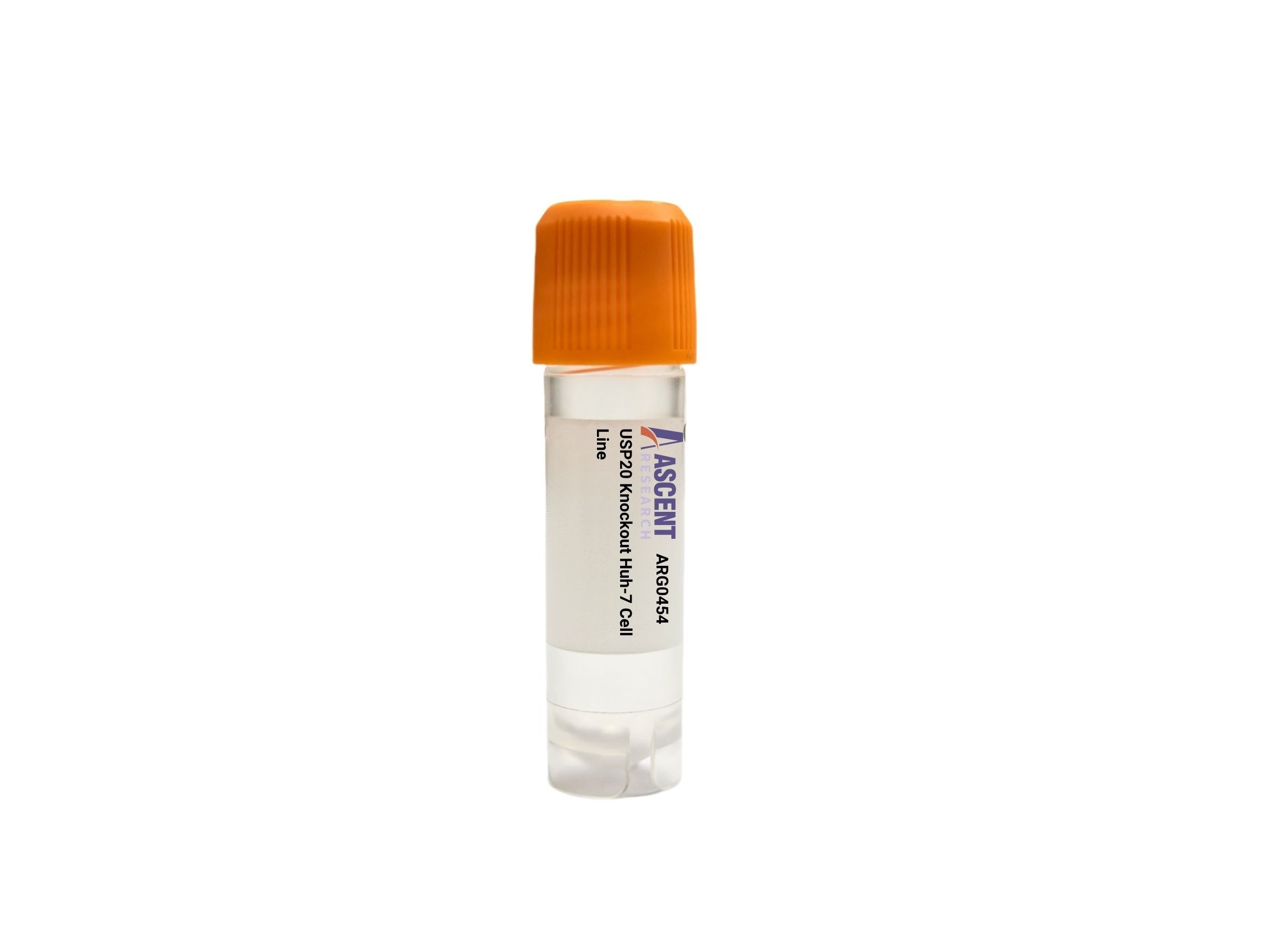
The USP20 Knockout Huh-7 Cell Line is a CRISPR/Cas9-edited knockout cell line derived from the human hepatocellular carcinoma Huh-7 line. It enables loss-of-function studies of USP20, a deubiquitinase that stabilizes key signaling factors including ??-catenin and HIF-1??, thereby modulating Wnt, NF-??B, hypoxia, and autophagy pathways. This product is ideal for investigating USP20's role in liver cancer pathogenesis, deubiquitinase biology, and drug target validation, using applications such as reporter assays, co-immunoprecipitation, and phenotypic profiling. It provides a precise genetic tool for hepatocellular carcinoma research.
 MBD1 Knockout K562 Polyclonal Cells
Cat. No. ARG19368
NFIC Knockout K562 Polyclonal Cells
Cat. No. ARG19367
Bub1 Knockout RAW 264.7 Polyclonal Cells
Cat. No. ARG23539
ANKHD1 Knockout MES-OV Polyclonal Cells
Cat. No. ARG24132
HLA-G Knockout A2780 Polyclonal Cells
Cat. No. ARG29121
IFNGR1 Knockout NCI-H1299 Polyclonal Cells
Cat. No. ARG30798
MBD1 Knockout K562 Polyclonal Cells
Cat. No. ARG19368
NFIC Knockout K562 Polyclonal Cells
Cat. No. ARG19367
Bub1 Knockout RAW 264.7 Polyclonal Cells
Cat. No. ARG23539
ANKHD1 Knockout MES-OV Polyclonal Cells
Cat. No. ARG24132
HLA-G Knockout A2780 Polyclonal Cells
Cat. No. ARG29121
IFNGR1 Knockout NCI-H1299 Polyclonal Cells
Cat. No. ARG30798
The USP20 Knockout Huh-7 Cell Line is a CRISPR/Cas9-edited human liver cancer cell line designed to ablate ubiquitin-specific protease 20 (USP20), generating a stable loss-of-function model. Quality-controlled for consistent knockout, it ensures reliable USP20 protein deficiency across passages, enabling precise functional studies in hepatocellular carcinoma (HCC) without the variability of transient knockdown methods.
The parental Huh-7 cell line was established from a hepatocellular carcinoma of a 57-year-old Japanese male and exhibits epithelial morphology. This widely used HCC model retains key tumorigenic features, including dysregulated proliferation, metabolic reprogramming, and sensitivity to hypoxic stress. Huh-7 cells are permissive for hepatitis C virus replication, extending their utility to viral hepatocarcinogenesis research. The well-characterized background makes this USP20 knockout derivative directly applicable to mechanistic and translational liver cancer studies.
USP20 is a deubiquitinase that cleaves K48- and K63-linked polyubiquitin chains from substrates, regulating protein stability and signal transduction. It is activated by hypoxia and inflammatory stimuli such as TNF-??, and directly deubiquitinates HIF-1??, ??-catenin, TRAF6, RIPK1, and ULK1. USP20-mediated stabilization of HIF-1?? amplifies hypoxia-driven gene expression; deubiquitination of ??-catenin potentiates Wnt/TCF/LEF transcriptional activity; and modification of TRAF6 and RIPK1 regulates the NF-??B pathway via the IKK?CI??B???Cp65 axis. Additionally, USP20 controls autophagy initiation by targeting ULK1 within the ULK1?CATG13?CFIP200 complex.
In the Huh-7 hepatocellular carcinoma context, USP20 disruption is particularly significant because USP20 may foster liver tumorigenesis by stabilizing oncogenic ??-catenin and HIF-1??. Both factors are commonly dysregulated in HCC and contribute to malignant properties. This knockout cell line allows direct assessment of USP20’s role in proliferation, apoptotic resistance, migration, and autophagy, offering a platform to identify USP20-dependent vulnerabilities for therapeutic exploitation.
Research applications include co-immunoprecipitation and ubiquitination analyses to study USP20 substrates, dual-luciferase reporter assays for Wnt or NF-??B activity, and phenotypic characterization via viability, apoptosis, and migration/invasion tests. The line supports HIF-1?? reporter measurements under hypoxia, autophagy flux monitoring, and small-molecule inhibitor screening. These tools facilitate target validation and deubiquitinase research in liver cancer. For further details, please contact Ascent Research.