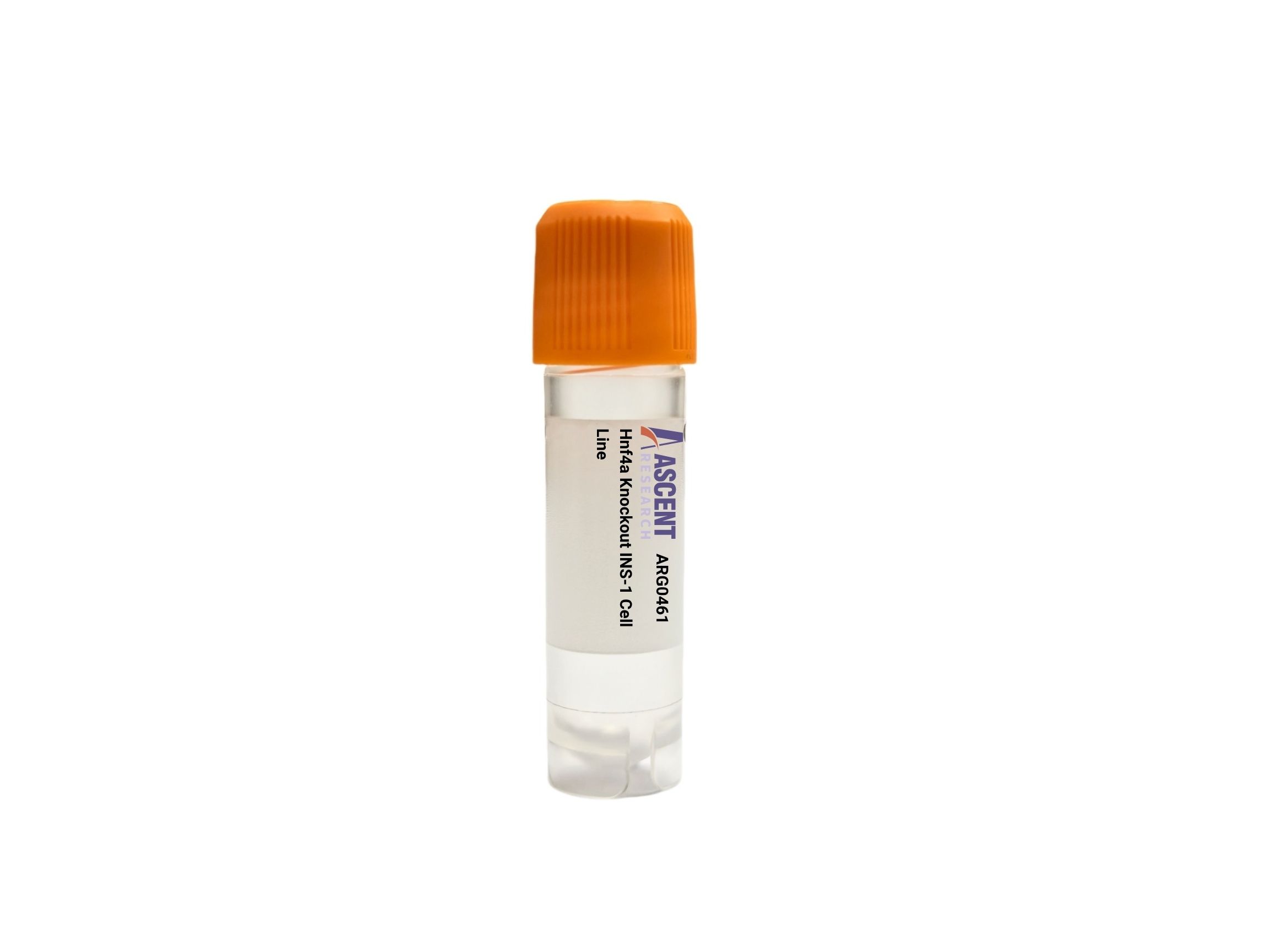
Genome-edited Cells
Pancreas
The Hnf4a Knockout INS-1 Cell Line is a CRISPR/Cas9-edited rat pancreatic beta cell line with targeted disruption of the Hnf4a gene, encoding transcription factor HNF4A. It plays a central role in insulin secretion and beta cell identity, regulated by HNF1A and interacting with PGC-1??, and controls downstream targets including INS and GLUT2. This model is essential for studying maturity-onset diabetes of the young type 1 (MODY1) and type 2 diabetes, enabling glucose-stimulated insulin secretion assays, insulin ELISA, and transcriptomic profiling. Ideal for functional genomics and drug discovery in metabolic disease.
 COL5A1 Knockout NCI-H1975 Polyclonal Cells
Cat. No. ARG16910
FMR1 Knockout jurkat Polyclonal Cells
Cat. No. ARG13615
CSRP3 Knockout jurkat Polyclonal Cells
Cat. No. ARG13380
MAP3K12 Knockout Jurkat Polyclonal Cells
Cat. No. ARG13270
NDUFS4 Knockout jurkat Polyclonal Cells
Cat. No. ARG13068
ANP32B Knockout NCI-H1299 Polyclonal Cells
Cat. No. ARG30343
COL5A1 Knockout NCI-H1975 Polyclonal Cells
Cat. No. ARG16910
FMR1 Knockout jurkat Polyclonal Cells
Cat. No. ARG13615
CSRP3 Knockout jurkat Polyclonal Cells
Cat. No. ARG13380
MAP3K12 Knockout Jurkat Polyclonal Cells
Cat. No. ARG13270
NDUFS4 Knockout jurkat Polyclonal Cells
Cat. No. ARG13068
ANP32B Knockout NCI-H1299 Polyclonal Cells
Cat. No. ARG30343
The Hnf4a Knockout INS-1 Cell Line is a CRISPR/Cas9-edited knockout cell line derived from the rat INS-1 pancreatic beta cell background, featuring targeted disruption of the Hnf4a gene. This loss-of-function model stably eliminates expression of the HNF4A transcription factor, enabling researchers to dissect its role in beta cell biology without the variability of transient silencing approaches. The cell line is provided as a ready-to-use culture and is designed for direct application in genetic and pharmacological studies of pancreatic islet function. It maintains the INS-1 cell line??s characteristic features while introducing a defined genetic lesion for rigorous functional interrogation.
INS-1 cells, originally from an X-ray-induced rat insulinoma, are a widely employed model for pancreatic beta cell research. They retain glucose-responsive insulin secretion and express essential beta cell markers, including insulin genes, Pdx1, and Glut2, making them a physiologically relevant platform. The INS-1 line replicates many aspects of primary beta cell function, such as metabolic coupling of glucose sensing to exocytosis. Its robustness and ease of culture enhance utility for high-throughput screening and mechanistic studies.
HNF4A is a nuclear receptor transcription factor that serves as a master regulator of genes critical for beta cell identity and metabolic control. It is activated by upstream regulators HNF1A and HNF1B, and cooperates with coregulators including PPARGC1A (PGC-1??), CREBBP, NCOA6, and MED1 to activate transcription. HNF4A directly regulates targets such as INS, SLC2A2 (GLUT2), GCK, HNF1A, PKLR, and APOC3, forming a network that sustains glucose-stimulated insulin secretion. Operating with PDX1, NEUROD1, MAFA, and NKX6-1, HNF4A maintains the differentiated state of beta cells and ensures tight coupling of glucose metabolism to insulin output.
In the INS-1 context, Hnf4a knockout disrupts this regulatory architecture, leading to marked impairments in insulin secretion and beta cell function. The model recapitulates molecular hallmarks of maturity-onset diabetes of the young type 1 (MODY1), where HNF4A mutations cause progressive beta cell failure. Loss of HNF4A attenuates expression of insulin and glucose sensing machinery, mirroring the secretory defect observed in patients. This makes the cell line a valuable surrogate for studying MODY1 pathogenesis and for investigating the interplay between HNF4A and other transcription factors implicated in monogenic and type 2 diabetes. It also permits exploration of HNF4A??s role in lipid metabolism and beta cell development pathways.
The Hnf4a Knockout INS-1 Cell Line supports a diverse array of experimental applications, from transcriptional profiling by RNA-seq and RT-qPCR to protein analysis via western blotting and immunofluorescence. Functional assays such as glucose-stimulated insulin secretion (GSIS) measurements, insulin ELISA, and flow cytometry-based phenotyping allow quantitative assessment of beta cell performance. Chromatin immunoprecipitation (ChIP-qPCR) can be employed to map HNF4A binding sites or assess epigenetic changes. These applications make the cell line ideal for target validation, drug screening for insulin secretagogues or sensitizers, and functional genomics studies addressing beta cell identity and diabetes mechanisms. For additional information, please contact Ascent Research.