Genome-edited Cells
Pancreas
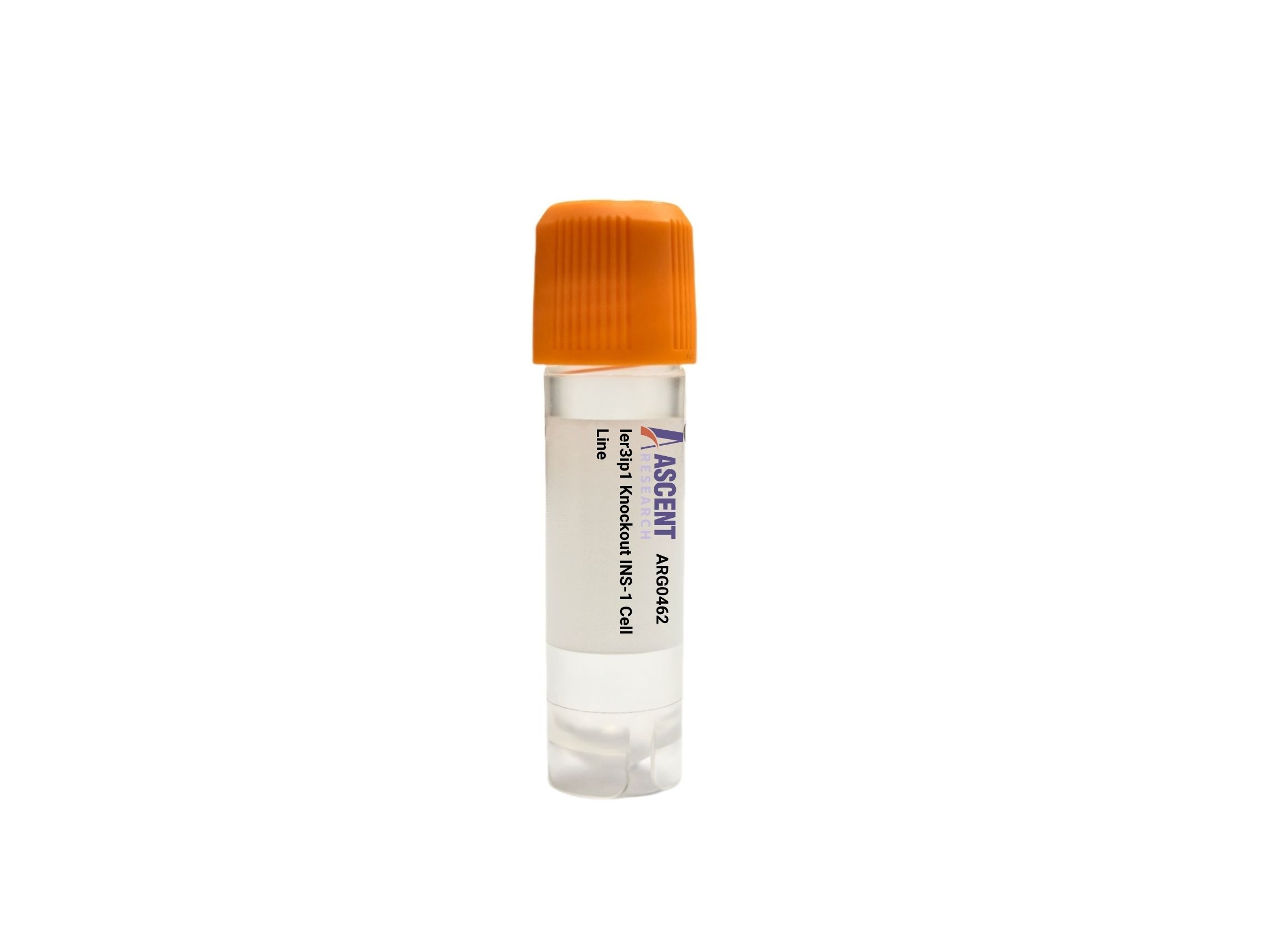
The Ier3ip1 Knockout INS-1 Cell Line is a CRISPR/Cas9-edited rat pancreatic beta cell line with disruption of the gene encoding IER3IP1, an ER-resident protein that regulates ER homeostasis and apoptosis through interactions with BiP, SEC61, and IER3 and via the PERK-eIF2??-CHOP signaling pathway. In INS-1 cells, IER3IP1 knockout triggers ER stress and CHOP?dependent apoptosis while compromising insulin secretion. This model is ideal for diabetes pathogenesis studies, drug screening for ER stress inhibitors, and functional assays such as western blotting for BiP/CHOP and glucose?stimulated insulin secretion measurements. Contact Ascent Research for details.
 LAPTM4B Knockout NCI-H1975 Polyclonal Cells
Cat. No. ARG17149
BRD4 Knockout A549 Polyclonal Cells
Cat. No. ARG23116
IKBIP Knockout jurkat Polyclonal Cells
Cat. No. ARG34321
CADM1 Knockout SK-HEP-1 Polyclonal Cells
Cat. No. ARG41793
DTNB Knockout HGC-27 Polyclonal Cells
Cat. No. ARG39898
CENPV Knockout MES-OV Polyclonal Cells
Cat. No. ARG6051
LAPTM4B Knockout NCI-H1975 Polyclonal Cells
Cat. No. ARG17149
BRD4 Knockout A549 Polyclonal Cells
Cat. No. ARG23116
IKBIP Knockout jurkat Polyclonal Cells
Cat. No. ARG34321
CADM1 Knockout SK-HEP-1 Polyclonal Cells
Cat. No. ARG41793
DTNB Knockout HGC-27 Polyclonal Cells
Cat. No. ARG39898
CENPV Knockout MES-OV Polyclonal Cells
Cat. No. ARG6051
The Ier3ip1 Knockout INS-1 Cell Line is a CRISPR/Cas9-edited knockout cell line targeting the Ier3ip1 gene in the rat pancreatic beta cell line INS-1. This tool supports loss-of-function studies of IER3IP1, an endoplasmic reticulum (ER)-resident protein essential for maintaining ER homeostasis and regulating apoptosis. The CRISPR/Cas9-mediated gene disruption provides a stable knockout model for investigating ER stress signaling and beta cell dysfunction.
INS-1 cells were originally derived from an X-ray-induced rat insulinoma and retain robust glucose-stimulated insulin secretion, faithfully reproducing key characteristics of primary pancreatic beta cells. They are widely employed in diabetes research to study insulin processing, vesicular transport, and the cellular effects of metabolic stress. This regulated secretory background makes them an ideal host for examining how IER3IP1 loss influences insulin output and ER stress responses.
IER3IP1 localizes to the ER and interacts with the chaperone BiP (HSPA5) and the SEC61 translocon, playing a central role in protein folding and trafficking. It functions within the unfolded protein response (UPR) network, where the ER stress sensors ATF6, IRE1, and PERK detect perturbations. IER3IP1 depletion hyperactivates the PERK-eIF2??-ATF4 signaling axis, driving expression of the pro-apoptotic transcription factor CHOP, which modulates BCL2 family proteins and caspase-3 to promote cell death. Additionally, IER3IP1 partners with IER3 (IEX-1) to coordinate survival signaling. Its involvement in vesicle-mediated transport further impacts insulin maturation and secretion, forging a direct link between ER proteostasis and beta cell functional integrity.
In the INS-1 context, IER3IP1 knockout disrupts ER homeostasis, leading to constitutive UPR activation and heightened sensitivity to pharmacological ER stressors such as thapsigargin and tunicamycin. This phenotype recapitulates aspects of beta cell failure in diabetes, where chronic ER stress drives apoptosis and impairs insulin secretion. The knockout model may exhibit altered ER morphology, elevated CHOP protein levels, and reduced glucose-stimulated insulin release. Concomitant changes in autophagy markers LC3 and p62 indicate crosstalk between ER stress and degradative pathways that may aggravate beta cell degeneration upon IER3IP1 loss.
This cell line enables detailed investigation of ER stress-induced beta cell apoptosis via western blotting for BiP and CHOP, RT-qPCR analysis of UPR target genes, and immunofluorescence visualization of ER morphology. It is also suitable for insulin secretion assays, cell viability measurements, and flow cytometry?based Annexin V apoptosis assays. For drug discovery applications, it supports the screening of compounds aimed at alleviating ER stress?mediated beta cell death. For further information or technical assistance, please contact Ascent Research.