Genome-edited Cells
Esophagus
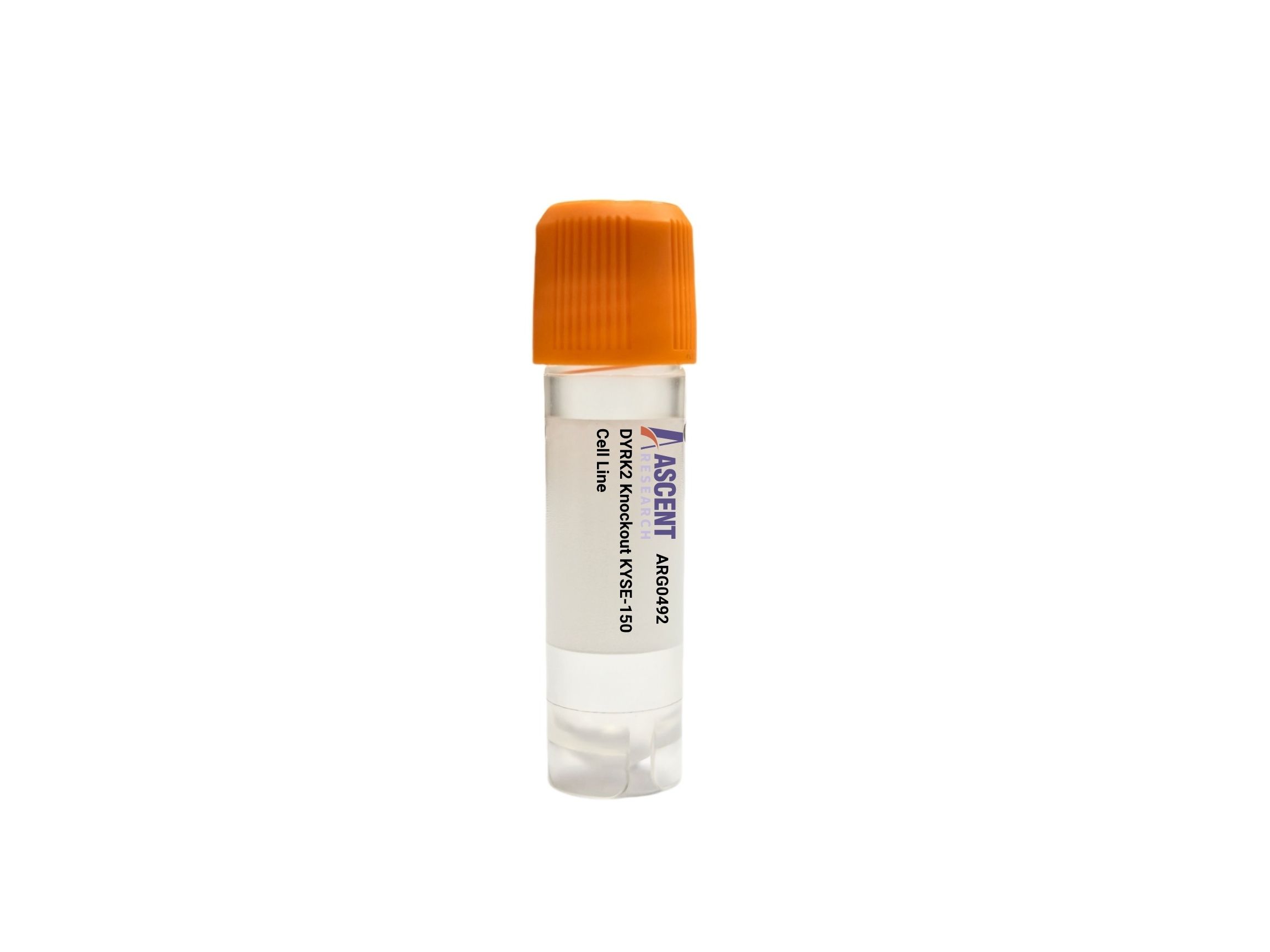
The DYRK2 Knockout KYSE-150 Cell Line is a CRISPR/Cas9-edited knockout cell line derived from human esophageal squamous cell carcinoma cells. This model disrupts the tumor suppressor kinase DYRK2, which regulates p53-mediated apoptosis and Wnt signaling by phosphorylating substrates such as p53 at Ser46, Dvl2, and Dvl3. Researchers can employ this knockout line to study apoptosis, DNA damage response, Wnt pathway inhibition, and drug resistance in esophageal cancer. Applications include viability assays, migration/invasion studies, and xenograft models, enabling deep investigation of DYRK2's role in tumor suppression and EMT.
 IQSEC1 Knockout K562 Polyclonal Cells
Cat. No. ARG20674
PHF10 Knockout jurkat Polyclonal Cells
Cat. No. ARG13372
FBXW9 Knockout A549 Polyclonal Cells
Cat. No. ARG10626
PDP1 Knockout Hela Polyclonal Cells
Cat. No. ARG8052
KIF1C Knockout HAP1 Polyclonal Cells
Cat. No. ARG27686
OSMR Knockout 786-O Polyclonal Cells
Cat. No. ARG5114
IQSEC1 Knockout K562 Polyclonal Cells
Cat. No. ARG20674
PHF10 Knockout jurkat Polyclonal Cells
Cat. No. ARG13372
FBXW9 Knockout A549 Polyclonal Cells
Cat. No. ARG10626
PDP1 Knockout Hela Polyclonal Cells
Cat. No. ARG8052
KIF1C Knockout HAP1 Polyclonal Cells
Cat. No. ARG27686
OSMR Knockout 786-O Polyclonal Cells
Cat. No. ARG5114
The DYRK2 Knockout KYSE-150 Cell Line is a CRISPR/Cas9-edited knockout cell line derived from human KYSE-150 esophageal squamous cell carcinoma cells. This loss-of-function model enables targeted disruption of DYRK2, a tumor-suppressive kinase. Generated via CRISPR/Cas9-mediated gene editing, the line provides stable DYRK2 ablation for functional studies in apoptosis, DNA damage response, and Wnt signaling. Supplied as a ready-to-use product, it accelerates research into DYRK2-dependent mechanisms without the need for in-house gene editing.
The parental KYSE-150 line is a poorly differentiated esophageal squamous cell carcinoma model established from a Japanese male. It is widely used to study esophageal cancer pathogenesis, drug responses, and metastasis. The genetic landscape of KYSE-150 reflects typical mutations found in this cancer type, offering a clinically relevant background for examining tumor suppressor gene function. Introducing a DYRK2 knockout into KYSE-150 allows dissection of DYRK2??s role in esophageal carcinoma progression.
DYRK2 is a dual-specificity kinase acting as a tumor suppressor by phosphorylating p53 at Ser46 to drive apoptosis upon DNA damage. Upstream ATM and ATR kinases activate DYRK2, which then modifies p53, inducing pro-apoptotic Bax and Puma and caspase-3 activation. DYRK2 also regulates Wnt signaling by phosphorylating Dvl2 and Dvl3, promoting ??-catenin degradation and inhibiting TCF4-driven transcription of c-Myc and Snail. Interactions with 14-3-3 and MDM2 further fine-tune p53 stability. Thus, DYRK2 integrates DNA damage and Wnt signals to control cell cycle, apoptosis, and EMT.
Loss of DYRK2 in esophageal squamous cell carcinoma compromises p53-mediated apoptosis and enhances survival, contributing to therapy resistance. This knockout line enables investigation of DYRK2 deficiency on genotoxic drug responses (e.g., cisplatin, 5-FU). Comparative analyses with parental cells can clarify DYRK2??s impact on DNA damage checkpoints, apoptotic priming, and Wnt-driven proliferation. The model is valuable for studying crosstalk between p53 and ??-catenin/TCF4 pathways and identifying synthetic lethal targets in DYRK2-null tumors.
This knockout cell line supports diverse assays: apoptosis (Annexin V/PI), cell cycle analysis, viability and drug sensitivity tests, migration/invasion assays for EMT, colony formation, and xenograft studies. It also facilitates RNA-seq and co-immunoprecipitation for mapping DYRK2-driven networks. Phospho-specific detection of p53 Ser46 serves as a kinase activity readout. For further details, contact Ascent Research.