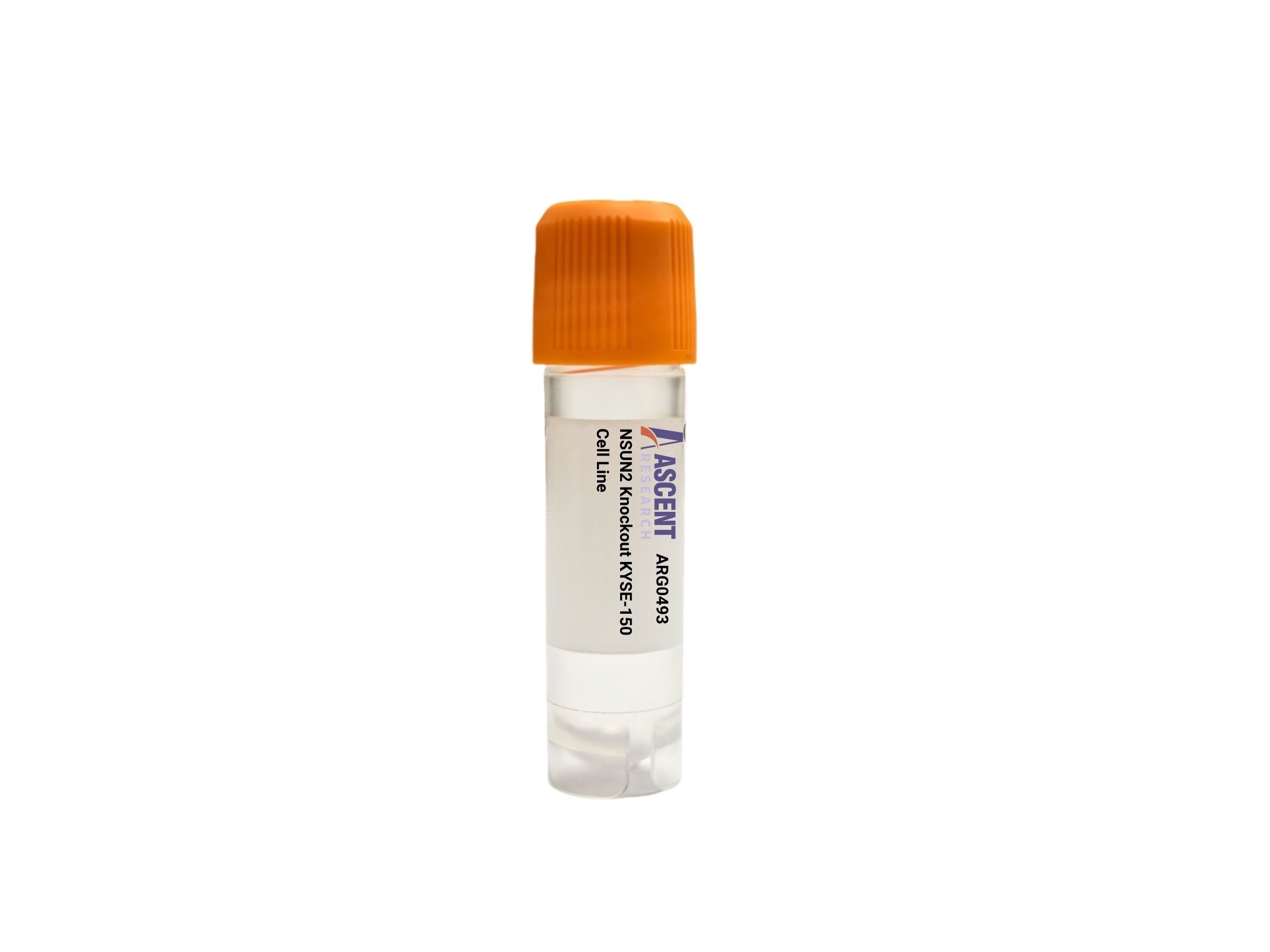
Genome-edited Cells
Esophagus
The NSUN2 Knockout KYSE-150 Cell Line is a CRISPR/Cas9-edited human esophageal squamous cell carcinoma model with targeted disruption of the NSUN2 gene, an RNA methyltransferase that installs 5-methylcytosine on tRNAs and select mRNAs. It enables epitranscriptomic research focused on tRNA modification, translation regulation, and stress responses. Engineered from the KYSE-150 ESCC line, this loss-of-function model ablates NSUN2-mediated m5C deposition, disrupting downstream targets like tRNA-Leu(CAA) and MYC translation. It is ideal for proliferation assays, drug screening, and functional studies of m5C modifications in cancer biology.
 NIPSNAP1 Knockout NCI-H1975 Polyclonal Cells
Cat. No. ARG16422
Erlin2 Knockout HEK293T Polyclonal Cells
Cat. No. ARG3957
ESYT1 Knockout T47D Polyclonal Cells
Cat. No. ARG11996
KCNN2 Knockout HAP1 Polyclonal Cells
Cat. No. ARG22964
ATP1A3 Knockout HT29 Polyclonal Cells
Cat. No. ARG33088
NIPSNAP1 Knockout NCI-H1975 Polyclonal Cells
Cat. No. ARG16422
Erlin2 Knockout HEK293T Polyclonal Cells
Cat. No. ARG3957
ESYT1 Knockout T47D Polyclonal Cells
Cat. No. ARG11996
KCNN2 Knockout HAP1 Polyclonal Cells
Cat. No. ARG22964
ATP1A3 Knockout HT29 Polyclonal Cells
Cat. No. ARG33088
 HCC827 Luciferase Stable Cell Line
Cat. No. ARG0263
HCC827 Luciferase Stable Cell Line
Cat. No. ARG0263
The NSUN2 Knockout KYSE-150 Cell Line is a CRISPR/Cas9-edited knockout cell line derived from the human esophageal squamous cell carcinoma (ESCC) cell line KYSE-150. This product features a targeted disruption of the NSUN2 gene using CRISPR/Cas9-mediated genome editing, generating a loss-of-function model that abrogates NSUN2-mediated RNA methylation. The knockout cell line is supplied as a stable, edited population suitable for a range of epitranscriptomic and cancer biology applications, and it serves as a robust platform for investigating the molecular consequences of NSUN2 deficiency without confounding off-target effects typically associated with siRNA or pharmacological inhibition.
KYSE-150 is a poorly differentiated esophageal squamous cell carcinoma cell line established from a primary tumor, and it is extensively used as a model for esophageal carcinogenesis, drug screening, and invasion studies. This cell line retains key features of aggressive ESCC, including contact inhibition loss and anchorage-independent growth, making it highly relevant for studying tumor progression and therapeutic response. The genetic background of KYSE-150, coupled with its well-characterized signaling networks, provides a clinically pertinent context for examining the role of NSUN2 in cancer biology. Researchers have employed KYSE-150 to dissect pathways driving proliferation, metastasis, and drug resistance, and the introduction of the NSUN2 knockout enhances its utility for mechanistic studies.
NSUN2 encodes an RNA methyltransferase that catalyzes the installation of 5-methylcytosine (m5C) on specific tRNAs and select mRNAs, thereby regulating RNA stability, translation efficiency, and cellular stress responses. NSUN2 activity is modulated by upstream regulators such as c-MYC and E2F1, and it is induced under conditions of oxidative stress or nutrient deprivation. The enzyme interacts with the m5C reader proteins ALYREF and YBX1 and acts on tRNA substrates including tRNA-Leu(CAA) and tRNA-Asp(GUC), as well as on mRNAs like CDKN1A and CDKN2A, to enhance their translation or stability. Disruption of NSUN2 abrogates this epitranscriptomic control, leading to reduced translation of key regulators such as MYC and altered expression of cell cycle modulators, thereby impacting proliferation and stress adaptation pathways.
In the KYSE-150 background, which exhibits characteristic dysregulation of MYC and cell cycle checkpoints, knockout of NSUN2 provides a powerful tool to dissect the intersection of RNA modification and oncogenic signaling. The loss of m5C modification on tRNAs is expected to impair translation fidelity and stress tolerance, while reduced methylation of target mRNAs may destabilize transcripts critical for tumor maintenance. This model system enables researchers to examine how epitranscriptomic defects influence ESCC phenotypes such as migration, invasion, and chemosensitivity, and it may reveal synthetic vulnerabilities exploitable for therapeutic intervention. Moreover, because NSUN2 mutations are linked to autosomal recessive intellectual disability, this line also supports comparative studies on RNA modification roles in neurodevelopment versus cancer.
Typical research applications include quantitative assessment of m5C levels via bisulfite RNA sequencing, analysis of tRNA methylation targets by RT-qPCR, and profiling of translational changes using polysome fractionation. Functional assays such as proliferation, migration, and invasion studies in two-dimensional and three-dimensional cultures, along with tumor xenograft models, can be performed to evaluate the impact of NSUN2 loss on tumorigenic potential. Additional techniques like RNA immunoprecipitation with ALYREF or YBX1 antibodies, flow cytometry for cell cycle distribution, and apoptosis assays further elucidate the mechanistic underpinnings. This cell line is well-suited for drug target validation screens targeting the m5C pathway and for functional studies of m5C RNA modifications in epithelial cancer biology. For detailed validation data, technical support, or ordering information, please contact Ascent Research.