Genome-edited Cells
Large intestine (colon)
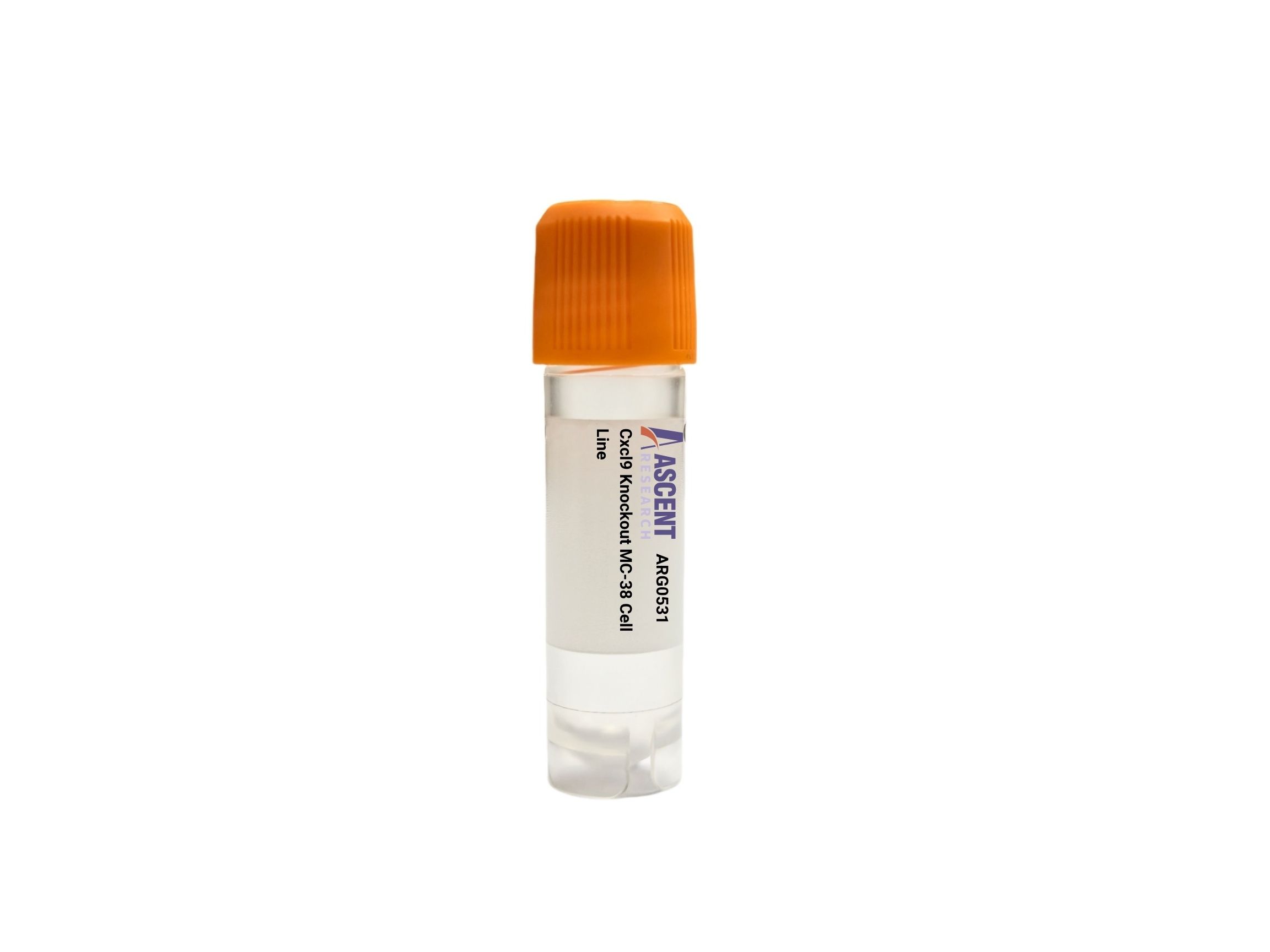
The Cxcl9 Knockout MC-38 Cell Line is a CRISPR/Cas9-edited cell line derived from MC-38 mouse colon adenocarcinoma cells. It carries a targeted disruption of the Cxcl9 gene, which encodes the chemokine CXCL9, a critical mediator of CD8+ T cell and NK cell recruitment through the CXCR3 receptor. This knockout model facilitates study of CXCL9-dependent immune cell trafficking and antitumor immunity in colorectal cancer. CXCL9 signals via JAK2/STAT1 and PI3K-AKT pathways and is regulated by IFN-??. The knockout line is suited for investigating immune checkpoint therapy responses, chemokine signaling, and tumor?Cimmune dynamics using transwell migration, flow cytometry, and in vivo tumor models.
 MYL9 Knockout 143B Polyclonal Cells
Cat. No. ARG11905
CBL Knockout HEK293T Polyclonal Cells
Cat. No. ARG42660
EFEMP1 Knockout SK-HEP-1 Polyclonal Cells
Cat. No. ARG40639
ID1 Knockout HAP1 Polyclonal Cells
Cat. No. ARG27590
MYL9 Knockout 143B Polyclonal Cells
Cat. No. ARG11905
CBL Knockout HEK293T Polyclonal Cells
Cat. No. ARG42660
EFEMP1 Knockout SK-HEP-1 Polyclonal Cells
Cat. No. ARG40639
ID1 Knockout HAP1 Polyclonal Cells
Cat. No. ARG27590
 Rabbit Mammary Ductal Epithelial Cell Medium
Cat. No. ARM0783
Rabbit Mammary Ductal Epithelial Cell Medium
Cat. No. ARM0783
 NCI-H292 Luciferase Stable Cell Line
Cat. No. ARG0615
NCI-H292 Luciferase Stable Cell Line
Cat. No. ARG0615
The Cxcl9 Knockout MC-38 Cell Line is a CRISPR/Cas9-edited knockout cell line derived from MC-38 mouse colon adenocarcinoma cells. It features targeted disruption of the Cxcl9 gene, encoding the chemokine CXCL9, a key immune cell recruiter. This model allows dissection of CXCL9-dependent immune modulation in tumors. The CRISPR/Cas9 approach yields stable gene disruption without transgenes.
MC-38 cells, from C57BL/6 mice via chemical carcinogenesis, are widely used in colorectal cancer and immunotherapy research. These cells form tumors in syngeneic hosts, enabling study of tumor?Cimmune interactions. They express neoantigens and respond to checkpoint blockade, central to immune evasion studies. The Cxcl9 knockout derivative retains parental features while lacking CXCL9, enabling comparative analyses.
CXCL9 is an interferon-?? (IFN-??)-inducible chemokine that signals through the CXCR3 receptor to direct migration of CD8+ T cells and NK cells into tumors. Transcriptional activation primarily involves IFN-??/STAT1, with synergistic input from TNF-?? and IL-1??. Upon binding, CXCR3 activates JAK2, leading to STAT1 phosphorylation, along with PI3K-AKT and ERK1/2 MAPK cascades. CXCL9 also interacts with glycosaminoglycans to establish chemotactic gradients. In the knockout, absence of CXCL9 abolishes these signaling events, potentially reducing immune cell recruitment and altering the balance of effector and regulatory cells within the tumor microenvironment.
In the MC-38 colon adenocarcinoma model, tumor-derived CXCL9 is critical for immune-mediated control, as it recruits CXCR3-expressing effector lymphocytes that suppress tumor growth and boost responses to immunotherapies, including anti-PD-1 and anti-PD-L1 agents. The Cxcl9 knockout cell line provides a defined system to investigate how loss of this chemokine reshapes the tumor immune microenvironment, typically resulting in decreased infiltration of CD8+ T cells and NK cells, enhanced tumor progression, and resistance to checkpoint blockade. This model enables dissection of CXCL9-dependent versus independent immune surveillance mechanisms and identification of compensatory pathways tumors exploit for immune evasion.
Researchers can utilize the Cxcl9 Knockout MC-38 Cell Line in diverse experimental contexts, including in vitro Transwell chemotaxis assays to assess immune cell migration, ELISA-based quantification of altered chemokine profiles, flow cytometric phenotyping of tumor-infiltrating immune cell subsets, and RT-qPCR analysis of chemokine and immune checkpoint gene expression. Co-culture and cytokine profiling experiments can reveal how loss of CXCL9 alters paracrine signaling networks between tumor cells and immune components. In vivo, implantation into syngeneic C57BL/6 mice allows longitudinal monitoring of tumor growth kinetics, immune infiltration dynamics, and responses to immunotherapies. This model is particularly suited for dissecting mechanisms underlying resistance to immune checkpoint inhibitors and evaluating combination strategies aimed at restoring CXCL9-mediated antitumor immunity. For further technical details and ordering information, please contact Ascent Research.