Genome-edited Cells
Breast
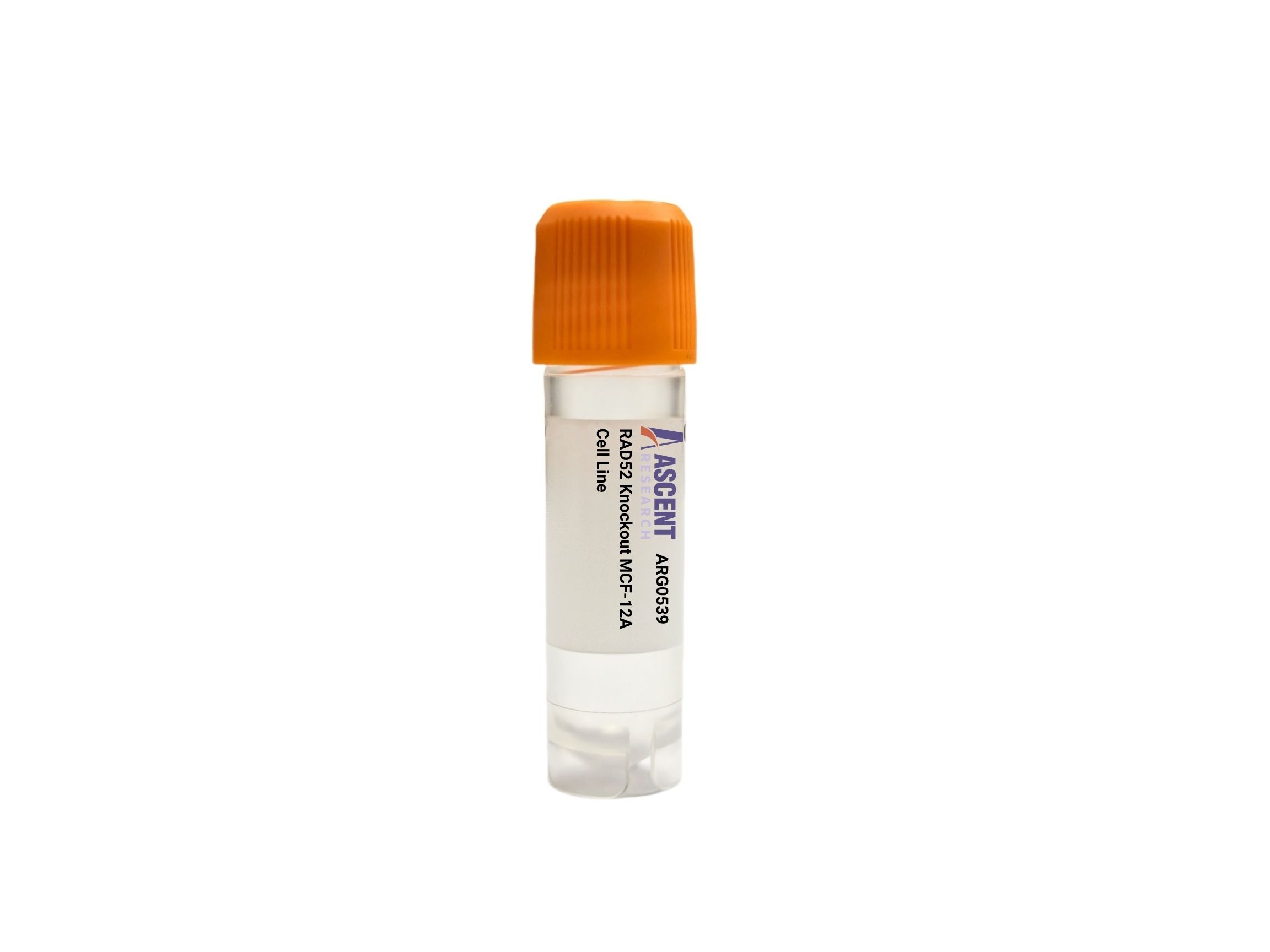
The RAD52 Knockout MCF-12A Cell Line is a CRISPR/Cas9-edited knockout line from non-tumorigenic human mammary epithelial cells, with disruption of RAD52??a key mediator of DNA strand annealing in homologous recombination that interacts with RAD51, RPA, and BRCA2. It serves as a model for studying DNA repair and synthetic lethal interactions with BRCA deficiency. The non-tumorigenic MCF-12A background enables exploration of genomic instability and breast cancer susceptibility, while the line is suitable for assays such as PARP inhibitor or cisplatin sensitivity screening, as well as immunofluorescence for DNA damage markers.
 LAMA3 Knockout A2780 Polyclonal Cells
Cat. No. ARG19193
LIFR Knockout SK-HEP-1 Polyclonal Cells
Cat. No. ARG15939
KANK2 Knockout 786-O Polyclonal Cells
Cat. No. ARG25396
ASF1A Knockout SK-HEP-1 Polyclonal Cells
Cat. No. ARG32281
LAMA3 Knockout A2780 Polyclonal Cells
Cat. No. ARG19193
LIFR Knockout SK-HEP-1 Polyclonal Cells
Cat. No. ARG15939
KANK2 Knockout 786-O Polyclonal Cells
Cat. No. ARG25396
ASF1A Knockout SK-HEP-1 Polyclonal Cells
Cat. No. ARG32281
 Cas9-GFP Overexpression A-549 Stable Cell Line
Cat. No. ARG0061
Cas9-GFP Overexpression A-549 Stable Cell Line
Cat. No. ARG0061
 Human Hepatic Macrophages
Cat. No. ARP0065
Human Hepatic Macrophages
Cat. No. ARP0065
The RAD52 Knockout MCF-12A Cell Line is a CRISPR/Cas9-edited knockout cell line derived from the human mammary epithelial MCF-12A host. This model features targeted disruption of the RAD52 gene, which encodes a key mediator of DNA strand annealing during homologous recombination repair. By abolishing RAD52 expression, the cell line provides a valuable tool for investigating DNA repair pathways and genomic stability in a non-tumorigenic epithelial context. The knockout was generated using CRISPR/Cas9-mediated gene disruption, establishing a stable loss-of-function model. This product is supplied as a cell line suitable for a wide range of assays.
MCF-12A cells are non-tumorigenic human mammary epithelial cells derived from benign breast tissue. They exhibit a luminal epithelial phenotype and maintain characteristics of normal breast epithelium, including hormone receptor expression and growth factor dependence. This background is ideal for studying early events of breast carcinogenesis and the role of tumor suppressors in a physiologically relevant model. Unlike cancerous lines, MCF-12A cells retain intact DNA damage response checkpoints, making them particularly valuable for investigating the consequences of repair gene disruption in a normal cellular environment.
RAD52 mediates DNA strand annealing during homologous recombination, functioning in both RAD51-dependent and independent repair pathways. It interacts with RPA, RAD51, BRCA2, and DNA, forming self-associating rings that promote strand pairing. Activation is driven by DNA double-strand breaks and regulated by ATM kinase, the MRE11-RAD50-NBS1 complex, and CDK1 phosphorylation, leading to assembly of DNA repair foci and maintenance of genomic stability. Additionally, RAD52 contributes to alternative pathways such as single-strand annealing (SSA) and break-induced replication (BIR), providing backup repair when BRCA1/2 are deficient.
In the non-tumorigenic MCF-12A background, RAD52 knockout provides a clean genetic system to examine DNA repair defects without confounding mutations typical of cancer lines. Loss of RAD52 impairs homology-directed repair, sensitizes cells to DNA-damaging agents, and reveals synthetic lethal interactions with BRCA1/2 deficiency. This model is especially relevant for breast cancer research, as RAD52 is a potential therapeutic target in BRCA-mutant cancers. The interplay with DNA damage response factors such as ATM, ATR, PALB2, and XRCC2 can be systematically dissected, enabling mechanistic insights into repair pathway regulation.
This cell line supports numerous research applications, including mechanistic dissection of homologous recombination, synthetic lethality screening with PARP inhibitors or cisplatin, and characterization of DNA repair inhibitor candidates. Common analytical approaches include Western blot and RT-qPCR for RAD52 expression, immunofluorescence for RAD52 and ??-H2AX foci, homologous recombination reporter assays, clonogenic survival after drug treatment, comet assay, and cell cycle analysis after irradiation. These methods allow comprehensive assessment of genomic instability and drug sensitivity. For further information, please contact Ascent Research.