Genome-edited Cells
Breast (mammary gland)
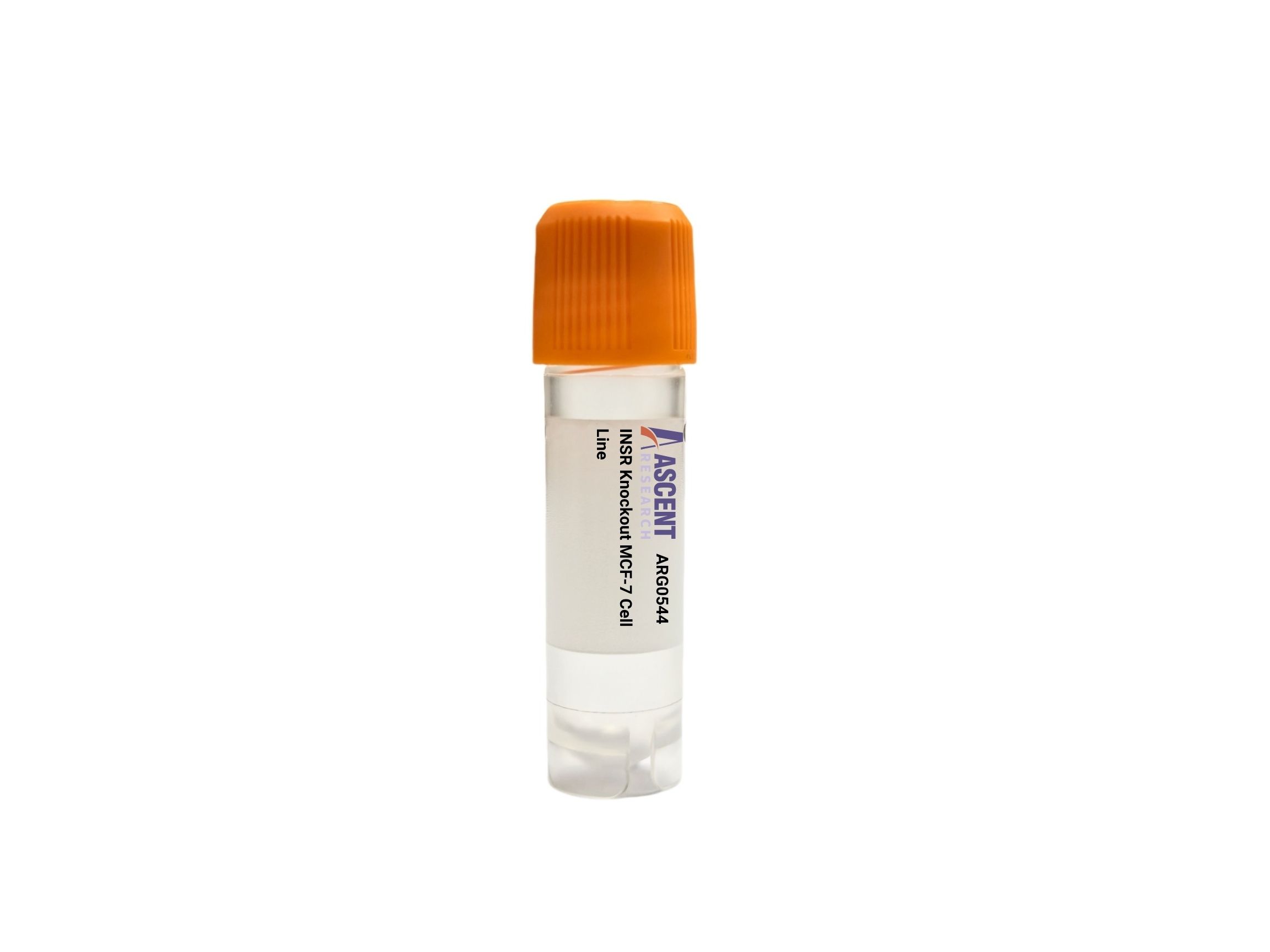
The INSR Knockout MCF-7 Cell Line is a CRISPR/Cas9-edited knockout cell line derived from the estrogen receptor-positive MCF-7 breast adenocarcinoma cell line, enabling loss-of-function studies of the insulin receptor (INSR). Disruption of INSR abolishes insulin-mediated activation of IRS1/IRS2 signaling and downstream PI3K/AKT and MAPK pathways, which regulate glucose metabolism, proliferation, and migration. This cell model is ideal for investigating insulin signaling in breast cancer, metabolic reprogramming, drug screening for insulin sensitizers, and insulin resistance mechanisms. Typical assays include phospho-AKT western blotting, glucose uptake, and proliferation assays.
 HEXIM2 Knockout SK-HEP-1 Polyclonal Cells
Cat. No. ARG32564
IDH2 Knockout jurkat Polyclonal Cells
Cat. No. ARG34305
KRT18 Knockout 786-O Polyclonal Cells
Cat. No. ARG35189
MICAL2 Knockout MES-OV Polyclonal Cells
Cat. No. ARG6381
LRCH2 Knockout HEK293T Polyclonal Cells
Cat. No. ARG4226
HEXIM2 Knockout SK-HEP-1 Polyclonal Cells
Cat. No. ARG32564
IDH2 Knockout jurkat Polyclonal Cells
Cat. No. ARG34305
KRT18 Knockout 786-O Polyclonal Cells
Cat. No. ARG35189
MICAL2 Knockout MES-OV Polyclonal Cells
Cat. No. ARG6381
LRCH2 Knockout HEK293T Polyclonal Cells
Cat. No. ARG4226
 Guinea Pig Ciliary Muscle Cell Medium
Cat. No. ARM0984
Guinea Pig Ciliary Muscle Cell Medium
Cat. No. ARM0984
The INSR Knockout MCF-7 Cell Line is a CRISPR/Cas9-edited knockout cell line derived from the MCF-7 breast epithelial adenocarcinoma line, designed for loss-of-function studies of the insulin receptor (INSR) gene. Disruption of INSR provides a clean background for investigating insulin signaling in an estrogen receptor-positive breast cancer model. The cell line is supplied as a stable culture, suitable for functional genomics, drug discovery, and signal transduction research. Loss of INSR function enables precise dissection of insulin-dependent pathways and their roles in cancer cell biology.
MCF-7 cells were originally isolated from a pleural effusion of a 69-year-old Caucasian female with metastatic breast adenocarcinoma. They retain estrogen receptor expression and are widely used to study hormone-dependent tumor biology, including proliferation, apoptosis, and migration. The INSR-knockout derivative maintains the parental line??s characteristics while eliminating insulin receptor function, ensuring genetic consistency for comparative studies.
INSR encodes a receptor tyrosine kinase activated by insulin, IGF-1, and IGF-2. Ligand binding triggers autophosphorylation and recruitment of IRS1, IRS2, SHC1, GRB2, and PTPN1, which propagate signals via PI3K?CAKT (involving PIK3CA, AKT1) and MAPK (MAPK3/MAPK1) pathways. Downstream, this promotes GLUT4-mediated glucose uptake, glycogen synthesis, and cell proliferation. Knockout of INSR abolishes these insulin-dependent cascades, enabling dissection of pathway-specific roles.
In MCF-7 cells, insulin signaling cross-regulates estrogen receptor activity and influences metabolic and growth responses. Loss of INSR is expected to impair insulin-stimulated AKT phosphorylation and glucose uptake, rendering the cells insulin-resistant. This model is valuable for studying insulin resistance in breast cancer, metabolic reprogramming, and the impact of hyperinsulinemia on tumor progression. It may also reveal altered sensitivity to endocrine therapies and serves as an isogenic control for wild-type MCF-7 studies.
Applications include mechanistic studies of insulin signaling in ER+ breast cancer, metabolic flux assays, and screening of insulin sensitizers or pathway inhibitors. Commonly used assays with this model include phospho-AKT western blotting, 2-NBDG glucose uptake, insulin dose-response, MTT proliferation, and transwell migration tests. It is a versatile tool for both basic and translational research. For more information, please contact the scientific support team at Ascent Research.