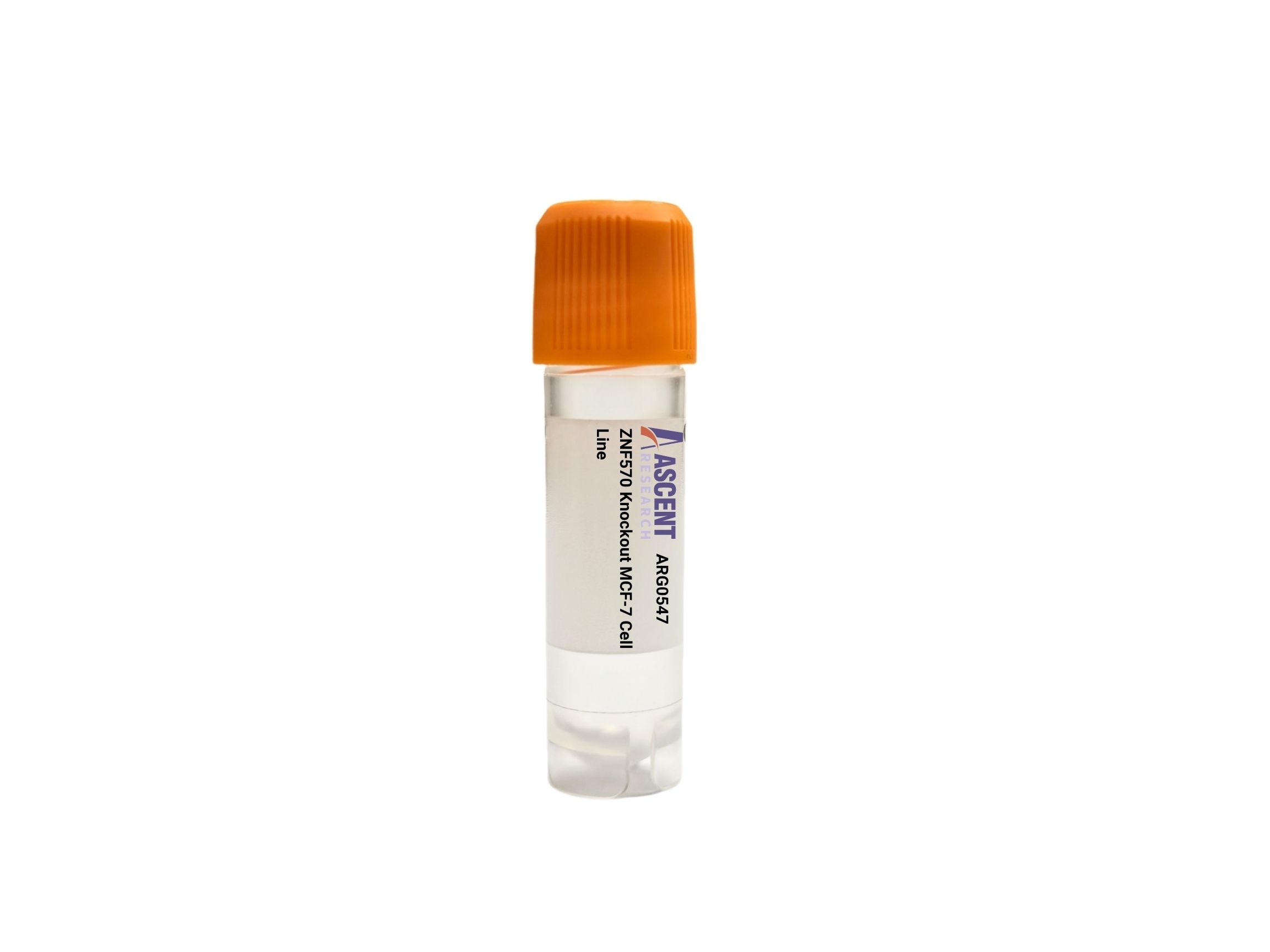
Genome-edited Cells
Breast (mammary gland)
The ZNF570 Knockout MCF-7 Cell Line is a CRISPR/Cas9-edited knockout line derived from ER+/PR+/HER2- MCF-7 breast adenocarcinoma cells, disrupting the zinc finger transcription factor ZNF570. This model facilitates study of ZNF570 function under estrogen receptor ?? and growth factor (EGFR/IGF1R) signaling via MAPK/ERK and AKT pathways, regulating proliferation/apoptosis targets like CCND1 and BCL2. Ideal for exploring hormone-mediated transcriptional regulation, the line supports assays such as RT-qPCR, RNA-seq, ChIP-qPCR, co-immunoprecipitation, and proliferation/apoptosis readouts. It serves drug target validation studies for zinc finger proteins in breast cancer.
 MTCH1 Knockout A549 Polyclonal Cells
Cat. No. ARG10560
CRBN Knockout Hela Polyclonal Cells
Cat. No. ARG8912
MRAS Knockout Hela Polyclonal Cells
Cat. No. ARG8177
KDELR1 Knockout SK-HEP-1 Polyclonal Cells
Cat. No. ARG32739
ACTA1 Knockout DLD-1 Polyclonal Cells
Cat. No. ARG35499
CALM1 Knockout Hela Polyclonal Cells
Cat. No. ARG41868
MTCH1 Knockout A549 Polyclonal Cells
Cat. No. ARG10560
CRBN Knockout Hela Polyclonal Cells
Cat. No. ARG8912
MRAS Knockout Hela Polyclonal Cells
Cat. No. ARG8177
KDELR1 Knockout SK-HEP-1 Polyclonal Cells
Cat. No. ARG32739
ACTA1 Knockout DLD-1 Polyclonal Cells
Cat. No. ARG35499
CALM1 Knockout Hela Polyclonal Cells
Cat. No. ARG41868
The ZNF570 Knockout MCF-7 Cell Line is a CRISPR/Cas9-edited knockout cell line derived from the MCF-7 breast adenocarcinoma parental line, featuring targeted disruption of the ZNF570 gene. This loss-of-function model enables investigation of the putative zinc finger transcription factor ZNF570 in breast cancer biology. Through CRISPR/Cas9-mediated gene disruption, constitutive ablation of ZNF570 expression allows researchers to dissect its regulatory functions in cellular signaling, gene expression, and phenotypic outcomes relevant to ER+ breast cancer. Supplied as a viable, adherent epithelial cell line suitable for a range of molecular and cellular assays.
The parental MCF-7 line is a widely used luminal A breast cancer model that is ER+/PR+/HER2- and exhibits estrogen-dependent proliferation. Isolated from a pleural effusion of metastatic mammary adenocarcinoma, it displays adherent epithelial morphology and faithfully recapitulates hormone-responsive disease. This background is extensively employed to study ER??-mediated transcriptional regulation, endocrine therapy resistance, and crosstalk with growth factor pathways. The ZNF570 knockout in this well-characterized system provides a clinically relevant platform for functional analysis.
ZNF570 is predicted to function as a zinc finger transcription factor, binding DNA via C2H2 domains to modulate target gene expression. Its activity is influenced by upstream signals from ER?? and growth factor receptors (EGFR, IGF1R), converging on MAPK/ERK (MAPK1/3) and AKT pathways. Key downstream targets include cell cycle regulator cyclin D1 (CCND1), the cyclin-dependent kinase inhibitor p21 (CDKN1A), and apoptosis regulators BCL2 and BAX. ZNF570 interacts with transcriptional corepressors NCoR and SMRT, other zinc finger proteins, and chromatin modifiers to fine-tune gene programs controlling proliferation, apoptosis, and epithelial phenotype.
Ablation of ZNF570 in MCF-7 cells permits a clear assessment of its role in estrogen-driven transcription and growth. It allows determination of whether ZNF570 acts as a coactivator or corepressor in ER?? complexes and how it influences the balance between proliferative and apoptotic signals. This model also reveals compensatory mechanisms among zinc finger proteins, shedding light on the therapeutic potential of targeting this transcription factor class in hormone-driven epithelial cancers.
This knockout line is suitable for a variety of functional studies, including MTT proliferation and Annexin V-based apoptosis assays under estrogen-stimulated or -deprived conditions. Transcriptomic analysis by RNA-seq or RT-qPCR can identify ZNF570-dependent gene networks, while ChIP-qPCR defines direct DNA binding targets. Co-immunoprecipitation enables mapping of interaction partners. The cell line also supports drug response experiments for target validation. For further technical information, please contact Ascent Research.