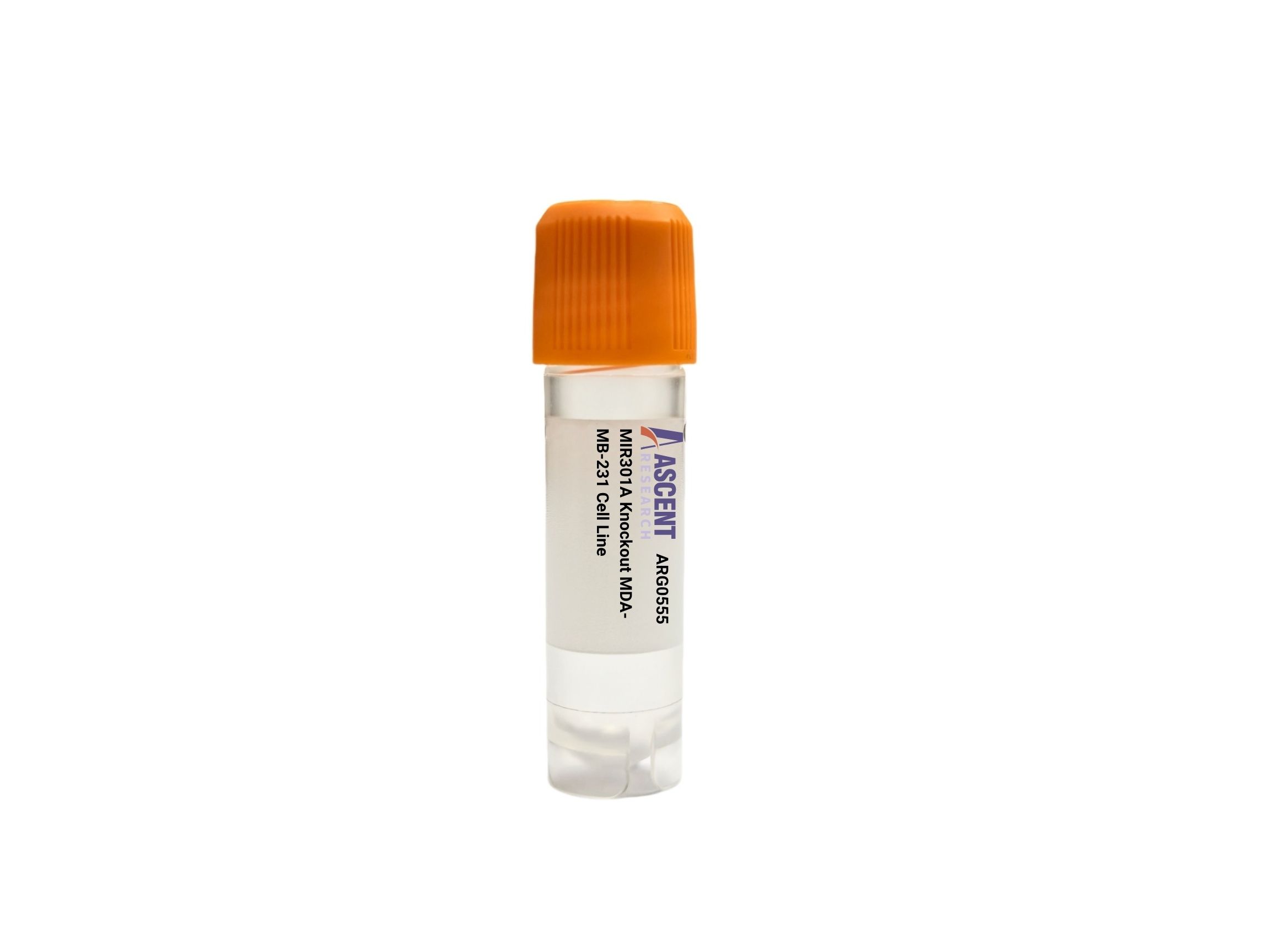
Genome-edited Cells
Breast (mammary gland)
The MIR301A Knockout MDA-MB-231 Cell Line is a CRISPR/Cas9-edited knockout cell line lacking expression of the oncogenic microRNA MIR301A, derived from the triple-negative breast adenocarcinoma MDA-MB-231 line. This model enables investigation of MIR301A??s role in promoting tumorigenesis through direct targeting of PTEN and SMAD4, which leads to PI3K/AKT and NF-??B pathway activation. Ideal for functional genomics and cancer biology research, the knockout cell line supports studies on proliferation, apoptosis, migration, and drug resistance. Common applications include RT-qPCR, western blotting, transwell assays, and xenograft models, facilitating biomarker discovery and therapeutic target validation in breast cancer.
 ISG15 Knockout Raji Polyclonal Cells
Cat. No. ARG23833
GSS Knockout 786-O Polyclonal Cells
Cat. No. ARG25215
DYNLT1 Knockout HAP1 Polyclonal Cells
Cat. No. ARG40174
C5orf24 Knockout HAP1 Polyclonal Cells
Cat. No. ARG27453
ISG15 Knockout Raji Polyclonal Cells
Cat. No. ARG23833
GSS Knockout 786-O Polyclonal Cells
Cat. No. ARG25215
DYNLT1 Knockout HAP1 Polyclonal Cells
Cat. No. ARG40174
C5orf24 Knockout HAP1 Polyclonal Cells
Cat. No. ARG27453
 Rabbit Bone Marrow Endothelial Cells
Cat. No. ARP0828
Rabbit Bone Marrow Endothelial Cells
Cat. No. ARP0828
 Human Middle Ear Epithelial Cells
Cat. No. ARP0016
Human Middle Ear Epithelial Cells
Cat. No. ARP0016
The MIR301A Knockout MDA-MB-231 Cell Line is a CRISPR/Cas9-edited knockout cell line designed to study the oncogenic microRNA MIR301A. Derived from the MDA-MB-231 human breast adenocarcinoma line, this product provides a stable loss-of-function model through targeted disruption of the MIR301A gene. By abolishing expression of this miRNA, researchers can precisely dissect its contributions to tumorigenic signaling without residual wild-type activity. The knockout cell line serves as a critical tool for functional genomics and mechanistic studies of miRNA-driven cancer pathways.
The parental MDA-MB-231 cell line is a widely used model of triple-negative breast cancer, characterized by lack of estrogen receptor, progesterone receptor, and HER2 amplification. It harbors mutations in TP53, KRAS, and BRAF, and exhibits a highly invasive and metastatic phenotype both in vitro and in vivo. This aggressive background makes the MIR301A knockout variant particularly valuable for examining how miRNA deregulation synergizes with common breast cancer mutations to drive progression and therapeutic resistance.
MIR301A is a well-established oncogenic microRNA that exerts its effects by directly targeting the tumor suppressors PTEN and SMAD4. This repression leads to constitutive activation of the PI3K/AKT pathway and NF-??B signaling, promoting cell proliferation, survival, and epithelial-mesenchymal transition. Transcription of MIR301A is activated by upstream regulators including NF-??B, STAT3, hypoxia, and IL-6. Additionally, MIR301A suppresses other targets such as BIM, CDKN1A, TP63, and TIMP3, broadening its influence on apoptosis, cell cycle, and tissue invasion. The miRNA functions within the RISC complex, interacting with AGO2, DICER1, and TRBP for processing and target recognition.
In the context of MDA-MB-231 cells, knockout of MIR301A abrogates its tumor-supportive functions, allowing researchers to evaluate the consequent re-expression of PTEN and SMAD4 and the restoration of tumor-suppressive signaling. This model is instrumental for delineating the specific contributions of MIR301A to the aggressive behavior of triple-negative breast cancer, including its roles in migration, invasion, and apoptosis resistance. Because the host line contains multiple oncogenic mutations, the knockout provides a unique platform to study cross-talk between miRNA regulation and mutant TP53, KRAS, and BRAF-driven pathways.
Typical research applications include functional assays such as RT-qPCR for MIR301A expression, western blotting for PTEN and SMAD4 levels, cell proliferation (MTT/CCK-8), transwell migration and invasion assays, and Annexin V apoptosis detection. The cell line is also suitable for luciferase reporter assays to validate target interactions, RNA-seq analysis to profile transcriptomic changes, and xenograft tumor models to assess metastatic potential in vivo. These applications support investigations into miRNA-mediated tumorigenesis, drug resistance mechanisms, metastasis biology, and therapeutic target validation. For additional technical information or to inquire about custom engineering services, please contact Ascent Research.