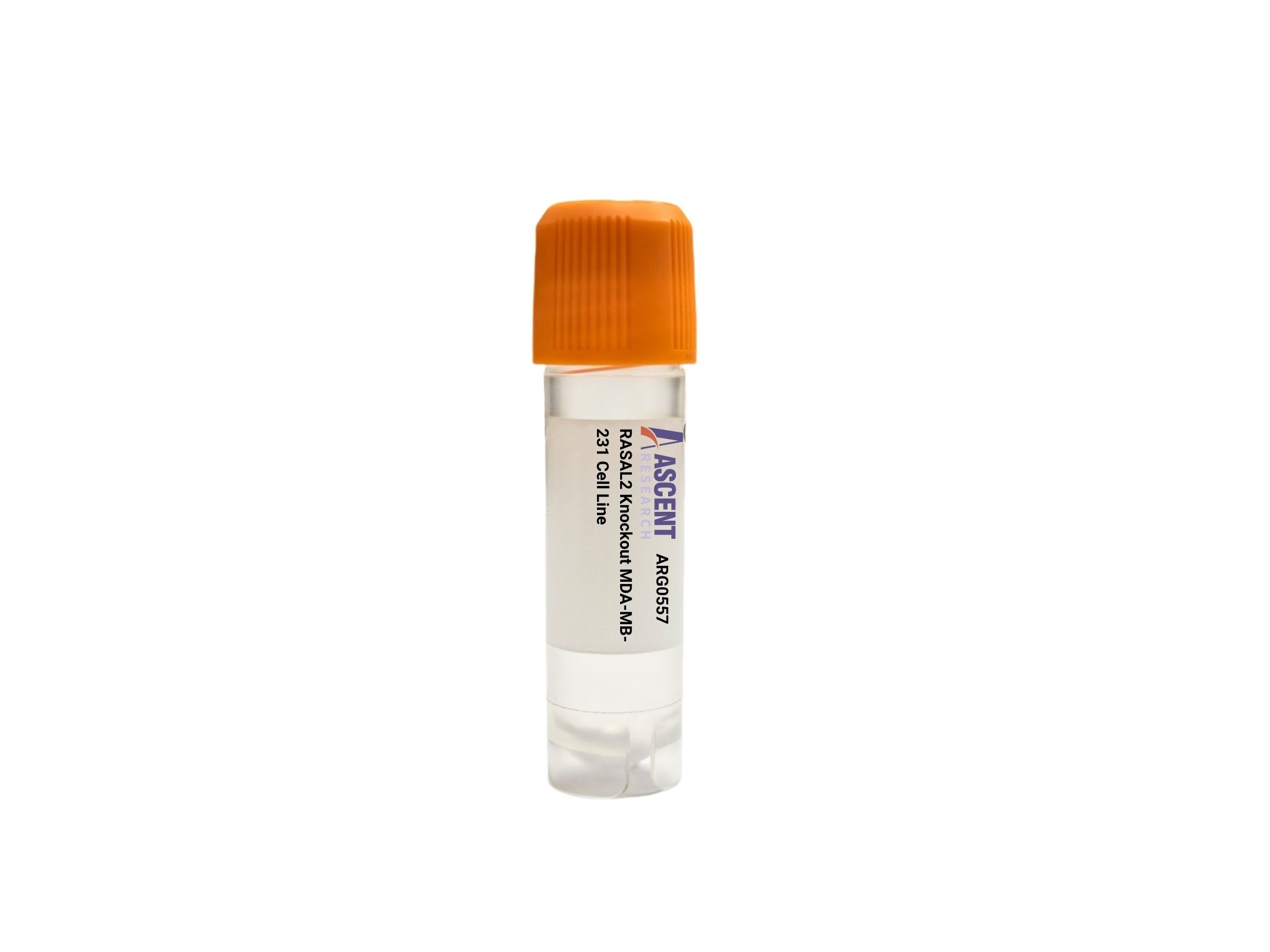
Genome-edited Cells
Breast (mammary gland)
The RASAL2 Knockout MDA-MB-231 Cell Line is a CRISPR/Cas9-edited knockout cell line featuring disruption of the RASAL2 gene in the MDA-MB-231 human breast adenocarcinoma background. RASAL2 is a RAS GTPase-activating protein and tumor suppressor that negatively regulates RAS-MAPK and PI3K-AKT signaling by accelerating GTP hydrolysis on RAS proteins; its loss leads to constitutive pathway activation and enhanced invasive potential. This model enables investigation of breast cancer metastasis mechanisms, RAS signaling dynamics, and therapeutic responses to agents such as MEK inhibitors. Applications include western blotting, migration assays, drug sensitivity testing, and transcriptomic profiling. Contact Ascent Research for additional information.
 CALR Knockout 143B Polyclonal Cells
Cat. No. ARG35025
BNIP3L Knockout NCI-H1299 Polyclonal Cells
Cat. No. ARG30543
JAGN1 Knockout A549 Polyclonal Cells
Cat. No. ARG34412
DGUOK Knockout HCT116 Polyclonal Cells
Cat. No. ARG7172
MNDA Knockout HEK293T Polyclonal Cells
Cat. No. ARG3764
NFAT5 Knockout AGS Polyclonal Cells
Cat. No. ARG3006
CALR Knockout 143B Polyclonal Cells
Cat. No. ARG35025
BNIP3L Knockout NCI-H1299 Polyclonal Cells
Cat. No. ARG30543
JAGN1 Knockout A549 Polyclonal Cells
Cat. No. ARG34412
DGUOK Knockout HCT116 Polyclonal Cells
Cat. No. ARG7172
MNDA Knockout HEK293T Polyclonal Cells
Cat. No. ARG3764
NFAT5 Knockout AGS Polyclonal Cells
Cat. No. ARG3006
The RASAL2 Knockout MDA-MB-231 Cell Line is a CRISPR/Cas9-edited cell line featuring targeted disruption of the RASAL2 gene in the MDA-MB-231 human breast adenocarcinoma background. This engineered knockout model eliminates RASAL2 protein function, providing a defined loss-of-function system for investigating the tumor-suppressive role of this RAS GTPase-activating protein. The cell line is supplied as an in vitro culture and is designed for a wide range of molecular and cellular analyses in cancer biology and signal transduction research.
The parental MDA-MB-231 cell line is a widely utilized model of triple-negative breast cancer, characterized by the absence of estrogen receptor, progesterone receptor, and HER2 amplification. Isolated from a pleural effusion of a metastatic mammary adenocarcinoma, these epithelial cells exhibit highly invasive and metastatic properties both in vitro and in vivo. Their aggressive phenotype makes them particularly suitable for studying the molecular mechanisms that drive breast cancer progression and metastasis.
RASAL2 functions as a negative regulator of RAS signaling by catalyzing GTP hydrolysis on RAS proteins, including HRAS, KRAS, and NRAS, thereby terminating downstream effector cascades. Loss of RASAL2 leads to constitutive activation of the RAS-RAF-MEK-ERK and PI3K-AKT-mTOR pathways, driving unchecked proliferation, survival, and motility. This gene is subject to regulation by upstream microRNAs such as miR-181a and the miR-200 family, as well as by epigenetic silencing and transcriptional repression. Downstream consequences of RASAL2 depletion include increased phosphorylation of MEK, ERK, and AKT, altered expression of cell cycle regulators, and induction of epithelial-mesenchymal transition markers, collectively enhancing cellular migration and invasion.
In MDA-MB-231 cells, the loss of RASAL2 exacerbates the already robust oncogenic signaling driven by the RAS-MAPK and PI3K-AKT axes, thus providing a highly relevant model for tumor suppressor functional studies in triple-negative breast cancer. This genetically defined system faithfully recapitulates the hyperactivated state observed in advanced breast cancers and enables dissection of the specific contributions of RASAL2 to metastasis, drug resistance, and epithelial-mesenchymal transition.
The RASAL2 Knockout MDA-MB-231 Cell Line is well-suited for western blotting to quantify phospho-ERK and phospho-AKT, RT-qPCR analysis of epithelial-mesenchymal transition markers, Transwell assays for cell motility, and cell proliferation measurements. Drug response profiling, such as sensitivity testing to the MEK inhibitor trametinib, and genome-wide transcriptomic studies by RNA-seq are also facilitated. It further supports functional genomics efforts to map RAS signaling dynamics in a metastatic context. For ordering or further information, please reach out to Ascent Research.