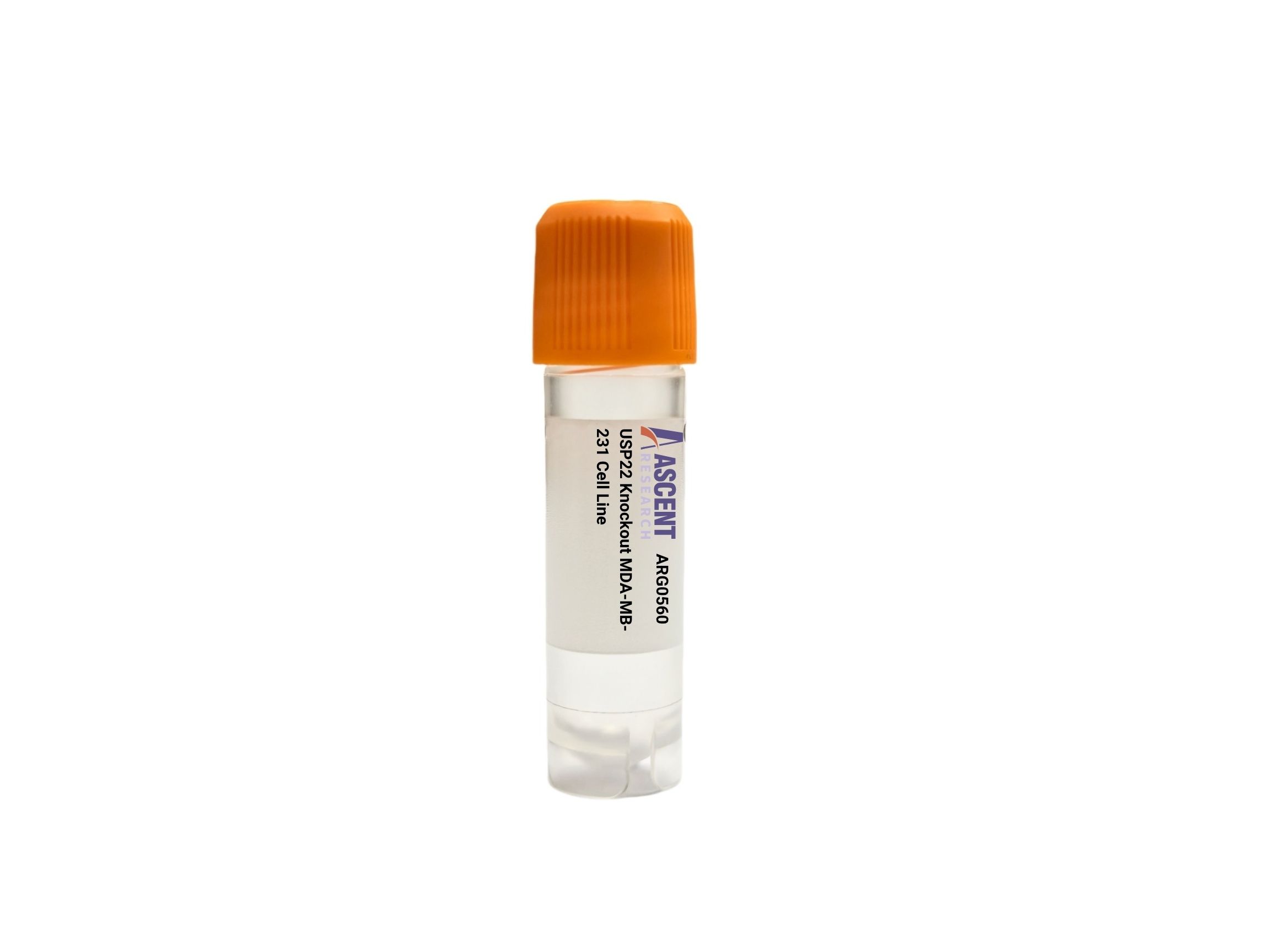
Genome-edited Cells
Breast (mammary gland)
The USP22 Knockout MDA-MB-231 Cell Line is a CRISPR/Cas9-edited knockout cell line derived from the human triple-negative breast cancer cell line MDA-MB-231, with targeted disruption of the USP22 gene. USP22 is a histone deubiquitinase and SAGA complex subunit that deubiquitinates histones H2A and H2B, regulating transcription of Wnt/??-catenin target genes such as Cyclin D1 and c-Myc, as well as NF-??B-driven pathways. This loss-of-function model is designed for studying deubiquitinase-dependent mechanisms in invasive and metastatic breast cancer, including cancer stem cell maintenance, drug resistance, and epithelial-mesenchymal transition. It is suitable for applications such as migration/invasion assays, Wnt reporter assays, and transcriptomic profiling.
 Human Dopaminergic Neuronal Precursor Cells
Cat. No. ARP1121
Human Dopaminergic Neuronal Precursor Cells
Cat. No. ARP1121
 NDUFS6 Knockout A549 Polyclonal Cells
Cat. No. ARG10446
DPP7 Knockout huh-7 Polyclonal Cells
Cat. No. ARG39683
EMSY Knockout MES-OV Polyclonal Cells
Cat. No. ARG6138
NAV2 Knockout AGS Polyclonal Cells
Cat. No. ARG2350
NDUFS6 Knockout A549 Polyclonal Cells
Cat. No. ARG10446
DPP7 Knockout huh-7 Polyclonal Cells
Cat. No. ARG39683
EMSY Knockout MES-OV Polyclonal Cells
Cat. No. ARG6138
NAV2 Knockout AGS Polyclonal Cells
Cat. No. ARG2350
 MGST1 Knockout SK-HEP-1 Cell Line
Cat. No. ARG0753
MGST1 Knockout SK-HEP-1 Cell Line
Cat. No. ARG0753
The USP22 Knockout MDA-MB-231 Cell Line is a CRISPR/Cas9-edited knockout cell line derived from the human MDA-MB-231 triple-negative breast cancer cell line, featuring targeted disruption of the USP22 gene. This loss-of-function model provides a clean genetic background for dissecting USP22-dependent chromatin regulation, gene transcription, and oncogenic signaling, generated through CRISPR/Cas9-mediated gene disruption to eliminate USP22 protein expression.
The parental MDA-MB-231 cell line is an estrogen receptor-negative, progesterone receptor-negative, HER2-negative (triple-negative) breast adenocarcinoma line established from a metastatic pleural effusion. Its highly aggressive, invasive epithelial phenotype makes it a standard system for studying metastatic mechanisms, drug resistance, and tumor progression in the absence of traditional hormone receptors.
USP22 encodes a histone deubiquitinase and core SAGA complex subunit that removes ubiquitin from histones H2A and H2B, modulating chromatin to permit transcription of Wnt/??-catenin and NF-??B target genes. Upstream regulators c-MYC, HIF-1??, and FOXM1 control USP22 expression, while USP22 interacts with SIRT1 and SAGA components GCN5, ADA2B, and TAF5L. It enhances transcription of Cyclin D1 and c-Myc downstream of ??-catenin/TCF/LEF, and sustains NF-??B-driven pro-survival programs. Deubiquitination of histones facilitates ??-catenin stabilization, promoting cell cycle progression and epithelial-mesenchymal transition.
In MDA-MB-231 cells, USP22 knockout impairs Wnt/??-catenin and NF-??B signaling, attenuating proliferation, migration, invasion, and metastatic capacity. This isogenic model enables dissection of deubiquitinase-dependent contributions to triple-negative breast cancer aggressiveness, stem cell maintenance, and chemoresistance, with relevance to prostate and colorectal cancers.
Researchers can employ this cell line in assays such as Western blotting, RT-qPCR, Boyden chamber migration/invasion, MTT proliferation, Annexin V apoptosis, TOP/FOP Wnt reporter, co-immunoprecipitation, and ??-catenin immunofluorescence. It is suited for RNA-seq and drug sensitivity screens to identify USP22-linked therapeutic vulnerabilities. Applications include Wnt and NF-??B pathway studies, deubiquitinase target identification, EMT mechanisms, and cancer stem cell analysis. For detailed product information and support, contact Ascent Research.