Genome-edited Cells
Embryo
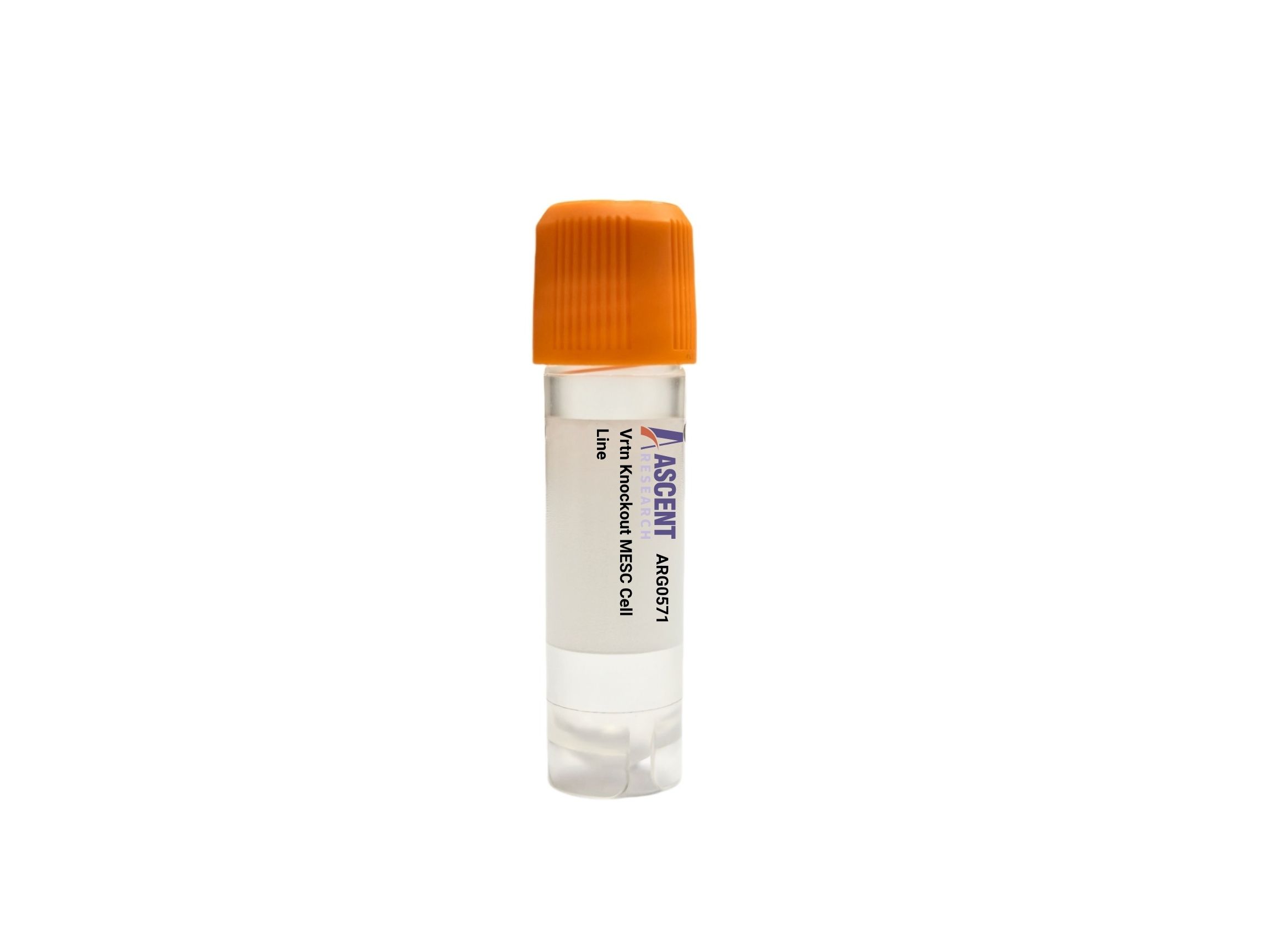
The Vrtn Knockout MESC Cell Line is a CRISPR/Cas9-edited mouse embryonic stem cell line offering a stable loss-of-function model for investigating vertebrate segmentation. Disruption of the Vrtn transcription factor, an essential integrator of the presomitic mesoderm segmentation clock, allows dissection of molecular mechanisms governing somite formation and axial skeleton patterning. By linking Notch (Notch1, Dll1, Hes7) and FGF signaling to downstream Pax1/Pax9 targets, this knockout cell line facilitates exploration of the segmentation clock network in a pluripotent background. Key applications include RT-qPCR monitoring of oscillatory gene expression, in vitro differentiation to presomitic mesoderm, and disease modeling of congenital vertebral malformations like scoliosis.
 NEK7 Knockout NCI-H1975 Polyclonal Cells
Cat. No. ARG16708
KITLG Knockout A549 Polyclonal Cells
Cat. No. ARG34486
DOK3 Knockout HAP1 Polyclonal Cells
Cat. No. ARG39627
CIRBP Knockout 786-O Polyclonal Cells
Cat. No. ARG5589
CMTM6 Knockout HEK293T Polyclonal Cells
Cat. No. ARG4397
NEK7 Knockout NCI-H1975 Polyclonal Cells
Cat. No. ARG16708
KITLG Knockout A549 Polyclonal Cells
Cat. No. ARG34486
DOK3 Knockout HAP1 Polyclonal Cells
Cat. No. ARG39627
CIRBP Knockout 786-O Polyclonal Cells
Cat. No. ARG5589
CMTM6 Knockout HEK293T Polyclonal Cells
Cat. No. ARG4397
 Mouse Gastric Mucosal Epithelial Cells
Cat. No. ARP0463
Mouse Gastric Mucosal Epithelial Cells
Cat. No. ARP0463
The Vrtn Knockout MESC Cell Line is a CRISPR/Cas9-edited mouse embryonic stem cell line designed for targeted disruption of the Vrtn gene. This cell line provides a stable loss-of-function model for investigating the molecular mechanisms of somitogenesis and vertebral column patterning. The use of CRISPR/Cas9 technology enables efficient gene disruption, allowing researchers to study Vrtn function in a pluripotent stem cell context without transient methods.
Mouse embryonic stem cells (MESCs) are characterized by their ability to self-renew and differentiate into derivatives of all three germ layers. Their pluripotency and well-established differentiation protocols make them an ideal host for modeling early mesodermal lineages, including the presomitic mesoderm. This background supports robust in vitro differentiation, enabling detailed analysis of gene function during somite formation and axial skeleton development.
Vrtn encodes a transcription factor that is a central component of the presomitic mesoderm segmentation clock. It integrates upstream signals from the Notch and FGF pathways: Notch1, Dll1, Lfng, and Hes7 generate periodic oscillations, while FGF signaling provides positional information. The Vrtn protein, acting downstream of Mesp2, transcriptionally regulates key targets such as Pax1 and Pax9, which are essential for sclerotome differentiation. Disruption of Vrtn uncouples the segmentation clock output, leading to defective somite boundary formation.
In the MESC system, the Vrtn knockout enables direct investigation of how this transcription factor coordinates oscillatory gene networks during mesoderm commitment. By guiding differentiation toward presomitic mesoderm, researchers can dissect the temporal and spatial dynamics of the segmentation clock in a reductionist model. This cell line is particularly valuable for studying congenital vertebral malformations, as it recapitulates the genetic disruption underlying segmentation defects such as scoliosis.
Typical experimental applications include RT-qPCR to monitor oscillatory expression of clock genes (e.g., Hes7, Lfng), immunofluorescence for somite boundary markers, and RNA-seq transcriptome profiling to identify downstream targets. Additional assays such as in vitro differentiation to presomitic mesoderm coupled with live-cell imaging of gene expression oscillations allow precise dissection of the segmentation program. This model also supports disease modeling studies for vertebral segmentation defects. For further details, please contact Ascent Research.